What Is a Car's Parking Light Circuit?
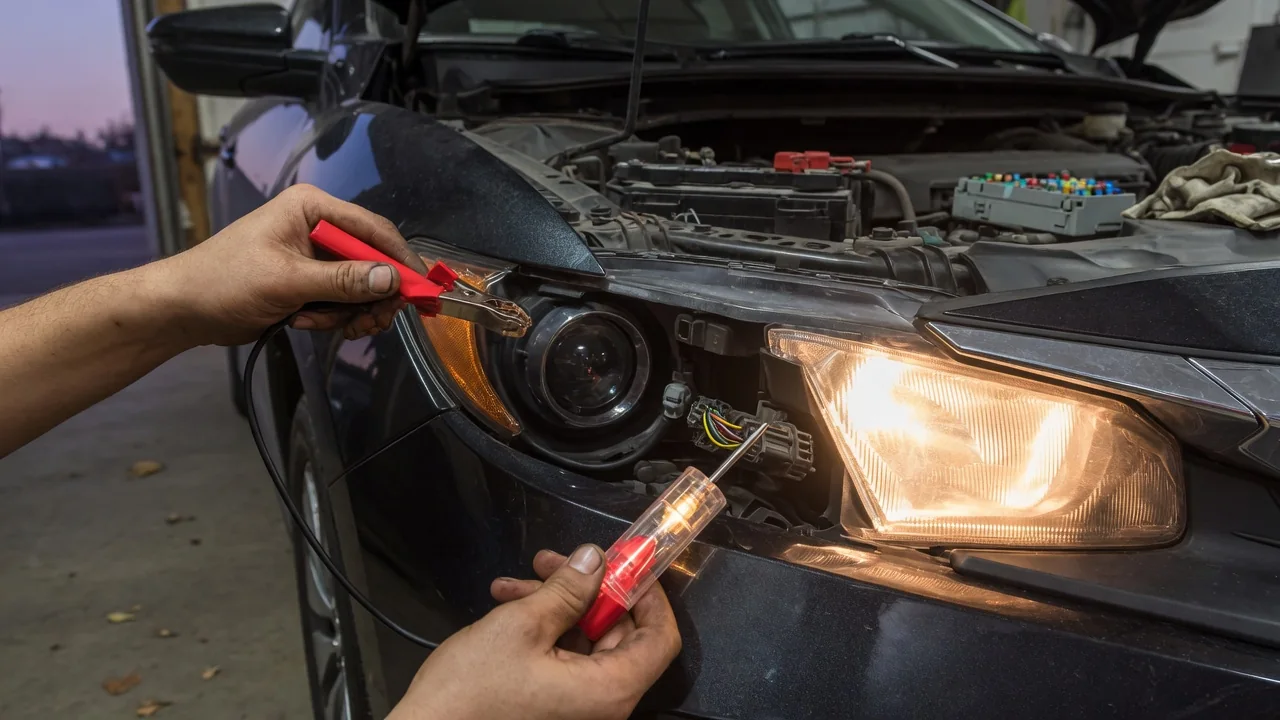
Drivers who ask what is a car's parking light circuit are usually looking at the first click of the headlight switch and wondering what it actually powers. In simple terms, it is the wiring path that feeds the low-intensity exterior marker lamps, making a vehicle's outline visible without lighting the road ahead. Understanding how it works helps explain several everyday lighting behaviors.
Lamp functions
The parking light circuit powers a group of dim exterior lamps rather than a single bulb. On a typical US-market vehicle, that group includes amber lamps at the front corners, red tail lamps at the rear, side markers along the fenders or bumper edges, and the license plate lamp. Their shared purpose is conspicuity: they show other road users where the vehicle is and how wide it is, without projecting a useful beam onto the pavement.
Many vehicles combine these functions with others inside the same housing. A dual-filament bulb or a multi-level LED may glow dimly as a parking or tail lamp and then brighten for a turn signal or brake light. Because of that sharing, a lamp that works brightly but not dimly, or the reverse, points toward one function of the assembly rather than the whole unit. The exact arrangement of lamps differs between makes, body styles and model years.
Switch positions
On a traditional stalk or dash-mounted rotary switch, the parking lights occupy the first position past off, often marked with a symbol of two small lamps facing away from each other. Turning to that position energizes the marker circuit alone. The next position adds the low-beam headlights while keeping the parking lamps lit, which is why the tail lamps and front markers remain on whenever the headlights are in use.
Vehicles with automatic headlights add a position that lets a light sensor decide when to switch everything on, and some omit a true off position entirely. On older designs the switch carries lamp current directly through its contacts, while many newer vehicles treat the switch as a request sent to a body control module, which then drives the lamps. Dashboard illumination commonly comes on with the parking position as well, giving a quick indoor confirmation that the circuit is active.
Battery use
Parking lamps are generally wired so they can operate with the ignition off, which is what allows a parked car to stay visible at a dim roadside. That convenience has a cost: with the engine stopped, the alternator is not replenishing anything, so every lit bulb draws directly from the battery. The draw is modest compared with headlights, yet hours of it can leave too little reserve to crank the engine, especially with an older battery or in cold weather.
Lamp technology changes the picture considerably. Incandescent marker bulbs consume noticeably more current than LED equivalents, so a vehicle with LED markers tolerates accidental overnight use better than one with filament bulbs throughout. Many vehicles also sound a chime when the driver's door opens with the lights on, and some shut the lamps off automatically after a delay to protect the battery. Whether a given vehicle has that protection is something the owner's manual will confirm.
Everyday Use and Observations
In daily driving, the parking position is useful when a vehicle is stopped or standing where it needs to be seen, such as a narrow shoulder at dusk or a dim loading area. It is not a substitute for headlights while moving. State laws generally require headlights in darkness and poor visibility, and marker lamps alone neither illuminate the road nor make an approaching car easy to judge from a distance.
A quick walk around the car with the switch in the first position shows whether the circuit is healthy. Every marker should glow at a similar, steady brightness, and the license plate should be readable. One confusing point is the daytime running light, which lights the front of many vehicles automatically but often leaves the tail lamps dark. Seeing bright front lamps and a lit instrument cluster does not guarantee the rear markers are on, so the switch position still matters.
Limits and Next Steps
When part of the circuit stops working, the pattern of the failure is the most useful clue. A single dark lamp often traces to a bulb, socket corrosion or a local ground, while every marker going out together suggests something shared, such as a fuse, the switch or a control module output. On module-controlled vehicles a stored fault code may accompany the problem, but a code identifies a circuit worth examining, not a part that has definitely failed, and manufacturer-specific codes need vehicle-specific confirmation.
Reasonable first steps for an owner are observational: note which lamps are affected, whether the problem follows the switch position, and whether moisture is visible inside a housing. Fuse locations and bulb types are listed in the owner's manual and vary widely by vehicle. A fuse that blows again after replacement, lamps that flicker or glow when switched off, or sealed LED assemblies with partial outages are better handled by a technician with the correct wiring diagram and test equipment.