What Is a Car's Hazard-Light Switch?
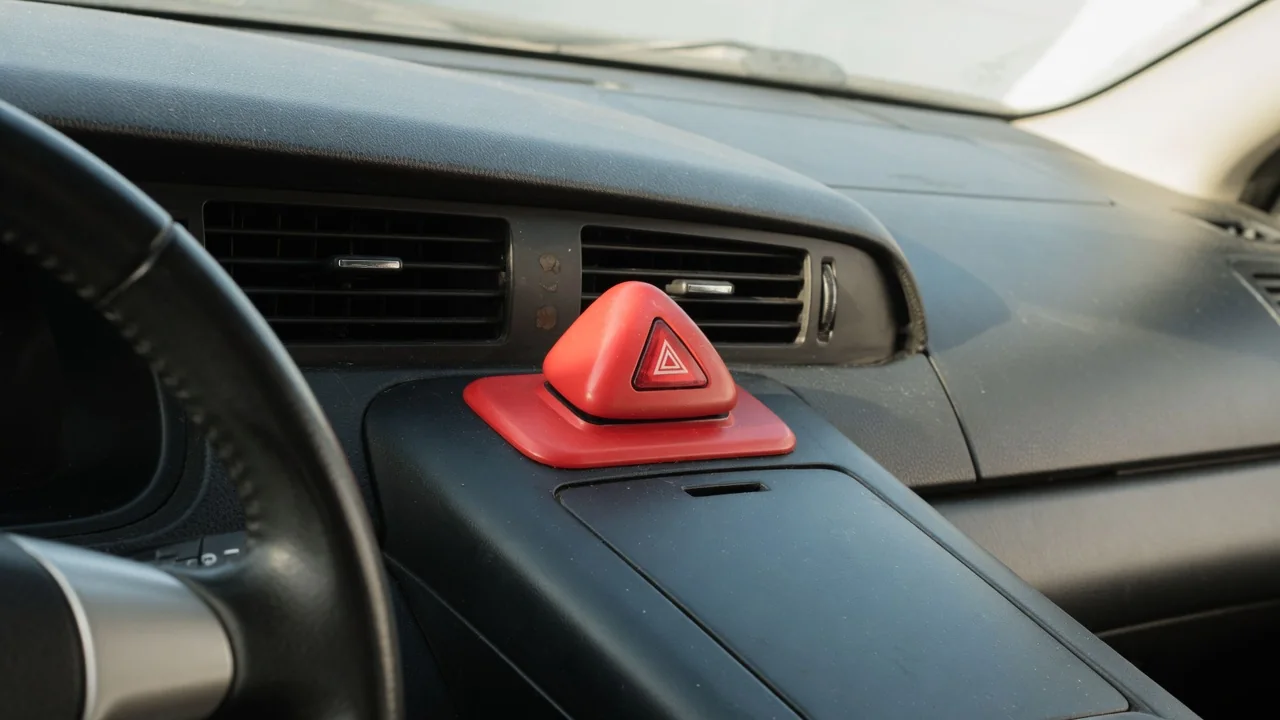
What is a car's hazard light switch? It is the control, usually marked with a red triangle, that makes every turn indicator flash at the same time to warn other road users that the vehicle is stopped, disabled or creating an unusual risk. Understanding how it behaves, what the lamps should do and what faults look like helps drivers use it with confidence.
Switch behavior
Pressing the hazard switch tells the vehicle to flash the left and right turn signals together, front and rear, along with any side repeaters or mirror-mounted indicators. On most cars the button latches or toggles, so one press starts the flashing and a second press stops it. Both arrow indicators on the instrument cluster normally blink in unison, and many vehicles add an audible tick. The control is commonly placed on the center of the dashboard, though some older designs put it on the steering column.
A key difference from the ordinary turn signal stalk is that the hazard circuit usually works with the ignition off, so a stranded car can still warn traffic. In older vehicles the switch routes current through a flasher relay; in many newer ones it simply sends a request to a body control module that pulses the lamps electronically. Some cars also activate the hazard flashers automatically after hard braking or a collision, a feature that depends on the manufacturer and should be confirmed in the owner's manual.
Lamp check
A simple lamp check starts with the car parked safely, the switch on and a walk around the vehicle. Every indicator position should flash at the same rhythm and with similar brightness: both front corners, both rear corners and any repeaters on the fenders or mirrors. A reflection in a garage door or shop window can help when no assistant is available. Comparing the left and right sides is useful, because a dim or dead lamp on one side stands out when everything is blinking together.
What you see depends on the lighting design. Some vehicles use amber bulbs or LEDs for the rear indicators, while others flash a red lamp shared with the brake light, so pressing the brake pedal during the check can change the appearance at the back. Trailers wired to the vehicle should flash as well. If the hazards work but one turn signal direction does not, or the reverse, that pattern is worth noting, since the two functions share lamps but not always the same switch path.
Fault clues
Fault clues usually fall into recognizable patterns. Hazards that do nothing at all, with no clicking and no cluster arrows, point toward the supply side: a fuse, the switch itself, the flasher unit or its wiring. Hazards that work while the turn signals do not, or the opposite, suggest a problem in the part of the circuit the two functions do not share. A much faster flash than normal often accompanies a failed bulb or a lamp with a poor ground, although not every vehicle signals a bulb failure this way.
On vehicles with electronic lighting control, a scan tool may show stored codes or live data for the hazard switch input and lamp outputs. Treat any code as evidence to interpret rather than proof that a specific part has failed, and remember that manufacturer-specific codes need vehicle-specific documentation to read correctly. Physical signs matter too: a button that sticks, fails to latch, feels loose or only works when pressed at an angle hints at wear inside the switch, while intermittent flashing over bumps suggests a connector or wiring concern.
Everyday Use and Observations
In daily driving the hazard flashers are meant for situations where the vehicle itself is the hazard: a breakdown on the shoulder, a flat tire, a stop in a live lane or the aftermath of a collision. Some drivers also use them briefly to warn following traffic of a sudden slowdown ahead. Rules on using hazards while moving, such as in heavy rain or funeral processions, differ from state to state, so local traffic law is the reference rather than habit.
One practical observation is that on many cars the hazards override the turn signals, so other drivers cannot tell which way you intend to move while they are flashing; some vehicles do let the stalk take priority, and it is worth learning which type you have. Another is battery drain: the flashers draw power with the engine off, and incandescent bulbs use more than LEDs, so a long roadside wait can weaken an already tired battery. Canceling the hazards before rejoining traffic restores normal signaling.
Limits and Next Steps
A walk-around check and a note of the symptoms are about as far as most owners can sensibly go. The owner's manual identifies the relevant fuses, and replacing a blown one with the same rating is generally straightforward, but a fuse that blows again indicates a fault that needs proper diagnosis rather than a larger fuse. The hazard switch often sits in a dashboard panel close to airbag components, trim clips and other electronics, which makes removal a job where vehicle-specific instructions matter.
When taking the car to a shop, describe exactly what happens: whether the fault affects hazards, turn signals or both, which lamps are involved, whether the cluster arrows flash and whether the problem comes and goes with temperature or bumps. That information lets a technician test the switch, flasher or control module, and wiring in a logical order instead of guessing at parts. Because working hazard lights are a basic safety feature and commonly part of roadworthiness inspections where those apply, a fault deserves prompt attention.