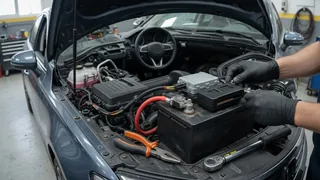
What Is a Car Battery Current Sensor
A car battery current sensor is the small electrical measuring device that reports how much current is moving into or out of the battery. Drivers rarely see it, but the charging system uses its signal constantly to adjust output. When the sensor reading is missing, skewed, or intermittent, the vehicle may overcharge, undercharge, or drain the battery overnight. Understanding what this part measures helps separate a weak battery from a regulation problem, and it explains why some replacement batteries fail early even when the alternator tests normally.
Meaning
In an automotive context, a car battery current sensor is an electrical component mounted at a battery terminal or in the nearby negative cable. Its job is to monitor the direction and amount of current flow around the battery. The reading is sent to the engine control module or battery management system, where it becomes one input for controlling charging voltage. Unlike a simple voltage check, the current signal shows whether energy is entering the battery during charging or leaving it to support loads.
The term can sound similar to a battery temperature sensor or a voltage monitor, but those measure different properties. The current sensor focuses on amperage rather than system voltage alone. Many vehicles place it in the negative battery cable, often inside a plastic module secured by the battery terminal. A wiring diagram will typically label it as a battery current sensor, battery monitor sensor, or intelligent battery sensor. Its presence is especially common on vehicles with stop-start systems or charging strategies designed to improve fuel economy.
How it works
The sensor measures current by detecting the small magnetic field produced around a conductor as electricity flows through it. Changes in that field correspond to changes in current, allowing the module to report both the amount and direction of flow. When the alternator is producing more than the vehicle consumes, current moves into the battery and the sensor reports a charging condition. When loads exceed charging output, the sensor reports discharge. The control module uses that information to adjust charging output within a safe range.
This feedback matters because a battery is not simply full or empty. The charging strategy can raise voltage slightly after a cold start, reduce output when the battery is near full, or temporarily allow a higher state of charge during deceleration. The current sensor also helps identify parasitic draw after shutdown. If the vehicle sees unexpected discharge while parked, it can log a fault or adjust sleep-mode behavior. A stable reading depends on clean connections at the battery terminals and a sensor that is mounted in the correct orientation.
Key differences
A current sensor and a voltage reading are related but not interchangeable. Voltage describes electrical pressure between two points, while current describes the rate of electron flow. A battery can show normal system voltage while delivering very little current, or it can show a large voltage drop under load when internal resistance is high. The current sensor adds a dynamic view of charging and discharging that a static voltmeter cannot provide. This is why modern charging control relies on both signals.
The sensor also differs from a traditional fusible link or fuse rating label, even though it may sit near the battery cables. A fuse is a protective device that opens a circuit under excessive current. The battery current sensor is a measuring device that must remain in the circuit to report continuously. Some vehicles integrate the sensor with the negative terminal, while others use a separate module in the positive cable. Manufacturer-dependent layouts mean the exact appearance and diagnostic procedure can vary by vehicle platform.
Understanding a problem
When a battery current sensor is unplugged, damaged, or receiving a poor signal, the vehicle may display a charging system warning, enter a reduced charging mode, or set a stored fault related to the sensor circuit. A common observation is a battery that keeps draining after the vehicle sits, even though a bench test shows the battery is healthy. Another clue is charging output that seems too high or too low despite a good alternator. The fault code is a starting point for diagnosis, not proof that the sensor itself has failed.
Practical first checks include inspecting the sensor connector for corrosion or looseness, confirming the battery terminals are tight, and looking for damaged wiring near the module. A parasitic draw test may show whether current is leaving the battery unexpectedly, but identifying the source requires careful circuit isolation. Because the sensor is part of a regulated charging strategy, replacement or relearning procedures should follow the manufacturer process for the specific vehicle. If the wiring is damaged or the module shows physical cracking, stop and seek qualified diagnosis before further use.