What Is a Battery Current Sensor? How It Tracks Charge and Faults
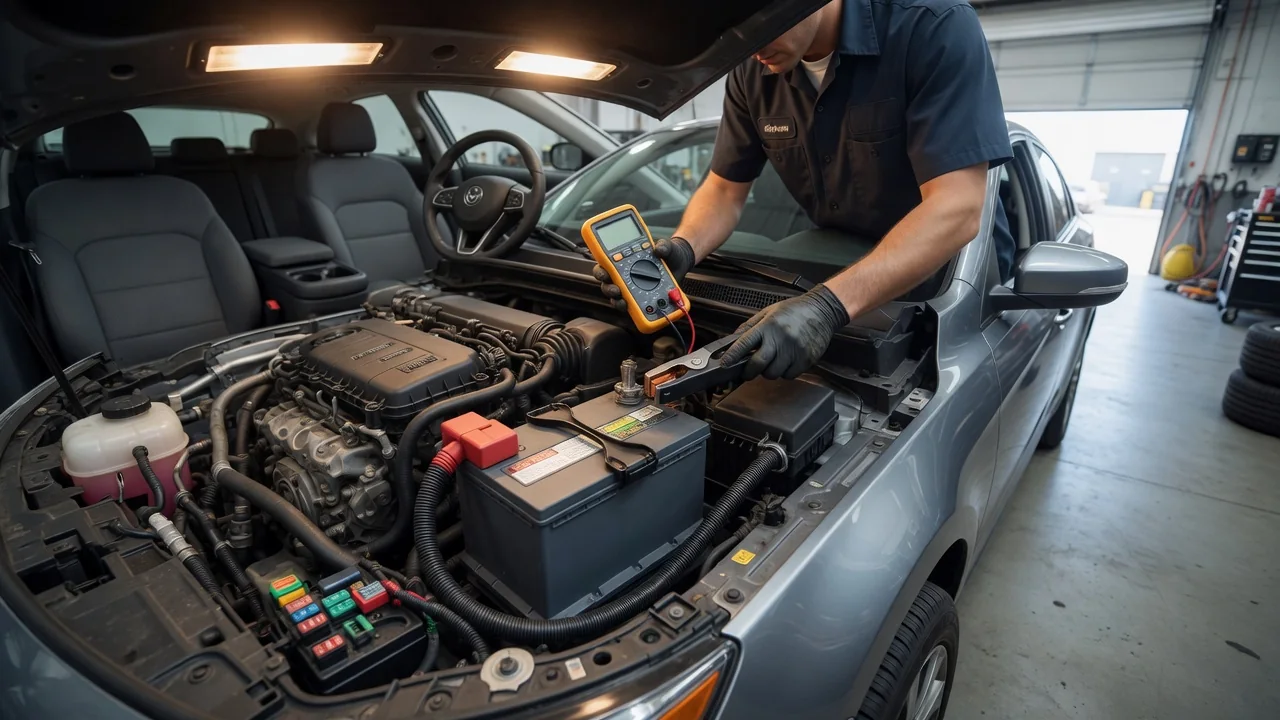
A battery current sensor is a small electronic device, usually mounted at or near the negative battery terminal, that measures how much current flows into and out of a car battery. In many modern vehicles it is part of an intelligent battery sensor that also reports voltage and temperature. A car battery current sensor gives the vehicle's control modules the data they need to estimate battery charge, manage the charging system, and decide when certain features can safely run.
Charge Flow: What the Sensor Measures
Current through a car battery flows in both directions. When the engine is off or electrical demand exceeds alternator output, current flows out of the battery. When the alternator or an external charger supplies more than the loads consume, current flows back in. A battery current sensor measures both the direction and the size of that flow. Two general designs are common. A shunt-type sensor routes the battery's ground current through a precision resistor with a very low, known resistance and measures the tiny voltage drop across it, which is proportional to current. A Hall-effect sensor instead surrounds the cable and detects the magnetic field the current produces, so it does not need to sit directly in the current path. Shunt-type units are often built into the negative terminal clamp itself.
In an intelligent battery sensor, a small built-in processor samples current, battery voltage and often temperature, then sends the results to another control module over a data network, commonly a LIN bus. By adding up current over time, a method usually called coulomb counting, the system tracks how many amp-hours have left or entered the battery. Because small measurement errors accumulate, this running total is periodically corrected with other information, such as resting voltage after the vehicle has sat undisturbed. The result is an estimate of state of charge rather than a direct reading, and the system may also estimate battery health from how voltage responds to heavy loads such as engine cranking.
Energy Management: How the Car Uses the Data
The main reason vehicles carry a battery current sensor is energy management. On older charging systems, the alternator regulator held a roughly fixed target voltage regardless of how full the battery was. With current and charge data available, energy management software can vary alternator output: charging harder when the battery is depleted, easing off when it is full, and adjusting the target for battery temperature. Many systems also reduce alternator load during acceleration and increase charging during deceleration or braking, recovering energy that would otherwise be lost. This kind of variable charging can reduce engine load, but how aggressively it is applied depends on each manufacturer's strategy.
Battery data also feeds decisions about features that rely on stored energy. Vehicles with automatic engine stop-start typically check estimated charge, temperature and battery condition before allowing the engine to shut off at a stop, and may restart the engine or block stop-start entirely when the battery cannot reliably support another restart. When charge falls low, some systems shed nonessential loads, such as heated seats or rear window defrosting, to protect starting capability. The exact features, thresholds and priorities are vehicle-specific.
The sensor matters while the vehicle is parked, too. Because it stays active at low power or wakes periodically, it can observe quiescent current, the small draw from modules, alarms and memory functions that continues with the ignition off. If that draw stays higher than expected, the system may record the event for later diagnosis.
Faults and Warning Signs
Faults can involve the sensor itself, its wiring, or the data it reports. Internal failure, water intrusion, a damaged connector, a broken communication wire or a loose terminal clamp can all stop the sensor from reporting or make it report implausible values. Because shunt-type sensors carry the full battery ground current, corrosion or a poor connection at the clamp can add resistance and heat as well as distort readings. When the host module loses or distrusts the sensor's data, it commonly falls back to a conservative default charging strategy, and diagnostic trouble codes related to the sensor, its communication circuit or charge estimation are typically stored.
Symptoms vary by vehicle but commonly include a battery or charging warning, a message about battery condition, stop-start staying unavailable, comfort features switching off unexpectedly, or a battery that seems chronically undercharged or overcharged. None of these signs is unique to the sensor. A worn battery, a failing alternator, a slipping drive belt, a parasitic drain or a bad ground can produce similar complaints, so replacing the sensor on symptoms alone may not fix the cause.
A frequent problem has nothing to do with sensor failure. If an accessory, an extra ground cable or a jump-start lead is connected directly to the negative battery post instead of to the vehicle side of the sensor, current through that path is not measured. The energy management system then works from an incomplete picture, which can skew charge estimates. For this reason, many owner's manuals specify a dedicated ground point for jump-starting or charging rather than the negative terminal.
Practical Implications and Limits
For owners, the most practical consequence appears at battery replacement. On many vehicles with an intelligent battery sensor, the system's learned data describes the old battery, and some manufacturers require the new battery to be registered or its parameters updated with a scan tool. Skipping that step where it is required may cause the system to treat a new battery as if it were an aged one. Installing a battery of a different technology or capacity than the vehicle expects can create a similar mismatch. Whether registration is needed, and which battery types are acceptable, should be confirmed in the owner's manual or service information for the specific vehicle.
It also helps to know what the sensor cannot do. It does not repair or protect a weak battery; it only measures and reports. Its charge figure can drift after the battery has been disconnected or charged by an outside source, and readings may need time or a reset to settle. A basic voltmeter confirms battery and charging voltage but cannot verify the sensor's internal calculations, so proper diagnosis usually requires a scan tool that reads live battery sensor data. Finally, not every car has a battery current sensor, so its absence is not a defect.