What Is a Smart Battery Terminal? How It Senses Current and Guides Charging
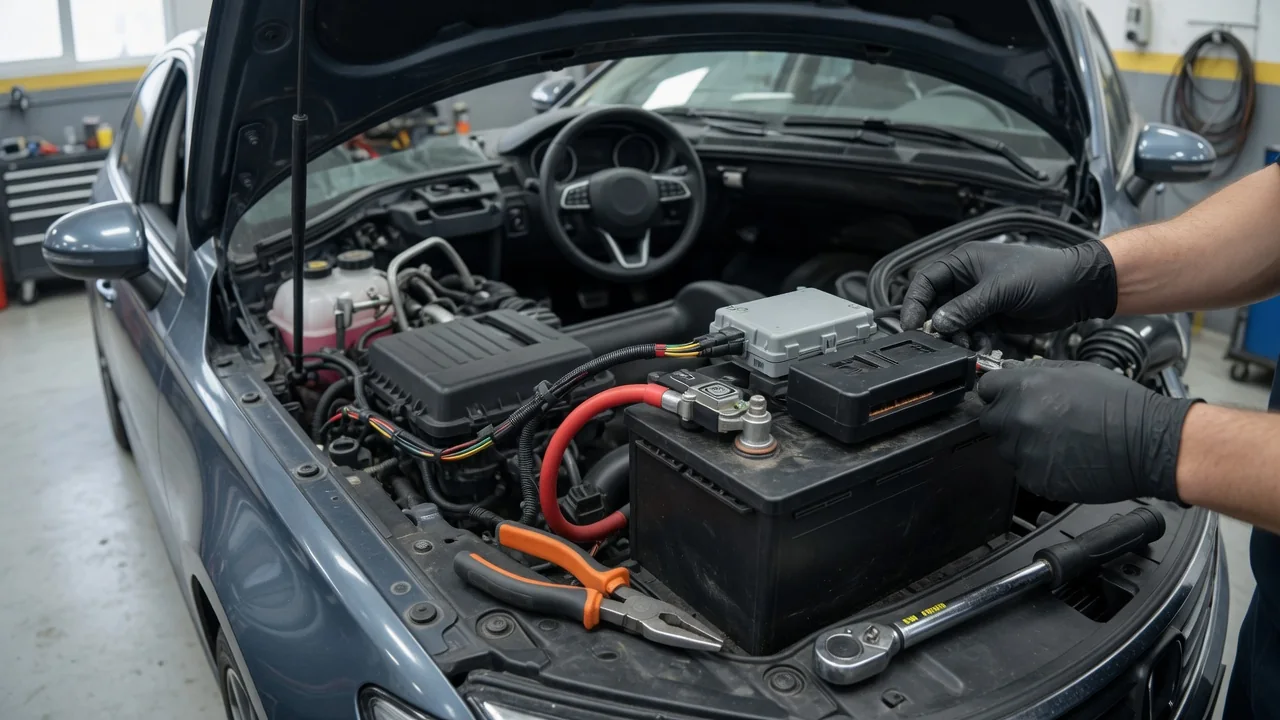
A smart battery terminal is a negative battery clamp with built-in electronics that measure what the battery is doing. Often called an intelligent battery sensor, it tracks the current flowing into and out of the battery, along with battery voltage and temperature, and reports that information to the vehicle's control modules. Those modules use it to manage charging, decide when features such as start-stop can operate, and flag a weakening battery. Knowing how a smart car battery terminal works explains why battery service on many modern vehicles involves more than swapping a box.
Current sensing
The sensor is usually built into the clamp that fits onto the battery's negative post. The vehicle's main ground cable attaches to the sensor body rather than directly to the post, so essentially all current moving between the battery and the vehicle's ground network passes through the device. A common way to measure that current is a precision shunt, a very low-resistance element whose small voltage drop rises in proportion to the current flowing through it. The electronics amplify and digitize that drop to calculate amperage in both directions, distinguishing charging current from discharge. Other sensing methods exist, but the principle is the same: the terminal sits in the current path so it can see the battery's energy flow. Most designs also measure battery terminal voltage and include a temperature sensor whose reading is used to estimate battery temperature.
Raw measurements alone do not say much about battery condition, so a small microcontroller inside the terminal processes them. By adding up current over time, a method often called coulomb counting, it tracks how much charge has gone in and out. It combines that running total with voltage and temperature data and with stored battery parameters to estimate state of charge, state of health, and the battery's ability to support an engine start, sometimes called state of function. The sensor has to handle a very wide range, from the small parasitic draw of modules while the vehicle is parked to the large surge of cranking current. For that reason it typically stays active in a low-power mode after the ignition is switched off, waking periodically to check the battery's resting condition.
The terminal does not act alone. It typically shares its results over a vehicle data network, frequently a LIN bus, with a body, gateway, or energy management module. The driver usually never sees the data directly, but a capable scan tool can often display it.
Charging control
In older charging systems, a voltage regulator held the alternator at a largely fixed output target regardless of how full the battery was. Systems that use a smart battery terminal let a control module command alternator output based on actual battery data. Depending on the vehicle's strategy, the system may hold the battery somewhat below full charge during steady driving, leaving room to absorb energy when the vehicle coasts or brakes, and then increase alternator output during deceleration when that energy would otherwise be lost. It may also reduce alternator load during hard acceleration so more engine output goes to the wheels. The general goal is to lower the mechanical load the alternator places on the engine without letting the battery run too low. Exact strategies differ between manufacturers and vehicle designs.
Battery protection is the other side of charging control. The ideal charging voltage changes with temperature, and different battery technologies, such as flooded lead-acid and AGM batteries, call for different charging profiles. Because the module knows battery temperature and the stored battery type and capacity, it can adjust charging accordingly. When the sensor reports a low state of charge, many systems respond by raising charging output, temporarily disabling start-stop so the engine keeps running, or reducing power to comfort loads such as heated seats or rear window defrosters until the battery recovers.
One side effect is that charging voltage on these vehicles may vary noticeably during normal driving. A reading that looks low or unsteady on a voltmeter is not automatically a fault, because it can reflect a deliberate charging strategy.
Service
Battery replacement is where the smart terminal matters most to owners and technicians. On many vehicles equipped with this kind of sensor, a new battery must be registered with the energy management system using a scan tool. Registration tells the module that a fresh battery is installed so it can reset its aging model, and on some vehicles it also records the battery's type and capacity. If that step is skipped where it is required, the system may continue treating the new battery as the old, worn one, which can lead to charging that does not suit the battery and to features such as start-stop being limited. Not every vehicle requires registration, so the procedure in the vehicle's service information is the reference to follow.
Physical handling also deserves care. The sensor is an electronic component built into the terminal, so prying, hammering, or twisting it to remove a stuck clamp can damage it. Extra ground wires for accessories should not be attached directly to the battery negative post, because any current flowing through them bypasses the sensor and makes its calculations inaccurate. For the same reason, many manufacturers specify connecting the negative lead of a battery charger or jump starter to a designated body or engine ground point instead of the battery negative post, so the sensor can account for that current. Terminal fasteners should be tightened to the value given in the service information, since a loose connection affects both the measurement and the electrical system.
When something goes wrong, the control module may store fault codes for lost communication with the sensor or for readings that do not make sense. After a battery has been disconnected, some systems need time to relearn the battery's condition, and certain functions may stay unavailable until that process finishes. Parasitic draw testing should account for the sensor and other modules waking periodically after shutdown.
Practical implications and limits
For everyday driving, the most visible effect is often a dashboard message saying start-stop is unavailable or the battery charge is low. These messages usually reflect the sensor's estimates rather than a confirmed failure, and they are common when a vehicle makes repeated short trips that do not give the battery enough time to recover. It also helps to remember that state of charge and state of health are calculated estimates, not direct observations of the battery's internal chemistry. Their accuracy depends on correct battery information in the module and on clean, tight connections; corrosion or a loose ground can make a healthy battery look weak, or the reverse.
The sensor also has clear boundaries. It cannot repair a failing battery or a weak alternator, and it may not detect every internal battery defect immediately. Installing a battery of a different type or capacity than the system expects, without updating the stored information where the vehicle allows it, can undermine the charging logic. Finally, the phrase smart battery terminal is also used for aftermarket products such as remote disconnect switches or wireless battery monitors. Those devices are separate from a factory battery sensor and generally do not feed the vehicle's charging control. If one is added, it should be installed so it does not create a current path that bypasses the original sensor.