Wastegate Actuator Repair: Assessing Repairability
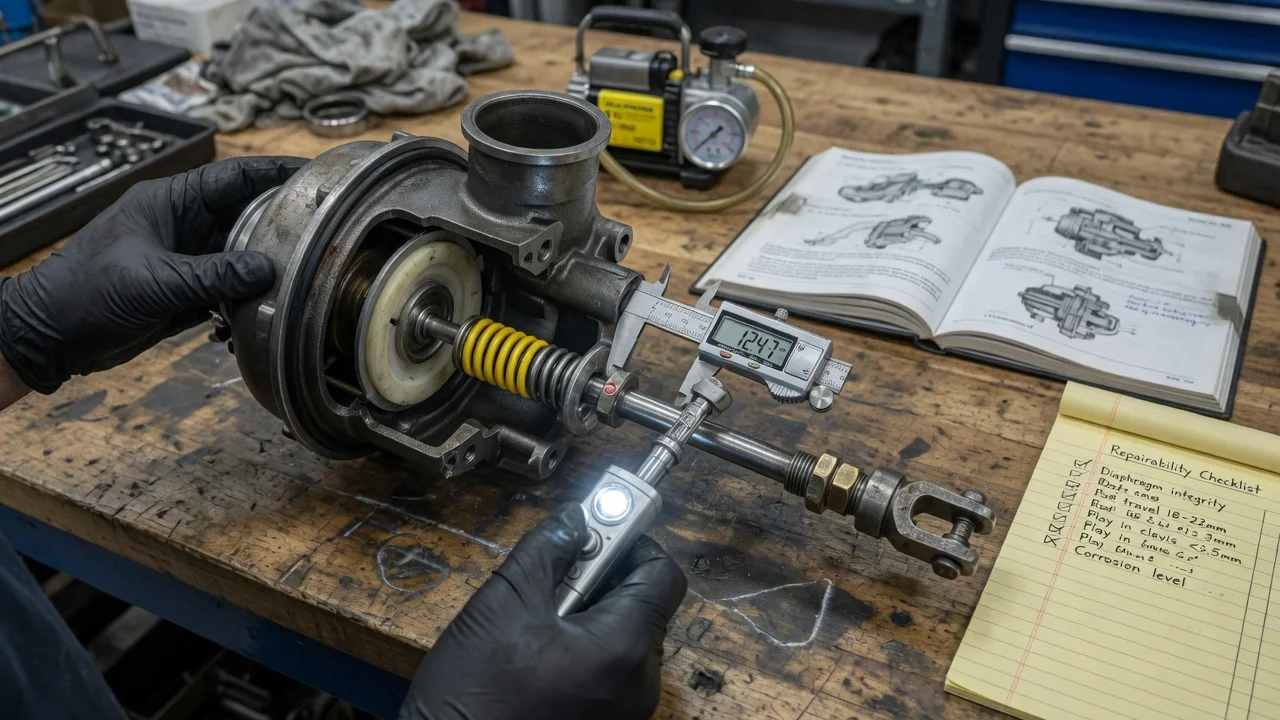
The wastegate actuator controls how much exhaust gas bypasses the turbine, which is how the engine regulates turbo boost. When the actuator fails, the engine may lose power, overboost or set fault codes. Before ordering parts, answer two questions. Is the actuator actually at fault? Can it be adjusted or repaired, or must it be replaced, sometimes together with the turbocharger? This guide explains how a technician makes that decision for a specific vehicle configuration.
Confirm the fault before repair
Many problems look like a failing actuator. Low boost, overboost, reduced-power mode, a rattle from the turbo area and a warning light can all come from other causes. Common ones include a boost leak at a hose or intercooler, a faulty boost control solenoid, a cracked vacuum supply line, a pressure sensor fault, an exhaust restriction or a worn turbocharger. Stored codes usually show that actual boost differed from target boost. They rarely prove that the actuator alone is responsible, so a code is a starting point for diagnosis, not a parts list.
How the actuator is tested depends on its type. For a vacuum- or pressure-operated actuator, a technician applies vacuum or pressure with a hand pump and gauge. The rod should move smoothly through its full travel, and the diaphragm should hold without leaking down. The linkage is also checked for wear, a seized pivot or a bent rod. For an electronic actuator, a scan tool compares commanded and actual position, runs any available self-test and checks the wiring, the connector and the position sensor signal. Readings only mean something when compared against the manufacturer specifications for that engine. A defect is confirmed when the actuator fails these tests even though its supply, control signal and wastegate mechanism have been checked and are working.
Define the repair scope
Wastegate designs vary widely, even within one model line. Some actuators work on vacuum, some on boost pressure, and others are electronic units with a motor and an integrated position sensor. On some turbochargers the rod length is set at the factory and fixed. Some electronic actuators are only sold as part of the complete turbo assembly. Twin-turbo layouts may have separate actuators with separate fault paths. Identify the exact parts from the VIN, engine code and part number, not from the model name. A remedy that suits one version can be wrong for another.
Next, establish how far the problem extends. The fault may sit in the actuator, the linkage, the wiring, or the wastegate flap and its bushing inside the turbine housing. A seized or worn flap bushing is a turbocharger housing problem, and a new actuator will not cure it. Review the service history too. A previous turbo replacement, engine tuning or an aftermarket boost controller can change what normal looks like. Operating conditions such as road salt, heavy towing or frequent short trips can explain corrosion or heat damage around the linkage and connector.
Compare repair options
Adjustment applies only where the manufacturer provides a rod length or preload setting. It can correct drift after linkage parts are replaced. It will not fix a leaking diaphragm or a failing motor, and an incorrect setting can cause the overboost or underboost it was meant to fix. Repairing individual components is often the most economical route when the actuator tests good. Examples include freeing a sticking pivot, replacing worn clips or bushings, renewing cracked vacuum lines and repairing a damaged connector. Gear repair kits are sold for some electronic actuators, but quality varies and a repaired unit may still need calibration before it reports position correctly.
Replacing the actuator makes sense when it is sold separately and the wastegate mechanism behind it is sound. The new unit still has to be set up or calibrated as the service information specifies. Replacing the whole turbocharger is the realistic option when the actuator is not serviced separately or when the turbine housing, flap or shaft is also worn. Specialist turbo shops can rebuild assemblies, set actuator preload on a test rig and calibrate electronic units. Each option leaves something unresolved. Adjustment does not fix an upstream boost leak, and a new actuator does not fix a worn wastegate bushing or a faulty control solenoid.
Requirements and limits
Proper work needs a scan tool that can read live boost-control data and run actuator tests and adaptation routines for the specific make. It also needs a hand vacuum or pressure pump with a gauge and the manufacturer's service information for rod settings, torque values and calibration steps. Many electronic actuators must be calibrated or have their end positions relearned after fitting. Some procedures require dealer-level or specialist equipment. If the calibration cannot be performed, the fault may return even with correct parts installed. In that case, specialist service is part of the repair, not an optional upgrade.
Turbochargers and exhaust parts get extremely hot, so let the engine cool fully before touching them. Support the vehicle properly before working underneath it. Fasteners near the turbine housing are often corroded and can snap, and a broken stud can turn a simple actuator job into a turbo removal. Never disable, block or modify the actuator to stop a code or raise boost. This can lead to uncontrolled boost and engine damage and may affect emissions compliance. If the job requires removing the turbocharger or using calibration tools you do not have, hand it to a qualified shop.
Verify the outcome
After the repair, clear the stored codes and repeat the original test: rod travel and leak-down for a pneumatic unit, or the actuator self-test for an electronic one. Complete any required learn procedure. Then road test the vehicle under the conditions the manufacturer's procedure describes, logging target and actual boost along with actuator position. Readings should track each other without codes returning. Listen for rattles at idle and when lifting off the throttle, and check that hoses and connections are secure once everything has reached operating temperature.
Record the codes found before and after the repair, the test readings, the part numbers, any adjustments made and confirmation that calibration was completed. That record strengthens the service history and helps if a warranty question comes up later. If symptoms persist, return to diagnosis rather than fitting another actuator. Look again at boost leaks, the control solenoid, the sensors and the condition of the turbocharger. A new actuator that fails quickly often points to excessive heat, contamination or an upstream control fault that still needs to be found. Inspecting the linkage and lines at the intervals in the vehicle's maintenance schedule helps catch wear early.