Intercooler Repair: Assessing Damage and Repair Options
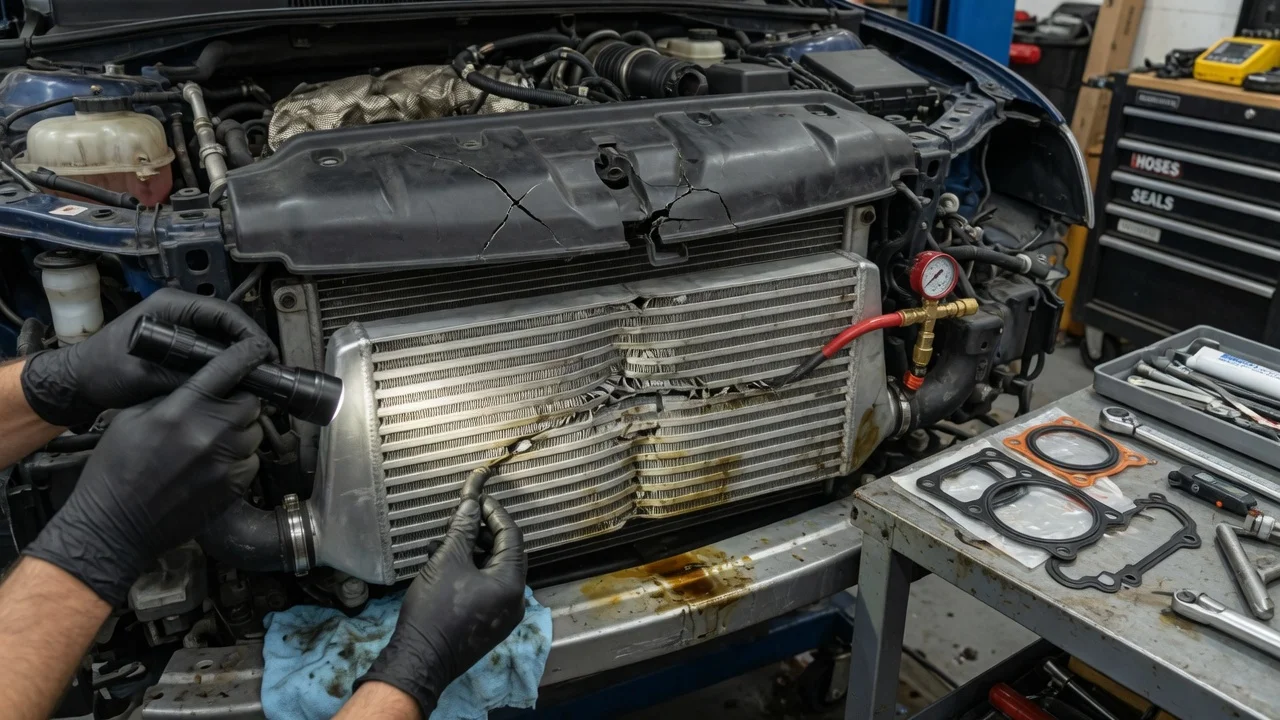
An intercooler cools compressed intake air on turbocharged and supercharged engines before it reaches the cylinders. When it leaks, cracks or becomes contaminated, the engine may lose power, smoke or set boost-related trouble codes. Many of the same symptoms also come from hoses, clamps, sensors or the turbocharger itself. This guide explains how to confirm an intercooler fault, define the repair scope for your specific engine, weigh repair against replacement, and check that the work actually solved the problem.
Confirm the fault before repair
The complaints most often blamed on the intercooler are reduced power under boost, a hiss or whoosh during acceleration, black smoke on diesels, oily residue around the core or couplers, and underboost codes such as P0299. Each of these is a symptom report, not proof of a failed intercooler. The same pattern can come from a split charge hose, a loose clamp, a worn coupler or O-ring, a sticking wastegate or variable geometry mechanism, a faulty boost or manifold pressure sensor, or an intake leak downstream of the cooler.
Useful evidence comes from a charge-air pressure test: the system is sealed and pressurized to the value given in the service information, then checked by sound and with a soapy water solution to locate escaping air. Combine that with a close inspection of the core and end tanks for cracks, impact damage and corrosion at the tank-to-core seams, and with scan tool data comparing desired and actual boost. Note the symptom conditions as well, since a leak that only appears when hot or under heavy load can be missed in a cold static test. A defect counts as confirmed when the leak or restriction is isolated to the intercooler itself, not merely suspected from driveability alone.
Oil inside the charge-air system needs interpretation. A light film is normal on many turbocharged engines because crankcase ventilation gases pass through the intake. Heavy pooling can indicate turbocharger seal wear or a crankcase ventilation fault, neither of which a new intercooler will fix. On water-to-air designs, coolant loss or coolant traces in the intake point to an internal leak that should be confirmed with a cooling system pressure test.
Define the repair scope
Intercooler layouts vary widely. Air-to-air units may be mounted at the front, on top of the engine or behind a bumper corner, while water-to-air units have their own coolant circuit, pump and front heat exchanger, and on some engines the cooler is built into the intake manifold. The same model name can cover several engine configurations across model years and trims, and a gasoline and a diesel version, or a pre- and post-update year, may use different coolers, pipes and part numbers. Identify the exact unit by VIN, engine code and manufacturer specifications rather than assuming every version shares one remedy.
Next, establish the extent of damage. A single crack in a plastic end tank is a different job from core damage after a front collision, corrosion spread across many tubes, or contamination after a turbocharger failure. If a compressor wheel has broken up, metal debris can travel through the cooler and into the engine, so the whole charge-air path must be addressed, and the cooler is often replaced because debris cannot be reliably flushed out. Review the service history for previous turbo work, repeated hose failures, body repairs and tuning changes that raise boost beyond the original design, because each affects what the repair needs to cover. A dealer can also confirm whether any technical bulletin applies to your specific build rather than the model in general.
Compare repair options
The simplest fix is correcting the connections: reseating pipes, replacing clamps, couplers or O-rings, and securing brackets. This resolves leaks at the joints, which account for many suspected intercooler problems, but leaves the core untouched, so it is only appropriate when testing shows the core holds pressure.
Component repair suits limited, localized damage. On cores with crimped plastic tanks, a radiator specialist may be able to fit a new tank, and aluminum cores or tanks can sometimes be welded by a shop experienced with thin heat exchanger material. Epoxy or sealant patches should be treated as temporary, because boost pressure and heat cycling stress them repeatedly. Flushing can remove oil buildup but does not repair damaged tubes. Any repair leaves open questions about fin damage, neighboring tubes and long-term durability that should be weighed against the cost.
Replacement makes sense when the core is crushed, corroded in multiple areas, contaminated with turbo debris, or when repair cost approaches the price of a new unit. Original-equipment and aftermarket parts can differ in fit and pipe routing, and larger performance coolers may change boost response and may raise tuning, warranty or emissions questions. Specialist service is appropriate for manifold-integrated water-to-air coolers and for cases where testing is inconclusive. Remember that replacing the cooler does not cure an underlying turbo oil leak, overboost condition or vulnerability to road debris.
Requirements and limits
Proper work needs a scan tool that reads diagnostic codes and live boost data, a charge-air pressure tester or suitable adapters, a torque wrench and service information for the exact engine, covering removal steps, fastener torque, test pressure and, on water-to-air systems, the coolant filling and bleeding procedure. Front-mounted coolers often require removing the bumper cover and supporting the radiator or air conditioning condenser, so the job can involve more disassembly than expected.
Let the engine and turbocharger cool before starting, support the vehicle on proper stands, and never pressurize the system beyond the specified test value, since excess pressure can blow off couplers or damage sensors. Water-to-air circuits may hold hot coolant under pressure, and oily residue and coolant must be disposed of correctly. Aluminum welding, tank recrimping and manifold-integrated cooler replacement are specialist tasks rather than general DIY work. Without the correct service information for your engine variant, do not guess at torque values or test pressures.
Verify the outcome
After the repair, repeat the pressure test to confirm the system holds. Clear stored codes, then road test under the same conditions that produced the original symptom, watching actual against desired boost and, where available, intake air temperature data. Confirm that codes do not return over several drive cycles and recheck clamps and couplers afterward, since new parts can settle slightly once heat cycled.
Record what was found, the test results, the parts and part numbers used and the repair method chosen. That documentation helps future diagnosis and shows buyers the work was done properly. If power loss, smoke or boost codes persist after a confirmed sealed system, the intercooler is no longer the likely cause. Diagnosis should move on to the turbocharger, wastegate or actuator, boost and air sensors, exhaust restriction, and fuel or ignition faults, rather than fitting another cooler.