CV Axle Repair: Assessing Damage and Service Options
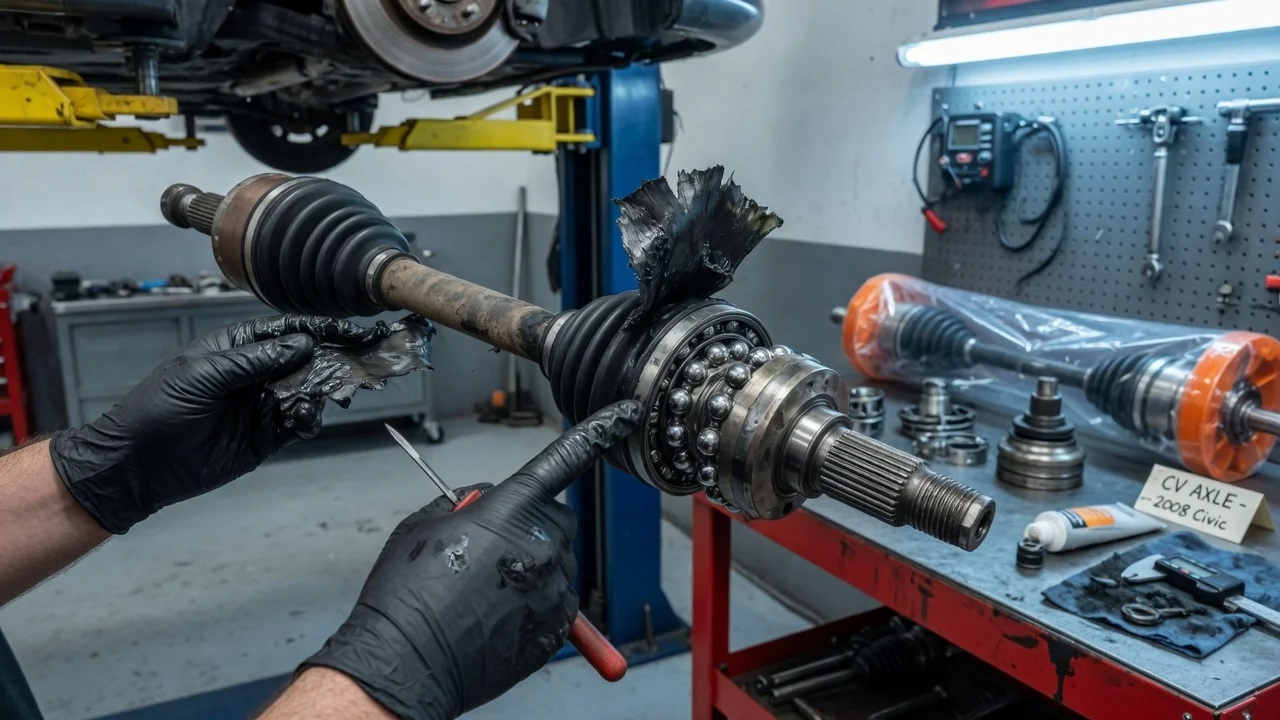
A clicking noise in turns or grease sprayed inside a wheel well often sends owners looking for a quick CV axle fix. The right repair depends on what has actually failed. Constant velocity axles carry power to the wheels while the suspension moves and the wheels steer, and damage can range from a split boot to a worn joint or a bent shaft. This guide covers how to confirm the fault, scope the work for your vehicle, compare repair options and check the result.
Confirm the fault before repair
Several drivetrain and suspension problems produce symptoms that resemble a failing CV axle. A rhythmic clicking or popping during acceleration through a tight turn is commonly linked to a worn outer joint. A shudder or vibration that changes with throttle load rather than road speed can point toward an inner joint. However, a humming or growling noise that rises with speed is more typical of a wheel bearing. Clunks over bumps may come from ball joints, tie rod ends, sway bar links or worn bushings. Engine and transmission mounts, tire defects, brake components and loose wheel fasteners can also mimic axle trouble, so a symptom alone is not a diagnosis.
Confirmation comes from inspection and a repeatable road test. With the vehicle safely supported, look for torn or cracked boots, missing or loose clamps, and grease thrown onto the suspension, brake parts or inner wheel well. Check the joints and shaft by hand for looseness beyond normal driveline lash, and look for a bent shaft or impact damage. Then reproduce the symptom on the road in the same maneuver that triggers it, in both turning directions if possible. A torn boot on a joint that is still quiet and free of excessive play is a different situation from a joint that already clicks. Review the service history as well: recent suspension work, alignment changes, ride height modifications or a previous axle replacement can all shape the diagnosis.
Define the repair scope
Identify exactly which axle and which joint are involved: left or right, front or rear, inner or outer. Then confirm the vehicle configuration. Front-wheel drive, all-wheel drive, four-wheel drive with independent front suspension and independent rear suspension layouts all use CV axles, but they differ in how the axle is retained, whether an intermediate shaft with a support bearing is fitted, which inner joint design is used and whether the inner end slides into the transmission or differential or bolts to a flange. Shaft lengths and joint designs often differ between left and right sides. Some outer joints also carry a tone ring for the wheel speed sensor. Because these details vary by model, engine, transmission and drivetrain, parts should be matched to the specific vehicle rather than assumed from a similar version.
Next, judge the extent of the damage. A boot that has only just split, with clean grease and no noise or play, may involve the boot alone. A joint that clicks, binds or shows contaminated, gritty grease has internal wear. A bent shaft, damaged splines or a cracked joint housing put the whole assembly in question. Fluid wetness around the inner joint may be a transmission or differential seal leak rather than an axle problem. Also note related parts that will be disturbed or may share the blame, such as the wheel bearing, hub nut, ball joints, tie rod ends and wheel speed sensor wiring.
Compare repair options
There is little to adjust on a CV axle itself, but some symptoms come from hardware rather than worn parts. A loose axle nut, loose flange bolts, an inner joint that is not fully seated or a slipped boot clamp can cause noise, play or grease loss. Correcting these to the manufacturer specifications may resolve the symptom, though the joint should still be inspected, because looseness can accelerate wear that remains after the hardware is tightened.
Component repair usually means a CV axle repair kit. A typical boot kit includes the boot, clamps and grease, and some kits include a retaining clip. Others supply a complete replacement joint. Rebooting is appropriate when the boot failed recently and the joint is quiet, clean and free of excessive play. The joint is normally removed or disassembled, cleaned, inspected and repacked with the supplied grease. Split-style boots that install without removing the joint exist, but many technicians consider one-piece boots the more durable choice. The limitation of any kit repair is hidden wear: if dirt or water already reached the joint, a new boot will not reverse that damage, and the noise may appear later.
Replacing the complete axle assembly, new or remanufactured, is common because the labor is often similar to rebooting and it removes uncertainty about joint wear. Quality and fit vary between suppliers, so confirm the part matches the vehicle configuration, side and length. Specialist service is appropriate when diagnosis spans the wider driveline, when a hub is seized or a differential seal is damaged, when the vehicle is lifted or modified and operates at unusual joint angles, or when original axles need professional rebuilding. Replacement does not fix a worn wheel bearing, leaking seal or damaged suspension part found during inspection; those require separate repair.
Requirements and limits
Vehicle-specific service information is essential. It defines the removal and installation procedure, torque values for the axle nut, flange bolts and suspension fasteners, and whether certain nuts or bolts must be replaced rather than reused. Some procedures specify when the axle nut is torqued relative to the vehicle being on the ground. Removing an inner joint from a transmission or differential can release fluid, and the unit must be refilled with the fluid type and to the level stated in the manufacturer specifications. Following a generic sequence or reused torque figures from another model is a common source of comebacks.
Typical equipment includes a suitable lift or jack with rated stands, a breaker bar and calibrated torque wrench, tools to separate ball joints or tie rod ends, a pry tool or slide hammer for some inner joints, and boot clamp pliers suited to the clamp type, since many factory-style clamps cannot be secured properly with ordinary pliers. Never work under a vehicle supported only by a jack. Protect brake hoses and wheel speed sensor wiring, and avoid letting the axle hang from an unsupported joint. If the hub is seized, fasteners are damaged, the vehicle is under warranty, the drivetrain layout is unfamiliar or the right tools and data are unavailable, the job belongs with a qualified shop.
Verify the outcome
Before driving, confirm that boots sit straight without twists, clamps are fully secured, the inner joint is properly seated and retained, all fasteners are torqued to specification, fluid has been refilled where required, and sensor wiring is connected and routed away from moving parts. Check that no warning lights are present. Then road test the vehicle using the same maneuvers that reproduced the original symptom: tight turns in both directions, acceleration from a stop and steady cruising. Afterward, look again for grease or fluid leaks at the boots and seals.
Record the repair in the service history: date, mileage, which axle and joint were serviced, whether a kit, new axle or remanufactured unit was used, parts warranty terms and any related findings left for later. This record helps if a symptom returns and supports future inspection during routine maintenance. Recheck the boots and fastener security after a short period of driving, especially if the vehicle sees rough roads or other demanding operating conditions.
If the original noise or vibration persists, revisit the diagnosis rather than replacing parts again. The cause may lie in the opposite axle, a wheel bearing, an intermediate shaft bearing, mounts or the differential. A new vibration after axle replacement can indicate an incorrect or defective part, or an axle that is not fully seated, and should be raised with the installer or parts supplier under warranty. A fresh leak where the axle enters the transmission or differential usually calls for seal service.