Too Much Oil in a Push Mower: Symptoms, Risks and How to Fix It
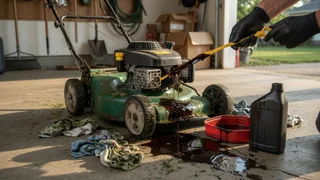
Putting too much oil in a push mower is a common mistake, especially because small walk-behind engines hold relatively little oil and a quick pour can easily go past the full mark. A slight overfill is usually not an emergency, but a noticeable one should be corrected before you keep mowing. Excess oil can cause smoke, hard starting, an oil-soaked air filter and, if ignored, leaks or other engine problems.
The Short Answer
If the oil level is only slightly above the full mark on the dipstick, many owners simply monitor the mower. If the level is clearly above the full line, the oil looks foamy, or the mower is smoking or running poorly, drain the excess until the level sits within the marked range. The exact acceptable range, the correct way to read the dipstick and the recommended oil all depend on the specific engine, so the engine maker's instructions take priority over general advice.
Why Overfilling Causes Problems
Most push mower engines are small single-cylinder four-stroke engines. Many use a splash lubrication system, where a part attached to the crankshaft or connecting rod dips into the oil and throws it around the inside of the crankcase. When the oil level is too high, the moving parts churn through more oil than intended. That churning can whip air into the oil, a condition called aeration or foaming. Aerated oil does not lubricate as well as solid oil.
Excess oil also leaves less air space in the crankcase and can raise internal pressure. The engine's breather, a vent that relieves crankcase pressure, may then push oil mist or liquid oil into the air intake. From there it can soak the air filter, reach the carburetor or end up in the combustion chamber, where it burns and produces smoke.
Common Symptoms of Too Much Oil
Symptom | What is likely happening; Blue or white smoke from the exhaust | Oil is reaching the combustion chamber and burning; Oil-soaked or dripping air filter | Oil is being pushed out through the breather into the intake; Hard starting or no start | Oil may be fouling the spark plug or restricting airflow through the filter; Rough running, surging or loss of power | A restricted air filter or oil in the combustion chamber is disturbing the fuel-air mixture; Oil leaking around seals or gaskets | Extra crankcase pressure is forcing oil past seals; Foamy or bubbly oil on the dipstick | The crankshaft is churning air into the oil
Not every overfilled mower shows all of these signs. A small overfill may produce nothing more than a brief puff of smoke at startup, while a larger one can make the engine smoke heavily or refuse to start.
How to Do an Accurate Level Check
Before draining anything, confirm the mower really is overfilled. An inaccurate reading is easy to get.
Park the mower on flat, level ground. A tilted mower gives a false reading. Let the engine sit so oil can drain back into the crankcase. Follow the manual on whether to check warm or cold. Remove the dipstick, wipe it clean and reinsert it. Check whether your dipstick should be screwed in fully or just rested on the threads. Engines differ, and the method changes the reading. The manual or the dipstick markings usually specify this. Remove it again and read where the oil reaches relative to the marks or crosshatched area.
How to Remove Excess Oil From a Push Mower
Whichever method you use, disconnect the spark plug wire first so the engine cannot start accidentally. Work with the engine cool to avoid burns. Remove a little oil at a time and recheck often, so you do not overcorrect and end up low.
Option 1: Extract Through the Fill Tube
For most owners, the simplest and cleanest method is a hand-operated oil extractor pump, a large syringe or a turkey baster with a length of clear tubing. Insert the tube down the oil fill neck, draw out a small amount and check the dipstick. Repeat until the level is within the marked range. This avoids tipping the mower and is well suited to a small overfill.
Option 2: Use the Drain Plug
Some push mower engines have a drain plug on the side or underside of the deck area. If yours does, you can loosen it briefly to let a small amount out into a container, then retighten it. Control can be difficult because oil may flow quickly once the plug is loose. Many owners prefer to drain the oil completely this way and refill carefully to the correct level.
Option 3: Tip the Mower and Drain From the Fill Neck
Many push mowers have no drain plug, so oil is often removed by tipping the mower and pouring it out of the fill tube. If you use this method, check the manual for the correct tipping direction. As a general rule, keep the air filter and carburetor side facing up, so oil and fuel do not run into the intake. Running the fuel tank low or emptying it beforehand reduces the chance of fuel leaking. Tip slowly, let a small amount drain into a pan, set the mower level and recheck.
What to Do After Correcting the Oil Level
Inspect the air filter. If it is wet with oil, clean or replace it according to its type. Paper elements generally need replacement once oil-soaked. Foam elements can often be washed, dried and lightly re-oiled if the manual calls for it. Check the spark plug. An oily or fouled plug can cause hard starting. Clean or replace it and confirm the gap matches the engine specification. Wipe away any oil that leaked onto the engine or deck. This makes it easier to spot a new leak later. Reconnect the spark plug wire, start the mower and let it run. Some smoke for a short period is common while leftover oil burns off. Recheck the oil level after running and cooling, to confirm it is still within range.
When to Be Concerned
If heavy smoke continues well after the level has been corrected and the air filter replaced, or if the engine knocks, will not turn over, or keeps leaking oil, there may be a separate problem. A mower that was tipped the wrong way or badly overfilled can also have oil in the cylinder. In that case the engine may be hard or impossible to pull over. Forcing the starter rope is not a good idea. A small engine repair shop can diagnose issues such as damaged seals, a stuck breather or oil in the cylinder.
How to Avoid Overfilling Next Time
Start with equipment identification. Find the engine model and type numbers, usually stamped or labeled on the engine shroud or block, and use them to look up the correct fill quantity and oil type. Follow the lubricant specification. Many walk-behind mower engines call for a straight SAE 30 or a multigrade such as 10W-30, depending on temperature range and manufacturer approval. Confirm what your engine requires rather than assuming. Pour slowly and in stages. Add part of the expected amount, wait a moment for it to settle, check the dipstick, then top up as needed. Do not rely on the bottle or the full capacity figure alone during an oil change. Some old oil usually stays in the engine, so the amount needed to reach full can be less than the listed capacity. Check the level before each use or as the manual recommends, and change the oil at the service interval specified for your engine and how hard you use it.
Bottom Line
Too much oil in a push mower is easy to fix and rarely causes lasting harm if corrected promptly. Confirm the overfill with a proper level check on flat ground, remove the excess gradually by extraction, the drain plug or careful tipping, and then inspect the air filter and spark plug for oil contamination. If symptoms persist after the level is correct, have the engine checked rather than continuing to run it.