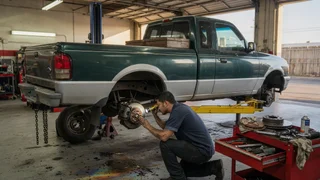
Service 1994–1996 Ford Ranger brakes

Brake service on a 1994–1996 Ford Ranger is a focused job built around the compact truck's disc-front and drum-rear foundation, with all wear parts needing inspection as a system. The 1996 Ford Ranger brakes share the same service logic as earlier 94 Ford Ranger brakes, so owners can approach pad thickness, rotor condition, caliper movement, fluid state, and drum friction as one connected hydraulic and mechanical circuit. The goal is to identify wear, noise, pulling, or a soft pedal before a small friction-material problem becomes a heat-damaged rotor or leaking wheel cylinder. Understanding each component helps a Ranger owner evaluate what a shop recommends or plan a careful driveway inspection without guessing at exact part numbers or intervals.
Essential answer
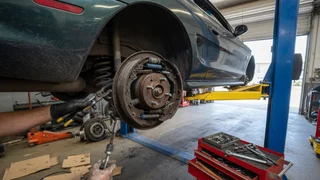
Servicing these brakes means evaluating the friction pairs at both ends of the truck and correcting the specific condition you can see, measure, or feel. On the front, disc brake pads clamp a spinning rotor, while the rear drum shoes press outward against an iron drum. Fixed front brake rotors and drum hardware do not have one universal replacement mileage; they are replaced when wear limits, cracking, scoring, or dimensional change support it. The essential answer is that a proper service starts with a complete inspection rather than assuming every 1996 Ford Ranger brakes complaint calls for the same new parts.
The most useful next action is to separate symptoms into categories: a metallic squeal usually points to a pad wear indicator or thin friction material, a pedal pulse often follows rotor thickness variation, and fluid loss can point to a leaking caliper seal or wheel cylinder. Because the 94 Ford Ranger brakes and later 1996 model use similar service principles, the same diagnostic order applies. Always confirm vehicle fitment before buying hardware, and treat any warning light or low fluid level as a reason to inspect the entire hydraulic path, not just add brake fluid and continue driving.