RV Tote Tanks: How to Choose a Portable Waste Tank for Your Motorhome
An RV tote tank is a portable waste container on wheels. You drain your motorhome's holding tanks into it at the campsite, then roll it to a dump station and empty it there. For most owners, the right tote is the largest one they can safely move over their usual ground. It also needs fittings that match their sewer hose and a sturdy valve and wheel setup. A tote matters most if you stay for long periods at sites without a sewer hookup. If you can simply drive the RV to a dump station, or you hire a pumpout service, you may not need one.
What a portable waste tank actually does
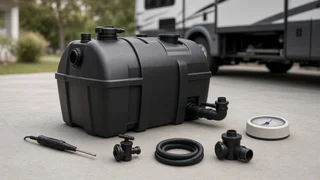
Sellers use several names for the same basic product: rv dump tank, sewer tote, rv sewage tote tank and portable black tank. All of them describe a sealed plastic container with an inlet for your RV sewer hose, an outlet for emptying, a vent, and wheels and a handle so it can be moved. The point is to avoid breaking camp and driving the whole vehicle to a dump station every time a holding tank fills.
A tote does not increase your onboard tank capacity. It is a transfer container. You still empty it at an approved dump point, usually in several trips if your holding tanks are larger than the tote.
Black water or gray water: decide first
Gray water comes from sinks and the shower. Black water comes from the toilet. Gray-only use is easier: it smells less, flows more freely and is less of a health risk if something spills. If you will move black water, choose a tote whose seals, caps and valve feel solid. Plan to flush it thoroughly every time you use it.
Many owners keep one tote for all waste and always empty the black tank first, then the gray, so the soapy gray water helps rinse the hose and tote. Others prefer a dedicated tote for each. Either works if you are consistent and clean the tote properly.
Sizing: tank capacity versus what you can move
It is tempting to buy a tote that matches your holding tanks, but weight usually decides. Water weighs roughly 8.3 pounds per gallon, and wastewater is similar. A tote carrying 30 gallons is therefore moving about 250 pounds before you add the weight of the tote itself. On a slope, gravel, grass or soft sand, that load quickly becomes hard to control.
Compare the tote's rated capacity with your black and gray tank sizes from the RV's documentation, and work out how many trips a full dump will take. Think about the route to the dump station: distance, slopes, surface and whether you will pull by hand or with a vehicle. Check the tote's empty dimensions against your storage space. A larger tote is only useful if you can carry it. If you are unsure, choose a size that is easy to handle and accept an extra trip. A smaller tote you can control is safer than a larger one you can't.
Wheels, frame and towing
Wheels make the biggest difference to how easy a tote is to use. Two-wheel designs tilt like a hand truck: you carry part of the load through the handle, but they move well on rough ground. Four-wheel designs carry the full load on the wheels and roll easily on pavement, but small casters can sink or catch on gravel and grass. Larger, wider wheels generally cope better with uneven campsite surfaces. Pneumatic tires smooth out bumps but can go flat. Solid tires need no maintenance but give a harsher ride.
Many totes offer a tow adapter that clips onto a hitch ball, bumper or ladder. Totes are designed to be towed at walking pace within a campground, not on public roads. Follow the manufacturer's stated speed and towing limits, and check that your tow point suits the attachment. A full tote that tips or breaks loose is a sanitation problem, not just an inconvenience.
Hose connection and valves
Most RV sewer outlets and hoses use 3-inch bayonet fittings, but adapters and tote inlets vary. Before buying, confirm that the tote's inlet will accept your existing sewer hose. Also check whether its outlet takes a standard hose or a short included one. A hose connection that seals properly at both ends prevents most spills.
Outlet valve: a gate valve on the tote's outlet lets you control the flow at the dump station instead of relying on a loose cap. Rinse port: a threaded fitting for flushing the tote's interior makes cleaning much easier. Caps and seals: look for gaskets on every opening and caps that lock firmly, as the tote will tip and bounce while you move it. Fill indicator: a gauge or clear section shows how full the tote is, so you can close the RV's dump valve before it overflows. Spare parts: check whether replacement seals, valves and wheels are available, because these wear out first.
Draining and flow rate
Draining a holding tank into a tote relies on gravity. The tote sits on the ground and its inlet is often only slightly lower than the RV's outlet, so the flow rate is lower than at a sewer hookup. Keep the hose short, avoid low spots where waste can pool, and open the RV's valve gradually. Watch the fill indicator and close the valve before the tote is full, leaving room so it can be moved without sloshing.
At the dump station, connect the tote's outlet hose to the station inlet before opening the valve. If the tote's outlet is close to the ground, it can drain slowly. Tilting the tote or raising one end, if the design allows it, helps the last of the waste drain out.
Venting and build quality
A vent lets air out while the tote fills and back in while it drains. Without one, filling is slow and draining gurgles and splashes. Check that the vent has a secure cap for moving the tote and is placed where it won't leak when the tote tilts.
Most totes are molded polyethylene. Molding quality, wall stiffness and how the axle and handle attach all affect how long a tote lasts. Weak spots tend to be where the handle joins the body and where the wheels mount, because these carry the load over bumps. Check how the frame attaches to the tank, and whether the handle locks or folds safely for storage.
Sanitation and cleaning
Wear disposable gloves while handling hoses, caps and valves, and keep hand sanitizer near the dump kit. Use a separate, clearly marked hose for rinsing. Never use your drinking water supply hose for waste tasks. Rinse the tote at the dump station after every use, using the station's non-potable rinse water where provided. Drain the tote completely, then leave the caps loose for a while or air it out before storing it sealed, to cut down on odor. Store the tote, sewer hose and gloves away from fresh water gear and food.
Storage and transport in the RV
Measure your storage bay or rear mounting space before you buy, including the wheels and handle. Some owners keep the tote in a storage bag or a dedicated bin to contain drips. Strap it down so it doesn't shift while driving. Always empty it before traveling: a tote is not designed to carry waste inside a moving vehicle.
When a tote isn't the best choice
If the dump station is far away, the ground is steep or loose, or moving a heavy load is difficult for you, look at other options. A macerator pump grinds waste and pumps it through a smaller hose. It can help where gravity flow is poor, but it needs power and a suitable outlet nearby. Some campgrounds and private companies offer mobile pumpout services. Another option is to pack up and drive the RV to the dump station, which avoids handling waste by hand altogether.
Campground rules and disposal
Only empty a tote at an authorized dump station or sewer connection. Releasing wastewater onto the ground or into storm drains is generally prohibited and creates a health hazard. Some campgrounds limit or forbid totes, or require them to be emptied only at certain points, so check the site rules before you arrive.
Buying checklist
What to check | Why it matters; Capacity versus your holding tanks | Shows how many trips a full dump will take; Full weight you can safely handle | Prevents tipping and loss of control on slopes and loose ground; Wheel type and size | Determines how well the tote rolls on gravel, grass or pavement; Inlet and outlet fittings | Must seal properly with your existing sewer hose; Outlet gate valve | Controls flow and reduces splashing at the dump station; Vent and cap design | Speeds filling and draining and stops leaks while moving; Fill indicator | Helps you avoid overfilling during transfer; Rinse port | Makes thorough cleaning easier; Tow adapter and speed limits | Must suit your tow point and be used within stated limits; Stored dimensions | Must fit your bay or mount when empty; Replacement parts | Seals, valves and wheels wear out first
For a first purchase, choose a tote with good wheels and a gate valve whose fittings match your sewer hose. Pick a size you can control when full. Capacity is easy to make up with an extra trip, but a tote that is hard to steer or leaks at the seals will be a problem every time you use it.