External RV Holding Tank: What to Check Before You Buy
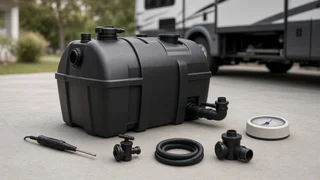
An external RV holding tank is a container that sits outside your motorhome's built-in plumbing. It lets you move waste water to a dump station, or bring extra fresh water to the rig, without driving the RV. For most buyers, the right choice is a wheeled portable waste tote sized to your gray tank, with fittings that match your sewer outlet. That answer changes in three situations: you need fresh water rather than waste capacity, you want to empty a black tank regularly, or you are thinking about a permanently mounted auxiliary tank. Each of these calls for different equipment and different checks.
Which type of external tank do you actually need?
The phrase covers several products that are not interchangeable. Decide which job you are solving before you compare models.
Type | Main job | Typical use case | Key caution; Portable waste tote (wheeled) | Carry gray and/or black water from the RV to a dump station | Campsites with no sewer hookup where you stay several days | Must be emptied only at approved dump points; never reuse for fresh water; Portable fresh water tank or bladder | Bring potable water to the RV's fresh tank | Boondocking or sites with no water spigot | Must be rated for drinking water and kept separate from waste equipment; Permanently mounted auxiliary tank | Add fixed holding or fresh water capacity to the vehicle | Long off-grid stays with no practical way to make dump runs | Adds weight, affects ground clearance, and usually needs plumbing work
Most people searching for an external RV holding tank want the first type: a portable waste tote. The rest of this guide focuses on that, then covers fresh water tanks and fixed auxiliary tanks more briefly.
Sizing tank capacity for a portable waste tote
Tank capacity is the first decision, and bigger is not automatically better. Start with the capacity of the RV tank you plan to empty, which is listed in your owner's documentation or on the coach's specification sheet. Then consider how many trips you are willing to make, and how much weight you can safely move.
Water weighs roughly 8.3 pounds per US gallon, and waste water is similar. A full tote gets heavy quickly. That matters on gravel, grass, slopes, and if you need to lift the tote into a truck bed. A tote that roughly matches your gray tank, or half of it, often makes more sense than one large enough to take everything in one trip but too heavy to control.
Compare the tote capacity with your gray and black tank capacities, not just your fresh tank. Estimate the full weight using about 8.3 pounds per gallon, then add the empty weight of the tote. Think about where you will push or tow it. Smooth pavement is very different from a rutted campground road. Check the storage space in your bays or tow vehicle. A large tote takes up the same space empty as full. If you have limited strength or mobility, choose a smaller tote and accept more trips.
Hose connection and fittings
The hose connection decides whether the tote is convenient or messy. Most North American RVs use a 3-inch bayonet-style sewer outlet, and many totes are built around that standard. Check your own outlet before buying. Some rigs, older coaches, and macerator-equipped systems use different fittings.
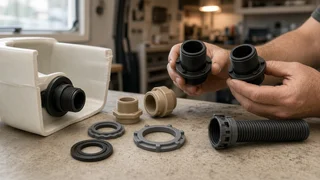
Inlet: confirm it accepts your sewer hose or has a compatible adapter, and check whether it seals securely. Outlet and drain valve: a gate valve or a short drain hose lets you control the flow at the dump station instead of tipping the tote. Vent: a vent lets air escape while filling and in while draining. Without one, filling and emptying are slower and splashing is more likely. Caps: check that all openings can be closed tightly for transport and storage. Hose length: make sure your sewer hose reaches from the RV outlet to the tote's inlet with a downward slope. Macerator systems: if your RV pumps waste through a smaller-diameter hose, confirm the tote has an inlet or adapter for that hose.
Wheels, handles and towing
How the tote moves matters as much as how much it holds. Totes are usually wheeled and pulled by hand or attached to a vehicle's hitch or ladder with a tow adapter.
Wheel type: larger wheels and pneumatic or solid rubber tires handle gravel and grass better than small hard plastic wheels. Number of wheels: two-wheel totes are easier to steer and tip to drain; four-wheel totes spread the load and may be steadier on long pulls. Handle: look for a sturdy handle that works for both hand pulling and attaching a tow adapter. Towing limits: if you tow a tote with a vehicle, follow the manufacturer's speed limit for that model, which is typically walking pace. Do not tow on public roads unless the manufacturer explicitly allows it. Clearance: make sure the tote can roll over speed bumps and curbs at the campground without scraping the drain fitting.
Material and build quality
Many portable totes are molded from polyethylene, which resists the chemicals used in holding tanks and does not corrode. Thicker walls generally hold up better to repeated use and being dragged over rough ground. If you plan to use the tote often, look at the wall thickness, the strength of the wheel axle and handle joints, the quality of the valve, and whether replacement parts such as caps, wheels, and valves are sold separately. A cracked fitting or seized valve on a waste tank is a real nuisance, so ease of repair is worth checking before you buy.
Gray water vs. black water
Many owners use a tote only for gray water from sinks and showers, and drive the RV to a dump station for black water. Gray water is easier to handle, and some campgrounds that accept totes limit them to gray water. If you plan to move black water, choose a tote with a reliable sealed valve, a rinse port if possible, and enough capacity to avoid overfilling. Keep a dedicated set of gloves and a rinse hose that is never used for drinking water.
Sanitation and disposal rules
Sanitation applies to every type of external tank. Waste water from an RV must be emptied only at an approved dump station or a sewer connection that is designated for RV waste. Dumping on the ground or into storm drains is generally illegal and can carry fines. Campground rules about totes vary: some allow them freely, some restrict them to gray water, and some ask you to use only their dump station. Check the rules wherever you stay.
Never use a waste tote, its hoses, or its fittings for fresh water, even after cleaning. Rinse the tote after each emptying and store it with the caps on. Use a separate, clearly marked hose for rinsing waste equipment. Wash your hands thoroughly after handling waste connections, even if you used gloves. Store the tote away from your fresh water hose and food supplies.
Portable fresh water tanks: what to check
If your problem is water supply rather than waste, you need a portable fresh water tank or collapsible bladder, not a waste tote. The checks are different because the water will be used for drinking and cooking.
Drinking water rating: the tank, hose, and fittings should be rated as safe for potable water. Do not use general-purpose containers whose materials are not intended for drinking water. Tank capacity and weight: the same weight concern applies. A full tank is heavy, and a bladder in a truck bed must be secured so it cannot shift. Transfer method: you will usually need a 12-volt transfer pump to move water into the RV's fresh tank. Compare the pump's flow rate with how quickly you want to fill, and check its power draw against your battery setup. Hose connection: use a dedicated drinking-water hose and confirm the pump inlet and outlet fit standard garden hose threads or whatever your setup uses. Filter specification: if you are filling from a source you are unsure about, an inline filter between the source and the tank can reduce sediment and improve taste. Check what the filter is rated to remove; many common inline filters address sediment and taste, not microbial contamination. Cleaning: choose a tank with an opening large enough to clean and sanitize, and allow it to dry fully between uses.
Permanently mounted auxiliary tanks
Some owners add a fixed external tank under the chassis or on a rack to extend their time off-grid. This is a vehicle modification, not an accessory purchase, and it needs more planning.
Weight: a full tank adds significant load. Compare it with your vehicle's cargo carrying capacity, which is listed on a label on the RV and varies by model year, chassis, and floor plan. Axle loading: where the tank is mounted affects how weight is distributed across the axles. Ground clearance and departure angle: an underbody tank can reduce clearance and catch on ramps, driveways, and rough campsites. Plumbing integration: connecting a fixed tank to existing lines, vents, and valves is best done by a qualified RV technician. Freeze protection: exposed tanks and lines can freeze in cold weather unless they are insulated or heated. Warranty: modifications to plumbing or the chassis may affect warranty coverage. Check your warranty terms before making changes.
Quick buying checklist
Decide what you need: waste tote, fresh water tank, or fixed auxiliary tank. Compare the capacity to the RV tank you will empty or fill. Calculate the full weight and check you can move it safely on the surfaces you expect. Confirm the hose connection matches your sewer outlet or water fittings. Check for a vent, a controllable drain valve, and secure caps. Look at wheel size, handle strength, and any towing speed limit. For fresh water, confirm the drinking-water rating, pump flow rate, and filter specification. Check the rules on totes at the campgrounds you use. Keep waste equipment and fresh water equipment completely separate.
If you match the tote to the tank you actually need to empty, choose a size you can handle when full, and check the fittings before buying, an external holding tank can make extended stays without a sewer hookup much easier. If you need more fresh water instead, buy a potable-rated tank and pump setup, and keep it entirely separate from anything that has touched waste.