Number on a Fire Extinguisher: What the Rating Means for Your Car
The number on a fire extinguisher is part of its fire extinguisher rating. It tells you how much fire of a given type the unit can handle in standardized testing. In the US, the rating is printed as numbers paired with letters, such as 1-A:10-B:C. The letter names the class of fire. The number in front of it shows relative capacity against that class. A higher number means more fire-fighting capacity. A letter with no number, such as C, means only that the extinguisher is safe to use on that type of fire. One condition changes the answer. These numbers describe the US rating system used on extinguishers listed for the American market. Extinguishers made to European standards use different numbering, so a US number and a European number are not directly comparable.
What the Letters on a Fire Extinguisher Mean
Each letter is a fire class. A fire class groups fires by the combustible material that is burning. Different materials need different extinguishing agents, so an extinguisher only works on the classes printed on its label.
Class | What is burning | Vehicle relevance; A | Ordinary solid combustibles: paper, cloth, wood, many plastics, upholstery | Seats, carpets, trim, cargo; B | Flammable liquids and gases: gasoline, diesel, oil, grease, some solvents | Fuel leaks, engine oil, transmission fluid; C | Energized electrical equipment | Wiring, battery cables, alternator, aftermarket electronics; D | Combustible metals such as magnesium | Uncommon in typical roadside fires; needs a specialized agent; K | Cooking oils and fats in commercial kitchens | Mainly food trucks and RVs with cooking equipment
Some extinguishers also show pictograms instead of, or alongside, the letters. A pictogram with a red slash means the extinguisher must not be used on that type of fire. For example, a water extinguisher may show a slashed electrical symbol.
What the Numbers Mean
Only the A and B classes carry numbers in the US system. The numbers measure different things, so a 2 in front of A cannot be compared with a 2 in front of B.
Number before A: relative capacity against ordinary combustibles, expressed as a water equivalent. Each unit is commonly described as equal to about 1.25 gallons of water, so 2-A is roughly equivalent to 2.5 gallons and 4-A to about 5 gallons. Number before B: the approximate area, in square feet, of a flammable-liquid fire that a non-expert user should be able to put out. A 10-B rating suggests about 10 square feet; a 20-B rating, about 20 square feet. C with no number: the extinguishing agent does not conduct electricity and has passed testing for use on energized equipment. It says nothing about size or capacity. D and K: these classes are usually shown without a capacity number on general-purpose labels, and the extinguishers are specialized for their hazard.
How to Read a Fire Extinguisher Label Step by Step
2-A:10-B:C; | | |; | | +-- C: safe on energized electrical equipment (no number); | +------- 10-B: about 10 sq ft of flammable-liquid fire; +------------ 2-A: water-equivalent capacity on ordinary combustibles
1) Find the rating panel on the label, usually near the classification letters or pictograms. 2) Separate the rating at the colons. Each segment covers one fire class. 3) Note which letters appear. Any class missing from the label is a fire the extinguisher is not rated for. 4) Read the number in front of A, if present, as relative capacity on solid combustibles. 5) Read the number in front of B, if present, as approximate square footage of a liquid fire. 6) Confirm whether C appears. If it does not, do not use the unit on anything that may still be energized. 7) Check for a testing laboratory listing mark, which shows the rating comes from a recognized standard. 8) Look at the pressure gauge, if fitted. The needle should sit in the green zone.
Other Numbers You May See on the Extinguisher
Not every number on the cylinder is part of the rating, and shoppers often confuse them. The largest number on the front is often the agent weight in pounds, such as 2.5 lb or 5 lb. This is the amount of extinguishing agent inside, not the capacity rating. Two extinguishers with the same weight can carry different ratings. You may also find a model number, a serial number, a manufacture date and, on some units, a service or hydrostatic test date stamped on the cylinder or neck. The label may also list an operating temperature range. That range matters for a unit that lives in a vehicle exposed to summer heat and winter cold.
Choosing a Rating for a Car, Truck or RV
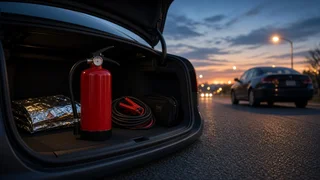
A vehicle fire can involve several fire classes at once. Fuel and oil are Class B, wiring that is still connected to the battery is Class C, and seats, carpet and plastics are Class A. For that reason, a dry chemical extinguisher rated ABC is a common general-purpose choice for passenger vehicles. A BC-rated unit covers fuel and electrical fires but not solid combustibles.
Look for at least B and C on the label for any vehicle with a fuel system and a 12-volt electrical system. Prefer an ABC rating if you want coverage for interior materials and cargo. Between two units of similar size, the higher A and B numbers indicate more capacity. Choose a size you can mount securely and reach quickly. A loose extinguisher can become a projectile in a crash. If you operate a commercial vehicle in the US, federal motor carrier rules set minimum extinguisher ratings, with stricter requirements for vehicles carrying placarded hazardous materials. Check the current regulation for your vehicle type rather than relying on general advice. For a food truck or RV with cooking appliances, consider whether a Class K unit is needed for the kitchen area in addition to a general-purpose unit.
Limits of the Rating in a Real Vehicle Fire
A rating describes performance under controlled test conditions. It does not guarantee results at the roadside. Wind, a fire hidden under the hood, a fuel leak that keeps feeding the flames, or a fire that has already reached the cabin can quickly exceed what a small portable unit can handle. Small vehicle extinguishers also discharge for only a short time, so there is little room for a second attempt.
Electric and hybrid vehicles add another limit. A burning high-voltage traction battery can reignite and release toxic gases, and a portable extinguisher is generally not expected to control it. The label rating does not change that. If a battery pack is involved, move away and leave suppression to firefighters.
If Your Vehicle Catches Fire
The extinguisher is secondary to getting people out. Safe evacuation comes first, then a call to emergency services. Use the extinguisher only on a small fire that is clearly within its capacity, and only when you have a clear escape route.
Pull over as soon as it is safe, stop the engine and switch off the ignition. Removing power is the simplest form of electrical isolation and can cut off an ignition source. Get every occupant out and move well away from the vehicle, upwind and clear of traffic. Call 911 and give your location. Mention if the vehicle is electric or hybrid. Do not open the hood fully if smoke or flames are coming from the engine bay. A sudden rush of air can make the fire grow. If you decide to use the extinguisher, keep your back to your escape route, aim at the base of the flames and sweep side to side. If the fire is not clearly shrinking within seconds, or the extinguisher empties, stop and back away. After any use, even a short burst, recharge or replace the extinguisher. A partly discharged unit may lose pressure.
Quick Summary
The letters on a fire extinguisher show which fire classes it can fight. The numbers in front of A and B show relative capacity: water equivalent for Class A and approximate square feet for Class B. C never carries a number and means only that the unit is safe on live electrical equipment. For most cars, an ABC or at least BC rating covers the likely hazards. Check the rating segment by segment, don't confuse the agent weight with the rating, and treat the extinguisher as a tool for small fires after everyone is safely out.