Kidde Fire Extinguisher Expiration Date: How to Check a Car Extinguisher
The short answer
Most Kidde fire extinguishers do not show a single "expires on" date. Instead, they carry a manufacture date, and how long the unit can stay in service depends on the model, whether it is disposable or rechargeable, and its condition. To find out whether a Kidde extinguisher in your car is still usable, locate the manufacture date, check the label or owner's manual for that model's stated service life or maintenance requirements, and inspect the unit's condition. If any of these checks fail, replace or service the extinguisher, whatever its age.
No model-specific service-life figures or date-code formats were available for this article. Kidde's lineup includes many models, and requirements can differ between them, so the label on your unit and its manual take priority over any general rule.
Where to find the date on a Kidde extinguisher
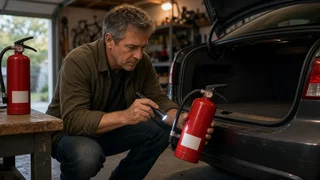
On many Kidde extinguishers, the manufacture date is stamped into the bottom of the metal cylinder rather than printed on the front label. It may appear as a short numeric or coded stamp, and it can be faint or hard to read. Some units also have date or service information on the label. If you cannot find or interpret the date, the model number on the label lets you look up that model's documentation or ask the manufacturer.
Disposable vs. rechargeable: why the type changes the answer
Whether an extinguisher is disposable or rechargeable matters most when judging its remaining life.
Disposable units: designed to be replaced, not serviced. They have a finite service life counted from the manufacture date, and they must be replaced after any use, even partial discharge. Rechargeable units: can be inspected, recharged and pressure-tested by a qualified fire-equipment service. Their usable life depends on keeping up that maintenance, not just on age.
The label usually states whether a unit is disposable or rechargeable. Compact extinguishers sold for vehicles are often disposable, but check your specific model rather than assuming.
Condition checks that override the date
An extinguisher well within its service life can still be unreliable. Inspect a vehicle-mounted unit regularly, following the interval on its label, and look for:
Pressure gauge: the needle should sit in the green (charged) zone. A needle in the recharge or overcharged zone means the unit needs attention. Safety pin and tamper seal: both should be in place and intact. A missing seal may mean the unit has been partly discharged. Cylinder: no dents, rust, corrosion or other damage. Nozzle or hose: no cracks, blockages or debris. Label: legible, with operating instructions readable. Use history: any discharge, however brief, means a disposable unit should be replaced and a rechargeable unit serviced.
Why a car is a harder environment for an extinguisher
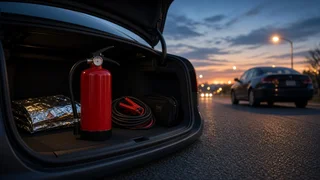
An extinguisher stored in a vehicle faces conditions a household unit usually avoids: wide temperature swings, constant vibration, and impacts if it is not secured. Vibration can cause the dry chemical agent in many extinguishers to settle and compact over time. Some owners periodically invert and gently tap the cylinder to help counter this, but whether that suits your unit depends on the model's instructions. A loose extinguisher can also become a projectile in a crash, so it should be held in a proper bracket. Check the label for the unit's rated storage temperature range, as cabin and trunk temperatures can exceed what some extinguishers are designed for.
Recalls
Kidde has recalled certain extinguisher models in the past. If you own an older Kidde unit, check its model number and manufacture date against current recall listings from the manufacturer or the US Consumer Product Safety Commission. A recalled unit should be handled according to the recall instructions, regardless of its age or gauge reading.
What to do next
Find the manufacture date, usually on the bottom of the cylinder. Confirm whether the unit is disposable or rechargeable, and look up the service life or maintenance requirements for its model. Inspect the gauge, pin, seal, cylinder and nozzle. Check the model against recall listings. Replace a disposable unit that is past its stated life, damaged, discharged or recalled. Take a rechargeable unit to a qualified service provider. Mount the replacement securely in the vehicle.
Gaps in this guidance
This guide does not give a specific number of years for any Kidde model, explain how to decode a particular date stamp, or list prices or recalled model numbers, because no verified details were available. For those, rely on the label and manual for your exact model, the manufacturer's support channels, or a licensed fire-equipment service.