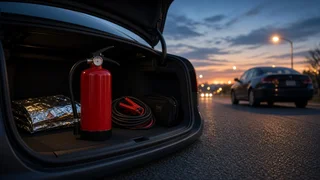
Fire Extinguisher Types and Ratings for Vehicle Fire Response
For most passenger cars, pickups and SUVs, the practical choice is a compact multipurpose dry chemical extinguisher rated for Class A, B and C fires, or at minimum a B:C unit, held in a secure bracket. Vehicle fires usually involve flammable liquids such as gasoline, diesel, oil or transmission fluid (Class B), energized wiring (Class C) and burning plastics, upholstery and tires (Class A). One important qualification changes the answer: a portable extinguisher is a tool for a small, early fire and for protecting your exit. It does not replace safe evacuation, and it will not stop a lithium-ion battery in thermal runaway in an electric or hybrid vehicle. This guide covers the main fire extinguisher types, what the letters and numbers on the label mean, and how that applies to a vehicle.
Fire types A, B, C, D and K
In the US, fires are grouped into classes according to the combustible material that is burning. Extinguishers are labeled with the classes they have been tested against, so understanding the classes is the first step in matching an extinguisher to a vehicle.
Class A: ordinary solid combustibles such as paper, cloth, wood, rubber and many plastics. In a vehicle this includes seats, carpet, headliner, interior trim and tires. Class B: flammable and combustible liquids and gases, including gasoline, diesel, motor oil, grease, brake fluid and propane. This is the most common fuel in engine compartment fires. Class C: fires involving energized electrical equipment. Once the power source is removed, the fire is treated as Class A or B depending on what is burning. Vehicle wiring, alternators, starters and aftermarket electrical accessories fall here. Class D: combustible metals such as magnesium, titanium and sodium. Some vehicle parts contain magnesium alloys, but metal fires are uncommon in ordinary roadside incidents and require specialized agents. Class K: cooking oils and fats in commercial kitchens. Relevant to food trucks and RV galleys, not to the vehicle itself.
Readers who see European or international labels should note that other systems use different letters. For example, some systems use a separate letter for flammable gases and a different letter for cooking oils. For use in the US, rely on the US class markings on the label.
How to read a fire extinguisher UL rating
A typical label reads something like 1-A:10-B:C or 5-B:C. This is the UL rating, from the testing laboratory that lists the extinguisher. It tells you two things: which fire classes the unit is approved for, and how much fire it can handle relative to others.
The number before A indicates water-equivalent extinguishing capacity. Each unit is roughly equivalent to 1.25 gallons of water, so 2-A performs about like 2.5 gallons of water on an ordinary combustible fire. The number before B is a relative measure of the flammable liquid fire area the unit can be expected to extinguish under test conditions. A 10-B unit is rated for a larger liquid fire than a 5-B unit. C has no number. It means the agent does not conduct electricity and is safe to use on energized equipment. Class D extinguishers carry no numerical rating. They are listed for specific metals, and the label states which ones. Class K extinguishers also carry no numerical rating.
The number is not the same as the weight on the label. Two extinguishers with the same weight of agent can carry different ratings depending on the agent and the nozzle design. When comparing units, look at the rating first and the size second.
Fire extinguisher types and uses: comparison chart
The extinguishing agent determines which classes a unit can handle, the residue it leaves behind and how well it works outdoors. The chart summarizes the common fire extinguisher types and their uses, with notes for vehicle use.
Agent | Typical classes | Vehicle suitability | Notes; Multipurpose dry chemical (monoammonium phosphate) | A, B, C | Good general choice for cars and light trucks | Covers interior, fuel and electrical fires; residue is corrosive to metal and electronics and must be cleaned up promptly; Regular dry chemical (sodium or potassium bicarbonate) | B, C | Good for engine compartment fuel fires | Effective on liquid fires; little or no effect on deep-seated Class A fires such as upholstery; Carbon dioxide (CO2) | B, C | Poor for roadside use | Agent disperses quickly in wind and outdoors; heavy cylinder; no residue; Clean agent (halogenated or similar) | B, C, some A | Suitable where residue is a concern | No residue and nonconductive; generally more expensive and less agent per unit of rating; Water | A | Not recommended | Spreads fuel fires and conducts electricity; Foam (AFFF or similar) | A, B | Limited, sometimes used in fleets | Smothers liquid fuel fires; not for energized electrical equipment unless specifically listed; Dry powder | D | Specialized only | Listed for specific metals; not a general vehicle extinguisher; Wet chemical | K | Food trucks and RV kitchens only | Designed for cooking oil fires
Fire extinguisher types and sizes for vehicles
Portable extinguishers are commonly sold by the weight of agent they contain, with compact units in the range of a few pounds being typical for passenger vehicles. Larger units deliver more agent and a longer discharge, but they are harder to mount and carry. The right size is a balance between capacity and the space where you can secure it.
Passenger cars, SUVs and pickups: a compact ABC dry chemical unit is the usual recommendation. A B:C unit is acceptable if Class A coverage is not a priority, but ABC handles interior fires as well. Commercial motor vehicles in the US: federal rules call for an extinguisher rated at least 5-B:C, or at least 10-B:C for vehicles transporting placarded hazardous materials. Fleet operators should confirm current requirements for their vehicle category. RVs, motorhomes and vehicles towing trailers: consider more than one extinguisher, with one near the driver and one near the living area or galley. A Class K unit is relevant only if there is a cooking appliance using oils and fats. Shop trucks and service vehicles carrying fuel cans or flammable liquids: a higher B rating offers more margin.
Small extinguishers empty in seconds, not minutes. That short working time is one of the main reasons a portable unit is only suitable for a fire that is still small.
Mounting and storage in a vehicle
Use a metal or rated bracket fastened to the vehicle structure. A loose extinguisher can become a projectile in a crash or roll under the pedals. Keep it reachable from outside the vehicle as well as from the driver's seat, so you can retrieve it after getting out. Check the label for the listed operating temperature range. Vehicle interiors and trunks can get very hot or very cold, and some agents are better suited to temperature extremes than others. Avoid placing it where it would be buried under cargo or in the engine compartment, where it could be engulfed by the fire you need it for.
Using an extinguisher on a vehicle fire
People come first; the vehicle comes last. Decide whether to fight the fire only after everyone is out and clear. Vehicles contain fuel, pressurized components such as struts, airbag inflators and tires, and plastics that produce toxic smoke, so conditions can worsen quickly.
Pull over to a safe spot away from traffic, buildings, dry grass and fuel pumps, then turn off the ignition. Switching off the engine is the practical form of electrical isolation available to a driver; do not try to disconnect the battery while there is active fire. Get all occupants out and move well away, staying upwind and out of traffic. Do not go back for belongings. Call emergency services (911 in the US) and give the location, the vehicle type and whether it is electric, hybrid or carrying hazardous cargo. Only attempt to use the extinguisher if the fire is small, you have a clear escape route behind you, and smoke is not filling the area. Do not fully open the hood if fire is in the engine compartment. A rush of air can intensify it. If possible, discharge through the grille, the wheel wells or the small gap at the edge of the hood. Use the PASS method: Pull the pin, Aim at the base of the fire, Squeeze the handle, Sweep side to side. If the extinguisher runs out or the fire grows, back away and wait for firefighters.
Electric and hybrid vehicle battery fires
A fire in an electric or hybrid vehicle may start in ordinary materials and can sometimes be knocked down with a portable extinguisher in the early stages. A fire that involves the high-voltage lithium-ion battery is different. Thermal runaway, a self-sustaining chain reaction inside the battery cells, generates its own heat and can continue or reignite even after visible flames are suppressed. Portable extinguishers are not designed to stop it, and a Class D extinguisher is not the answer either, because lithium-ion batteries contain little metallic lithium. Signs such as hissing, popping, jets of smoke or flame from beneath the vehicle mean you should evacuate, keep everyone at a distance and tell emergency services that it is an electric or hybrid vehicle. Firefighters may need large volumes of water and extended monitoring.
Inspection and replacement
Check the pressure gauge regularly where fitted. The needle should be in the operable range. Look for damage, corrosion, a missing pin or tamper seal, and a cracked or clogged nozzle. Vehicle vibration can compact dry chemical powder. Following the manufacturer's guidance on periodic inspection helps keep the agent free-flowing. Replace or recharge an extinguisher after any use, even a brief discharge, since partial use can let pressure leak away. Disposable units are replaced at the end of their service life; rechargeable units should be serviced by a qualified technician according to the label and manufacturer instructions.
Choosing the right type
For an ordinary car or light truck, a securely mounted ABC dry chemical extinguisher offers the broadest coverage of the fire types a vehicle is likely to present, with a B:C unit as the narrower alternative for fuel and electrical fires. Choose a clean agent if residue on electronics is a major concern and the cost is acceptable. Commercial vehicles should meet the B:C rating that applies to their category. In every case, read the UL rating rather than relying on size alone, keep the unit maintained, and treat it as a way to handle a small fire or protect your escape, not as a reason to stay near a burning vehicle.