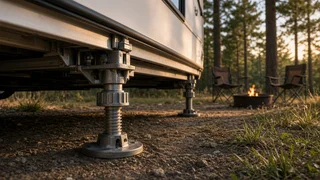
Hydraulic Caravan Jacks for Campsite Leveling: What to Check Before You Buy
A hydraulic caravan jack is a practical tool for lifting one side of a caravan so you can slide leveling blocks or ramps under a wheel. It is also useful for wheel changes. It is a good buy if three conditions hold. Its load rating comfortably exceeds the weight on the wheel or side you will lift. It fits under your chassis support point when fully lowered, even with a flat tire. And you can set it on firm ground or a solid base. A hydraulic jack lifts the caravan; it is not meant to hold it up while you camp. Once the caravan is level, the weight should rest on the wheels, blocks and properly set stabilizers, not on the jack. In the US, many owners would call this setup a travel trailer, and most product listings use RV or trailer terms. The same principles apply. Search terms such as hydraulic jack for caravan or hydraulic jacks for caravans tend to bring up three kinds of product: compact bottle jacks, purpose-built caravan lifting jacks, and installed leveling systems. These work in quite different ways, so it helps to know which one you are actually shopping for.
What a hydraulic caravan jack does at the campsite
Most single-axle caravans are leveled in two directions. Front-to-back leveling is usually done with the jockey wheel or tongue jack at the hitch. Side-to-side leveling is harder, because the caravan has to be raised on its low side. A hydraulic jack makes this easier. It raises the low side with short pumps of a handle, so you need less effort than with a scissor jack. Most designs also let you lower the load gradually by opening a release valve.
The usual sequence is simple. You lift the low side until it is level or slightly above. Then you place a block, pad or leveling ramp under the tire and lower the caravan back onto it. After that, you deploy the corner steadies or stabilizers. Stabilizers are designed to reduce rocking and movement. They are not designed to lift the caravan or carry its full weight, so do not use them as jacks.
Types of jack and leveling equipment
Option | How it works | Main strengths | Main limitations; General-purpose hydraulic bottle jack | Vertical ram raised by a pump handle | Compact, widely available, high lifting force for its size | May be too tall to fit under a low chassis point; small base can sink on soft ground; Purpose-built hydraulic caravan jack | Hydraulic lift shaped or sized for caravan chassis and wheel-change use | Designed around caravan ground clearance and support points; often easier to position | Must match your chassis type and support point; fewer general uses; Leveling ramps or wheel levelers | Caravan is towed or pushed onto a ramp or curved leveler | No lifting, fast, simple | Limited correction range; need room to maneuver; not useful for wheel changes; Manual scissor or screw jack | Mechanical screw lift | Inexpensive and light | Slow, more effort, often less stable; Installed leveling system (hydraulic or electric) | Permanently mounted legs controlled from a panel | Convenient, can level automatically | Significant cost and weight; installation must suit the chassis and frame
Load rating: match it to real weight, not brochure weight
The load rating is the maximum weight the jack is designed to lift. Do not compare it with the unladen weight in a brochure. Compare it with what the caravan actually weighs when packed for a trip, including water, gas, batteries, awning and gear. If you have weighed the caravan at a public scale or know its maximum permitted mass, use that figure.
When you jack one side, the jack carries a large share of that side's load. That is less than the full caravan weight, but loads are rarely spread evenly. A margin above the expected side load therefore matters. It covers uneven loading, a slight angle on the jack, and the extra effort needed to start a lift. If the rating is only just enough, choose a higher-rated jack.
Lift range and closed height
Two dimensions decide whether a jack will actually work on your caravan. The first is its minimum or closed height, meaning how low it sits when fully retracted. The second is its maximum lift. A jack that fits under the support point on level ground may not fit when the tire is flat or the caravan stands in a dip. The jack also needs enough travel to lift the wheel high enough for your blocks or ramp. For wheel changes, it must lift the wheel clear of the ground.
Measure the height of your chassis support point above the ground. Do this with the caravan loaded, and if possible with the tire deflated or with the wheel on the low side of a slope. Compare that measurement with the jack's published closed height and lift range. If the product listing does not state these figures, treat that as a reason to look elsewhere or ask the seller.
Support points and stabilizer mounting
A support point is a place on the chassis or axle that the caravan or chassis maker has designated as safe for lifting. Many caravan chassis have marked jacking points or brackets, and some need a specific adapter or jack head shape. Lifting from the wrong place can bend chassis members, damage the floor or body, or let the jack slip. Check the caravan's manufacturer instructions or handbook to find where lifting is permitted.
Avoid lifting on the stabilizer mounting brackets or corner steady legs unless the manufacturer says this is permitted. Avoid floor panels and bodywork as well. Before buying, confirm that the jack head will seat securely on your support point. A head that is too small, too large or the wrong shape is a common source of slips.
Ground stability
Campsite ground is often grass, gravel or soft soil, and a hydraulic jack concentrates heavy loads onto a small base. On soft ground, the base can sink or tilt as the caravan rises. Look for a jack with a broad, flat base. Carry a solid base plate or board to spread the load, and make sure the jack stands vertically before you begin lifting. On a noticeable slope, consider using ramps first, or re-pitching to a flatter spot.
Kojack and other purpose-built caravan jacks
Kojack is one of the names owners often search for when looking at purpose-built hydraulic caravan jacks. Branded caravan jacks like this are generally sold for caravan wheel changes and leveling rather than general garage use. Specific models, ratings, dimensions and compatible chassis can vary and may change over time, so check the current product details instead of relying on older forum posts or reviews. Treat any brand the same way. Compare its stated load rating, closed height, lift range and chassis compatibility with your own caravan's measurements and manufacturer guidance.
Buying checklist
Load rating clearly above the realistic loaded weight on the side you will lift; Closed height low enough to fit under your support point with a flat tire; Lift range enough to clear the wheel and fit your leveling blocks; Jack head that seats securely on your chassis support point, or a compatible adapter; Broad, stable base, or a separate base plate for soft ground; Release valve that lowers the load smoothly and controllably; Weight and storage size that suit your payload and locker space; Clear instructions covering safe use and maintenance; Compatibility with single or twin axles, if your caravan has two axles
Safe use at the campsite
Keep the caravan hitched or chock the wheels on the side not being lifted, and apply the handbrake; Place the jack only at a designated support point, on firm ground or a base plate; Lift slowly and watch for the jack leaning or the base sinking; Never put any part of your body under a caravan supported only by a jack; Lower the caravan onto blocks or ramps, then remove the jack before setting the stabilizers; Check the jack for fluid leaks or a ram that slowly creeps down, and store it upright if the instructions require it
When a different solution makes more sense
If you only need small side-to-side corrections and rarely change wheels, leveling ramps may be quicker and need no lifting at all. If you level often on uneven sites, or find manual effort difficult, an installed leveling system may be worth comparing. It must be rated for your caravan's weight, and it must be suitable for mounting on your chassis frame. For many owners, the best combination is a well-matched hydraulic jack plus a set of leveling blocks. That pairing covers campsite leveling and roadside wheel changes, as long as the jack fits your support point and is never used as the long-term support.