Bullseye Leveling Jacks: What to Check Before You Buy
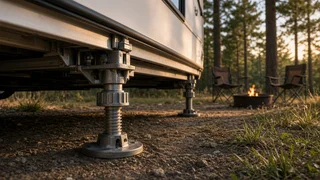
If you are shopping for Bullseye leveling jacks, the short answer is this: they are only the right buy if the jack's job, load rating and mounting method match your trailer. The most important condition is whether a jack is designed to lift and level the trailer or only to steady it once it is already level. Many campsite jacks are stabilizers, not lifting jacks. Using a stabilizer to raise a loaded trailer can bend the jack, damage the frame or leave the setup unsafe. Confirm which type you are looking at before you compare anything else. The name can also cause confusion. A "bullseye" in RV and caravan setups usually means a round bubble level that shows tilt in every direction at once. Some leveling products are sold with or around this kind of level, and some sellers use the word loosely. Treat the name as a label, not a specification, and judge the product on what its listing and manufacturer instructions actually state.
Leveling Jacks vs Stabilizer Jacks
Leveling and stabilizing are separate jobs, and mixing them up is the most common buying mistake.
Leveling: raising one side or corner of the trailer until it sits level. This is usually done with leveling blocks, ramps or chocks under the tires, the tongue jack for front-to-back adjustment, or a powered leveling system rated to lift the vehicle. Stabilizing: reducing rocking and bounce once the trailer is already level. Corner stabilizer jacks, scissor jacks and many bolt-on drop-down jacks are meant to be lowered until they make firm contact with the ground, not to carry the trailer's weight off its tires. Powered leveling system: hydraulic or electric jacks engineered to lift and level the vehicle, often with automatic sensing. These are a larger investment and are typically matched to specific chassis or frame designs.
If a listing calls a product a leveling jack but the instructions say it should not be used to lift the trailer, follow the instructions. The product is a stabilizer regardless of how it is marketed.
What to Check When Choosing Bullseye Leveling Jacks
Check | Why it matters | How to confirm; Intended function | Determines whether the jack may lift weight or only steady the trailer | Product description and manufacturer instructions; Load rating | Each jack must handle the load at its support point with margin | Stated rating per jack, not just a combined total; Frame compatibility | Jacks must bolt or weld to a structural member, not to flooring or skirting | Your trailer's frame layout and the jack's mounting requirements; Stabilizer mounting method | Bolt-on, weld-on and clamp-on designs differ in strength and reversibility | Included hardware list and installation steps; Extension range | Too little travel fails on sloped sites; too much may hang low while towing | Retracted and extended height compared with your ground clearance; Operation | Crank, drill-driven or electric affects setup time and effort | Drive type and whether a socket adapter or controller is included; Foot or pad size | Larger contact area spreads load on soft ground | Pad dimensions and whether add-on pads fit; Model year and trailer specifics | Frame changes between model years can affect fit | Your trailer's year, model and floor plan, checked against the jack's stated fitment
Load Rating and Support Points
A load rating tells you how much weight a jack is designed to carry. For stabilizers, this figure is not an invitation to lift the trailer; it describes what the jack can tolerate at its support point once deployed. Check whether the rating is per jack or for a set, and compare it with the realistic weight of a loaded trailer rather than its empty weight. Water tanks, gear and occupants moving inside all add load and shift it between corners.
The support point is where the jack meets the frame. Jacks should attach to the main frame rails or a manufacturer-designated location. Mounting to a crossmember that is not designed for concentrated loads, or to the floor structure, can lead to flexing or cracking over time.
Stabilizer Mounting: Bolt-On, Weld-On or Clamp-On
Bolt-on: usually the easiest for owners to install and remove. Check that the bolt pattern and hardware suit your frame thickness and that drilling the frame is acceptable for your trailer. Weld-on: a permanent, rigid attachment. It typically requires a qualified welder and may have implications for frame warranty, so check before committing. Clamp-on: avoids drilling or welding but depends on correct torque and periodic checks to stay secure.
Ground Stability at the Campsite
Even a well-rated jack is only as steady as the ground beneath it. Soft soil, sand, gravel and hot asphalt can let a jack foot sink or shift. Wide pads or solid blocks under each foot spread the load and reduce sinking. On slopes, avoid extending a jack to its limit; build up the surface underneath instead so the jack works within the middle of its travel, where it is generally more stable.
Using a Bullseye Level With Your Jacks
A round bullseye level shows side-to-side and front-to-back tilt in a single reading, which makes it useful during setup. A common order of work is:
Place the level on a flat, fixed surface inside or on the trailer that you know sits true to the frame. Level side to side first using blocks or ramps under the tires, then chock the wheels. Unhitch and adjust front to back with the tongue jack. Lower the stabilizers until they make firm contact, working diagonally to avoid twisting the frame. Recheck the level after the stabilizers are down, since deploying them can shift the reading slightly.
Common Mistakes to Avoid
Lifting the trailer with jacks that are only rated for stabilizing. Choosing by combined load rating without checking the per-jack figure. Mounting to non-structural parts of the trailer. Over-extending jacks on uneven ground instead of adding blocks underneath. Forgetting to retract stabilizers fully before towing. Skipping the manufacturer instructions for torque values, inspection intervals and lubrication.
Choosing Your Next Step
Start by deciding whether you need leveling, stabilizing or both. If your trailer already levels easily with blocks and the tongue jack but rocks once you are inside, a set of stabilizer jacks with a suitable load rating and a mounting method that fits your frame is usually the sensible path. If you want the jacks themselves to raise and level the trailer, you are looking at a powered leveling system, and fit to your specific chassis becomes the deciding factor. In either case, match the product's stated fitment to your trailer's model year and frame, and follow the manufacturer instructions for installation and use.