Automatic RV Leveling Jacks: What to Check Before You Buy
Automatic RV leveling jacks use sensors and a control unit to extend powered jacks until the coach or trailer sits level, usually from a single button or touchpad. For many motorhomes and larger fifth wheels they save setup time and reduce guesswork. Whether they suit your rig depends on four things: the RV type and frame, the system's load rating relative to your vehicle's weight, the power source available, and the ground you usually park on. If any of these does not line up, a manual or semi-automatic setup may be the better buy.
The Short Answer: When Auto Leveling Jacks Make Sense
Auto leveling jacks tend to make the most sense for owners who move campsites often, travel solo or with limited help, or own a heavy coach where manual blocks and crank stabilizers are slow and awkward. They make less sense on light towables where the added weight eats into limited cargo capacity, on rigs whose frame was not designed to accept a jack system, or for owners who rarely relocate and can level once and leave the RV in place.
The condition that most often changes the answer is compatibility. A leveling system is engineered around a chassis or frame family, a weight range and specific mounting locations. A kit that fits one model year or floor plan may not fit another, even within the same brand, so the decision starts with your exact vehicle rather than with the jacks themselves.
Leveling Jacks vs Stabilizers
These terms are often confused when shopping. Leveling jacks are built to lift and hold part of the RV's weight so the floor sits level. Stabilizer jacks are built to reduce rocking and bounce once the RV is already level; most are not rated to lift the vehicle and can bend or damage their stabilizer mounting points if used that way.
Some automatic systems combine both roles, while others only automate stabilizers. Read the product description carefully: if a listing talks about stabilizing rather than leveling, it may not correct an unlevel site at all.
How an Automatic Leveling System Works
A typical automatic leveling system has three parts: the jacks, a power unit that drives them, and a controller with level sensors. When you start the auto-level routine, the controller reads the RV's angle front to back and side to side, then extends jacks in sequence until the readings fall within its target range. Many systems also offer one-touch retraction, manual control of individual jacks, and warnings if a jack is not fully stowed.
Each jack is a support point, a place where the vehicle's weight is transferred to the ground. More support points generally spread the load more evenly and reduce movement, which is why larger rigs often use more jacks than smaller ones.
Hydraulic vs Electric Systems
Factor | Hydraulic | Electric; Common applications | Larger motorhomes and heavy fifth wheels | Lighter coaches, towables and some smaller motorhomes; Lifting capacity | Generally suited to heavier loads | Generally suited to lighter to moderate loads; Speed | Often quicker to deploy | Often slower, varies by design; Maintenance | Fluid level, hoses and fittings need checking; leaks are possible | No hydraulic fluid; motors, gears and wiring need checking; Added weight | Pump, reservoir and lines add weight | Often lighter overall, depends on system; Noise | Pump noise during operation | Motor noise during operation
Treat this comparison as a general pattern, not a rule. Actual capacity, speed and weight vary between products, so compare the specific systems you are considering rather than the technology type alone.
What to Check Before Buying
Vehicle and Frame Compatibility
Confirm that the system is listed for your RV's chassis or frame, model year and floor plan. Motorhome chassis, fifth-wheel frames and travel trailer frames differ in rail size, crossmember layout and available mounting space. Tanks, plumbing, generators, slide-out mechanisms and exhaust routing can all block a planned jack location. If the seller cannot confirm fitment for your exact configuration, treat that as an unresolved question, not a yes.
Load Rating
The system's load rating should be appropriate for your RV's loaded weight, not its empty weight. Check the vehicle's gross weight rating and, if possible, weigh the rig as you actually travel. Remember that the leveling system itself adds weight, which counts against your cargo capacity on a towable or against payload on a motorhome.
Number of Jacks and Placement
Systems are commonly sold in four-point and six-point configurations, with six-point setups more typical on fifth wheels because they can also support the front where the hitch connects. Placement matters as much as count: jacks should sit at reinforced locations specified for the frame, not wherever there happens to be space.
Ground Clearance and Stowed Position
Retracted jacks hang below the frame. Check how much clearance they leave and whether they affect departure angle at steep driveways, fuel station aprons or uneven campground entrances. Jacks that stow horizontally or tuck closer to the frame may help on lower rigs.
Power Supply
Most systems run from the RV's 12-volt house battery. If you camp off-grid, consider whether your battery bank can comfortably handle leveling and retraction, especially in cold weather or after a night of use. A weak battery can leave jacks partially deployed, so ask whether the system has a manual retraction method for that situation.
Controller Features
One-touch auto-level and auto-retract; Manual control of individual jacks for awkward sites; Warning or interlock if jacks are down when the engine starts or the parking brake is released; Ability to save or recalibrate the level reference point; Clear error messages rather than generic fault codes; Manual or emergency retraction if power or the controller fails
Installation and Warranty
Factory-installed and dealer-installed systems are usually the simplest route for warranty and support. Aftermarket installation is possible on many rigs but typically involves frame drilling or welding, wiring and, for hydraulic units, routing lines. Ask who will install it, whether the installation affects the RV's frame or chassis warranty, what the leveling system's own warranty covers, and where service is available along the routes you travel.
Ground Stability and Site Limits
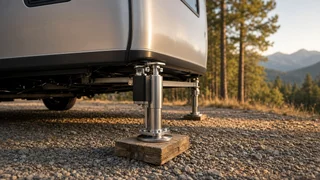
Even the best automatic leveling jacks depend on what is underneath them. On soft soil, grass, sand or hot asphalt, jack feet can sink and the RV can slowly drift out of level. Wide jack pads or boards spread the load and improve ground stability. On very steep sites, the system may reach the end of its travel before the RV is level; in that case, partial leveling with blocks under the tires before deploying the jacks is a common approach, if the manufacturer instructions allow it.
Many manufacturers advise against lifting the tires completely off the ground, because it shifts weight onto the jacks and frame in ways that may exceed their design. Follow the guidance for your specific system on how far to lift.
Leveling jacks are not a substitute for proper jack stands. Do not crawl under an RV supported only by its leveling system.
Ownership Trade-Offs
Convenience: faster setup and teardown, especially for solo travelers; Consistency: repeatable level readings help refrigerators, slide-outs and doors work as intended; Weight: the system adds weight that reduces cargo or payload capacity; Cost: purchase and installation are a significant expense compared with manual leveling; Maintenance: hydraulic fluid, seals, hoses, motors and sensors need periodic attention; Failure modes: a stuck or leaking jack can delay departure, so a manual retraction plan matters
Questions to Ask the Seller or Installer
Is this system confirmed for my RV's exact chassis or frame, model year and floor plan? What is the load rating, and how does it compare with my RV's loaded weight? How much does the system add to the vehicle's weight? How much ground clearance remains with the jacks retracted? Does it level automatically or only stabilize? How do I retract the jacks if power or the controller fails? What routine maintenance is required, and how often? Does installation affect my RV or chassis warranty, and what does the system warranty cover?
Choosing Your Next Step
If you are buying an RV, check whether automatic leveling jacks are already installed or offered as a factory option, since that removes most compatibility questions. If you are retrofitting, start with your exact vehicle details and loaded weight, shortlist only systems confirmed for that configuration, then compare hydraulic and electric options on load rating, clearance, power needs and service support. If none fit cleanly, a quality manual leveling kit paired with proper stabilizers remains a practical alternative.