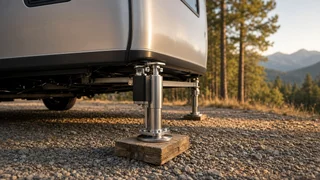
Manual RV Leveling Jacks: What to Check Before You Buy
If you are shopping for manual leveling jacks for an RV, the short answer is this: most manual RV jacks are stabilizers, not lifting jacks. Scissor jacks, corner steadies and drop-down legs keep a parked trailer from rocking and bouncing. They are generally not built to raise the weight of the RV to make it level. On most travel trailers, leveling is done in two parts. You correct side-to-side tilt with leveling blocks or ramps under the tires, and you correct front-to-back tilt with the tongue jack or fifth-wheel landing gear. Then you lower the stabilizers. One condition changes that answer. Some components are designed and rated to carry or lift part of the trailer's weight. Fifth-wheel landing gear and tongue jacks are the common examples, and some aftermarket manual leveling systems also make this claim. If the manufacturer instructions for a specific jack say it may be used for lifting, follow those limits. If the jack is sold or labeled as a stabilizer, do not use it to lift.
Leveling versus stabilizing: why the difference matters
Leveling means getting the RV close to horizontal. Refrigerators, slide-outs, doors, drains and sleeping comfort all work better when the RV is level. Stabilizing means reducing movement once the RV is already level and resting on its tires and hitch support. A stabilizer only needs to resist the shifting load of people walking inside. A jack that lifts has to carry a large share of the vehicle's static weight.
Using a stabilizer as a lifting jack can bend the jack or overload its mounting. It can also stress the frame at a point that was never meant to be a support point. That is why the search term "manual RV jacks" covers products with very different jobs. You need to know which job a product is rated for before comparing anything else.
Common types of manual RV jacks
Type | Typical job | Where it is used | Key check; Scissor stabilizer jack | Stabilizing only | Corners of travel trailers and fifth wheels | Extended and retracted height range, mounting style; Drop-down or swing-down leg | Stabilizing only | Trailer corners, often with a telescoping or adjustable leg | Leg reach on uneven ground, locking pin or crank design; Tongue jack (A-frame jack) | Supports the tongue and adjusts front-to-back level | Bumper-pull travel trailers | Rated tongue weight capacity, lift range, foot or wheel; Fifth-wheel landing gear (manual crank) | Supports the front and adjusts front-to-back level | Fifth-wheel trailers | Rated capacity, gear range, crank effort; Portable jack stands or stack jacks | Extra stabilizing under the frame | Any towable, placed by hand | Rated load, base width, height adjustment; Leveling blocks and ramps | Side-to-side leveling under the tires | Any RV, including motorhomes | Rated load per block or ramp, tire width fit
Leveling blocks and ramps are not jacks. They are included here because on a manually leveled trailer they do the side-to-side work that buyers often expect a jack to do.
What to check when choosing manual RV jacks
1) Intended use and labeling
Read the product description and markings for words like "stabilizer" or "stabilizing jack," versus "leveling" or "lifting." Retail listings sometimes use "leveling jack" loosely for products that are really stabilizers. The manufacturer's instructions and warnings are the more reliable guide.
2) Load rating, and what it actually means
A load rating is only useful if you know what it describes. Check three things: • Whether the figure is per jack or per pair or set. • Whether it is a static stabilizing rating or a lifting rating. • How it compares with the weight that jack will see in your setup. For a tongue jack or landing gear, compare the rating with your trailer's actual tongue or pin weight, not its overall dry weight. Leave a margin for loaded cargo, water and propane. For stabilizers, a higher rating usually means a sturdier jack. It does not make a stabilizer suitable for lifting.
3) Height range and ground clearance
Measure from the mounting surface on the frame to the ground with the RV level on typical ground. A useful jack should do two things: • Reach the ground on uneven sites with only modest blocking. • Retract high enough that it does not reduce ground clearance when towing. The retracted height matters on steep driveways, ramps and campground entrances. A jack that hangs low can strike the ground there.
4) Stabilizer mounting and frame compatibility
Stabilizer mounting is the most common fitment issue. Check the following: • Whether the jack bolts on, welds on, or uses a clamp-style bracket. • Whether the bracket matches the shape and size of your trailer's frame rails. • Whether there is clearance from tanks, plumbing, wiring, steps and the spare tire. • Whether the RV maker allows drilling or welding on the frame, since this can affect warranty coverage. Frame dimensions and underbody layouts vary between brands and even between floor plans or model years of the same trailer line. Measure your own trailer rather than assuming a jack will fit because it suits a similar model.
5) Footprint and ground stability
A jack is only as steady as the ground under it. Look for a wide foot or pad, or plan to use separate jack pads. Soft soil, gravel, grass and hot asphalt can let a narrow foot sink. Wood or plastic pads spread the load, and they also add height on sites where the jack cannot reach the ground on its own.
6) Operation and convenience
Most manual jacks use a hand crank or a hex or socket drive. Many owners use a cordless drill with a matching socket adapter to save effort. If you plan to do this, check the following: • Whether the manufacturer permits drill operation. • Whether a clutch or speed limit is recommended. • Whether over-driving at the end of travel could strip the screw. Also consider how easy each crank point is to reach without crawling under the RV.
7) Build quality and corrosion resistance
Jacks sit low, exposed to road spray, salt and grit. Check the finish, such as plating, powder coat or paint, and whether the screw mechanism is covered or exposed. Look at whether the threads can be cleaned and lubricated easily. A jack that seizes from corrosion is a common complaint on older trailers.
Manual jacks versus a powered leveling system
An electric or hydraulic leveling system can lift and level the RV with little effort, often from a control panel. These systems are common on motorhomes and on some larger fifth wheels. Manual jacks trade that convenience for other strengths: • Lower cost. • Less weight. • No dependence on battery power. • Fewer parts that can fail. For smaller and mid-size travel trailers, manual stabilizers combined with leveling blocks and a good tongue jack are a common and practical setup. If you set up often, have physical limits on cranking, or regularly camp on uneven sites, a powered tongue jack or a full powered leveling system may be worth comparing. Make sure any such system is approved for your RV's frame and weight.
Basic manual leveling sequence for a towable RV
1) Park on the firmest, flattest spot available and check side-to-side level with a bubble level or level app. 2) Place leveling blocks or ramps under the low-side tires, pull onto them, and recheck. 3) Chock the tires securely before unhitching. 4) Unhitch following the trailer and hitch manufacturer instructions. 5) Use the tongue jack or landing gear to set front-to-back level. 6) Lower the stabilizer jacks until they firmly contact the ground or pads, without lifting the RV. 7) Before departure, retract every stabilizer fully before raising or moving the trailer.
Common mistakes to avoid
• Lifting the trailer with stabilizer jacks to correct tilt. • Relying on jacks or stabilizers to hold the trailer in place instead of wheel chocks. • Working under an RV supported only by its stabilizers or leveling jacks. • Forgetting to retract a stabilizer before driving away. • Setting jacks directly on soft ground without pads. • Buying by load rating alone without checking height range and frame fit.
Next step
Before buying, confirm three things about your RV: • Its frame layout and the measured distance from the frame to the ground. • Its tongue or pin weight. • What the RV manufacturer allows for mounting accessories to the frame. Then decide which job you need covered: steadiness, front-to-back adjustment, side-to-side leveling, or all three. Choose manual jacks that are rated for that job, and add blocks or ramps for the work a stabilizer should not do.