Hydraulic RV and Motorhome Leveling Systems: What to Check Before You Buy
Hydraulic jacks for an RV are usually the right choice for heavier motorhomes, especially Class A coaches and larger fifth wheels. In these vehicles, the weight, frame design and the need for fast, firm leveling justify a pump-driven system. On lighter trailers and many smaller motorhomes, electric or manual stabilizers are often adequate and simpler to own. Three conditions change that answer more than any brand name: the load rating of the jacks compared with your vehicle's weight, whether the chassis has approved mounting points for them, and whether the system is designed to level the vehicle or only to steady it. This guide explains what to check so you can choose between a factory system, a replacement or a retrofit.
Leveling versus stabilizing: know which one you are buying
A leveling system raises or lowers each corner or side of the vehicle until the floor is level. Stabilizers only reduce rocking and bounce once the vehicle is already parked level, usually with blocks or ramps. The two terms are often used loosely in listings. A product described as stabilizer jacks may not be built to carry the vehicle's weight during leveling. Before you compare prices or brands, confirm which job the jacks are designed to do.
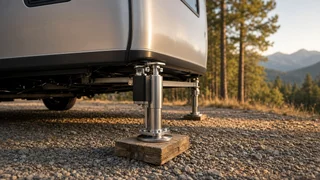
Hydraulic jacks on a motorhome are typically sold as complete leveling systems. A typical system has an electric pump, a fluid reservoir, valves, hoses, the jack cylinders, sensors and a control panel. Many systems can level automatically by reading a level sensor and extending jacks until the coach is within tolerance. Others rely on manual control, where the driver extends each jack while watching an indicator.
When hydraulic jacks make sense
Heavy coaches: hydraulic cylinders can generate high force from a compact jack, which suits the weight of Class A and larger Class C motorhomes. Frequent moves: automatic leveling saves time if you set up at a new site often. Uneven sites: hydraulic systems usually offer more stroke and lifting force than light-duty electric stabilizers, which helps on sloped pads. Factory-equipped chassis: many diesel and gas Class A platforms were designed around a hydraulic system, so a like-for-like replacement is often simpler than switching types. Less suitable: light travel trailers, van-based campers and vehicles without reinforced frame mounting areas, where added weight, cost and installation work may outweigh the benefit.
Hydraulic and electric leveling compared
Factor | Hydraulic system | Electric system; Typical use | Heavier motorhomes and large fifth wheels | Lighter trailers, smaller motorhomes, some fifth wheels; Lifting force | Generally high for the jack size | Varies widely; light-duty units may only stabilize; Speed | Usually quick once the pump is running | Varies by motor and screw design; Maintenance | Fluid level, hoses, fittings, seals | Motors, gears, screws, wiring; Common failure modes | Leaks, worn seals, pump or valve faults | Motor or gearbox wear, wiring faults; Added weight | Pump, reservoir, fluid and heavier cylinders | Often lighter overall; Repair approach | Often needs hydraulic-capable service | Often component-level replacement
Neither type is better in every situation. The right fit depends on vehicle weight, how the chassis was built, and what service is available along your usual routes.
What to check before choosing a system
Load rating against vehicle weight
Each jack, and the system as a whole, carries a load rating. Compare it with your vehicle's gross vehicle weight rating (GVWR), which is the maximum loaded weight set by the vehicle maker, not with the empty weight. Also consider how the weight is split between the front and rear axles. On many motorhomes the rear carries considerably more, and the jacks at that end must handle it. If a seller cannot tell you the rating for the exact jack model, treat that as a reason to keep looking.
Chassis compatibility and stabilizer mounting
Jacks must attach to structural frame rails or reinforced brackets that the chassis maker allows for this purpose. Each jack location becomes a support point that carries a large concentrated load, so drilling or welding in the wrong place can weaken the frame. Compatibility can differ by chassis manufacturer, model year, wheelbase and powertrain, including gas versus diesel and exhaust routing. Confirm that a kit or replacement jack is listed for your specific chassis, not just for a coach class, and note any differences that remain unresolved.
Number and layout of jacks
Systems commonly use three, four or six jacks. More jacks spread the load across more support points and can reduce movement inside the coach, but they add cost, weight and parts to maintain. Check ground clearance at each jack location when retracted. Also check that the jacks will not interfere with steps, slide-outs, exhaust or storage doors.
Controls and safety interlocks
Automatic versus manual leveling, and whether you can override the automatic mode. A warning or interlock that alerts you if jacks are down when the ignition is on or the parking brake is released. Automatic retract functions, and how the system behaves if power is lost. Air suspension handling: on air-ride chassis, the system should work with the suspension, often by releasing air before leveling, as the system maker specifies. A readable control panel and clear fault codes, which make troubleshooting easier.
Pump, reservoir and fluid
Find out where the pump and reservoir are mounted, how easy they are to reach for fluid checks, and which fluid the system requires. Using the wrong fluid can damage seals. Ask whether the system has a manual retract method, such as a release valve or hand pump. A manual retract lets you stow the jacks and move the vehicle if the pump or electronics fail at a campsite.
HWH and Kwikee systems on Class A motorhomes
Readers researching HWH hydraulic leveling jacks for Class A motorhomes, or Kwikee hydraulic jacks, are usually replacing or repairing a system already installed on a used coach. Both names have long appeared on motorhome leveling equipment. For a replacement, the practical steps are the same whichever brand is fitted:
Record the model and part numbers from the existing jacks, pump and control box before ordering anything. Check whether replacement cylinders, seals and controllers are still offered for that generation of the system, since older systems may have parts that are discontinued or superseded. Match the stroke length, mounting pattern and hose fittings, not just the jack's appearance. Ask whether a mixed setup, such as new jacks with an old controller, is supported or whether components must be replaced together. Confirm which local or mobile service shops work on that brand, because hydraulic repairs often need specific knowledge and tools.
If you are shopping for a used Class A, ask for any service history on the leveling system. Inspect for fluid residue around jacks and hoses, and run the system through a full extend and retract cycle before you agree to buy.
Using hydraulic jacks safely at the campsite
Even a well-chosen system depends on ground stability. Soft soil, hot asphalt and gravel can let a jack sink or slip. Wide jack pads or boards spread the load and reduce this risk. Park as close to level as possible before deploying, so the jacks do not have to make large corrections.
Many system makers advise against lifting the wheels off the ground. Doing so moves the vehicle's weight from the suspension and tires onto the jacks and frame mounts, and it can make the vehicle less stable. Leveling jacks are not designed as service jacks, so never work underneath a vehicle supported only by them. Always follow the manufacturer's instructions for deployment sequence, maximum lift and retraction before driving.
Ownership costs and maintenance
Check the fluid level and condition at the intervals the system maker recommends. Inspect hoses, fittings and cylinder rods for leaks, cracks and corrosion, especially after winter road travel. Keep the jack rods clean, since dirt on the rod can wear the seals. Exercise the system periodically if the vehicle sits in storage for long periods. Budget for seal kits, sensors or a pump over the life of the vehicle, and get repair quotes before assuming a fix will be minor.
Next step
Start with your vehicle's chassis maker, model year and GVWR, then confirm whether a hydraulic leveling system, or a replacement for the one you have, is listed for that exact chassis. With those details, you can compare load ratings, jack layout, controls and service access, and decide whether a direct replacement, a full new system or a simpler electric setup best fits how you travel.