A-Frame Trailer Jacks for Campsite Setup: What to Check Before You Buy
The Short Answer
An A-frame jack is the tongue jack that mounts on the triangular front frame of a travel trailer or pop-up camper. At the campsite it supports the tongue after you unhitch and adjusts the trailer's nose up or down for front-to-back leveling. When buying one, the deciding checks are its rated capacity compared with your loaded tongue weight, enough lift range for both your tow vehicle's hitch height and uneven ground, a mounting style that fits your existing A-frame, and whether you want manual cranking or a 12-volt electric motor.
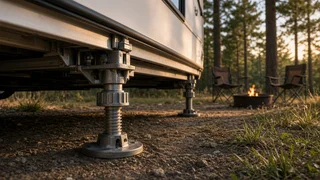
Two conditions change the answer. If your trailer has a straight tongue rather than an A-frame, you need a different style of jack, usually a swivel or side-mount type. And if your goal is to stop the trailer from rocking, the A-frame jack is not the right tool; that job belongs to stabilizer jacks at the corners.
What an A-Frame Jack Does and Does Not Do
The jack carries the tongue load when the trailer is off the hitch, lifts the coupler clear of the hitch ball, and lowers it back onto the ball when you hook up. It is also often used to raise the tongue when attaching the spring bars of a weight-distribution hitch.
It only changes pitch, meaning front-to-back level. Side-to-side leveling is done separately with leveling blocks or ramps under the wheels before you unhitch. Stabilizer jacks lower to the ground to reduce movement once the trailer is level, but they are not designed to lift the trailer's weight. Keeping these three jobs separate prevents the most common setup mistakes.
Manual or Electric
Manual A-frame jacks come in top-wind and side-wind versions. A top-wind jack has the crank on top of the post. A side-wind jack has a geared crank on the side, which usually takes less effort per turn but more turns overall. Electric jacks use a 12-volt motor powered by the trailer's battery and raise or lower the tongue with a switch.
Factor | Manual (top-wind or side-wind) | Electric (12-volt); Effort | Requires cranking, which can be tiring on heavier tongues | Push-button operation; Power needed | None | Trailer battery with proper wiring and circuit protection; Complexity | Few parts to fail | Motor, switch and wiring can fail; a manual override crank is important; Weather exposure | Mainly corrosion of the post and gears | Motor housing and switch also need protection from water; Extras | Rarely included | Often includes a work light near the coupler; Installation | Bolt on and go | Bolt on plus running power leads to the battery
Electric jacks make the most sense for heavier tongues, frequent moves between sites, or owners who find cranking difficult. Manual jacks suit lighter trailers, owners who want simplicity, and setups where battery power is limited. If you choose electric, confirm it has a manual override so you can still raise or lower the tongue with a dead battery.
Capacity Versus Tongue Weight
Jacks are rated in pounds, and the rating should comfortably exceed your trailer's loaded tongue weight, not just its empty figure. Tongue weight is the downward force the coupler places on the hitch, and a commonly cited guideline puts it at roughly 10 to 15 percent of total trailer weight. Propane tanks, a battery box, and cargo stored in the front of the trailer all add to it.
Some electric jacks list separate lift and static capacities. The lift rating is what matters when you raise the tongue; the static rating applies when the jack is simply holding the load. If the specifications are unclear, compare against the lower number.
Lift Range and Drop Legs
Lift range, sometimes called travel, is how far the jack extends from fully retracted to fully extended. You need enough to lift the coupler above your hitch ball, which matters more with lifted trucks or tall hitch setups, and enough to level the nose on sloped sites.
Many A-frame jacks have a drop leg: an inner tube that slides down and pins at set positions before you begin cranking. It adds reach without using up the jack's screw travel and saves time on very uneven ground. Also check retracted height so the foot clears the ground while towing, especially over driveway dips and steep campground entrances.
Mounting and Fit
Most replacement A-frame jacks bolt through a mounting plate on the trailer tongue. Many use a three-bolt flange, but hole spacing, bolt size and the diameter of the tube that passes through the tongue plate can differ. Before ordering, compare the existing jack's flange and tube against the new jack's listed dimensions. Some older or lighter trailers use a weld-on mount, which makes replacement a bigger job.
Also check physical clearance. A-frame tongues often carry propane tanks, battery boxes or storage boxes, and the new jack's motor housing or crank needs room to work and to be removed later. On electric models, confirm the wiring can reach the battery and that the circuit is protected by a fuse or breaker sized for the jack.
Useful Extras
Integrated light: helps when hitching after dark and when locating the coupler over the ball. Footplate or jack pad: spreads the load on soft ground, gravel or grass and reduces sinking. Weather cover: protects an electric motor and switch from rain and road spray. Clear switch layout: separate up and down controls that are hard to press by accident. Retracted and extended height markings or published figures: make it easier to confirm fit before buying.
Using the Jack at the Campsite
Level side to side first with blocks or ramps while the trailer is still hitched. Chock the wheels on both sides before unhitching. Place a pad or block under the jack foot on soft or uneven ground. Raise the coupler off the ball, then pull the tow vehicle away. Adjust the jack to level the trailer front to back using a level on the trailer body or floor. Lower stabilizer jacks only after leveling is complete, and only until they contact the ground firmly. Never work under the trailer while it is supported only by the tongue jack.
Pre-Purchase Checklist
Confirm your trailer has an A-frame tongue rather than a straight tongue. Estimate loaded tongue weight, including propane, batteries and front storage. Choose a jack whose lift capacity clearly exceeds that figure. Compare required lift height against your hitch height and typical campsite slopes. Match the mounting flange, bolt pattern and tube diameter to your existing mount. Check clearance around propane tanks, battery boxes and storage on the tongue. For electric models, verify battery access, wiring path, circuit protection and a manual override. Decide whether a drop leg, light or footplate matters for the sites you use.