Electric A-Frame Trailer Jacks: What to Check Before You Buy
The Short Answer
An electric A-frame jack is a powered tongue jack that bolts to the triangular hitch frame at the front of a travel trailer or caravan. It raises and lowers the trailer tongue at the push of a button, which makes hitching, unhitching and front-to-back leveling at camp much easier than cranking by hand. A suitable choice comes down to five checks: a load rating comfortably above your actual tongue weight, enough lift and retracted clearance for your trailer and tow vehicle, a mounting pattern that fits your A-frame, a reliable 12-volt power connection, and a manual backup in case the motor or battery fails.
One condition changes the answer: an electric A-frame jack is designed only for A-frame trailer tongues. Trailers with a straight, single-bar tongue need a different jack style, usually a side-mount or swivel tongue jack, and fifth-wheel trailers use their own landing gear system.
What an Electric A-Frame Jack Does and Does Not Do
The jack supports the front of the trailer when it is uncoupled. At a campsite it lets you raise or lower the nose to level the trailer from front to back, while side-to-side leveling is handled with blocks or ramps under the wheels.
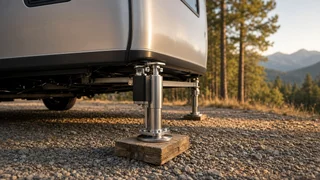
It is not a stabilizer. Stabilizer jacks at the corners of the trailer reduce bounce and sway when people move around inside. A tongue jack carries load at a single point near the front, so even a strong electric unit should be used together with corner stabilizers rather than in place of them. Corner stabilizers themselves are meant to steady the trailer, not to lift it.
Load Capacity: Match the Rating to Your Real Tongue Weight
Tongue weight is the downward force the trailer coupler places on the hitch ball. A common rule of thumb puts it at roughly 10 to 15 percent of the loaded trailer weight, but the figure varies with how the trailer is packed, where the water and propane are stored, and what is carried in front storage compartments.
Choose a jack with a lift rating that sits clearly above your loaded tongue weight, not just above the dry figure on the trailer sticker. A jack working near its limit runs slower, draws more current and wears faster. If you can, measure loaded tongue weight with a tongue scale or at a public scale rather than relying on an estimate.
Some manufacturers list a separate static (support) rating and a lift rating. The lift rating is the one that matters for choosing, because the jack has to raise the trailer, not just hold it.
Lift Range and Retracted Height
Two dimensions decide whether a jack will work with your setup:
Travel or lift range: how far the inner tube extends. It must lift the coupler clear of the hitch ball and also allow enough nose-down and nose-up adjustment to level on uneven sites. Retracted height: how short the jack is when fully raised. Too long, and the foot may drag or strike the ground on driveway entrances and steep ramps, or interfere with a low tow vehicle bumper.
Many jacks include a drop leg, a removable extension pinned below the main tube, which adds reach without the motor having to travel the full distance. This is useful when the tow vehicle is tall, such as a lifted truck, or when campsites slope noticeably. Measure your current hitch height, coupler height and ground clearance before comparing models.
Mounting and Fit
Most A-frame jacks mount through a hole in the top plate of the A-frame and bolt down with a pattern that is widely used across travel trailers in the US, often three bolts. That convention makes many replacements close to bolt-on, but you should still confirm the bolt pattern and the mounting hole diameter on your trailer against the jack before buying.
Check that the motor housing will not hit the propane bottles, battery box, cargo tray or a weight-distribution hitch when installed. Confirm the jack can rotate or be positioned so the controls are reachable. If your trailer uses a weight-distribution hitch, make sure spring bars and brackets clear the jack body. On older trailers, inspect the A-frame plate for rust or cracking before adding a heavier powered unit.
Power Supply and Wiring
Electric A-frame jacks run on 12-volt DC power, usually from the trailer house battery mounted on the tongue. The jack draws significant current while lifting, so the wiring should be sized for that load, kept as short as practical, and protected with a fuse or circuit breaker close to the battery. Many kits include the wiring and protection; if yours does not, follow the jack maker's recommended wire size and fuse rating.
A weak or deeply discharged battery is the most common reason an electric jack slows or stops. If you camp off-grid, keep the house battery charged, because you will need it to raise the tongue before hitching.
Manual Override
A manual override lets you raise or lower the jack with a hand crank or socket if power is lost. Treat it as essential. Check that the override is included, find out where it engages, and store the crank somewhere you will remember. Without it, a dead battery or failed motor can leave the trailer stuck on its jack or stuck down on the hitch.
Weather Protection and Build Quality
The jack lives at the front of the trailer, directly in the path of road spray, rain, salt and grit. Look for a sealed or well-shielded motor housing, a protected switch, and corrosion-resistant finishes on the tube and hardware. A weatherproof cover helps extend life, especially in regions that use road salt.
Internal gearing and the screw mechanism determine how smoothly the jack runs under load over time. Since detailed internal specifications are not always published, warranty length and the availability of replacement parts such as motors and switches are useful indicators of how the manufacturer expects the product to hold up.
Convenience Features
These features do not affect lifting ability but can matter in daily use:
Built-in LED light for hitching after dark. Foot pad or swivel foot to spread load on soft ground. Auto-stop or limit switches that cut power at full extension or retraction. Remote or wireless control on some models. A level indicator or bubble level mounted near the jack.
Quick Comparison Checklist
Check | What to confirm | Why it matters; Lift rating | Clearly above your loaded tongue weight | Prevents strain, slow operation and early failure; Lift range | Enough travel to clear the hitch ball and level on slopes | Avoids extra blocking or failed hitching; Retracted height | Foot clears the ground and tow vehicle when raised | Prevents dragging and impact damage; Mounting | Bolt pattern and hole size match your A-frame | Ensures a secure, straightforward install; Clearance | No conflict with propane, battery box or hitch hardware | Avoids relocation work; Power | 12V supply, correct wire size, fuse or breaker | Reliable operation and electrical safety; Manual override | Included and accessible | Backup when power fails; Weather resistance | Sealed motor and switch, corrosion-resistant finish | Longer service life; Support | Warranty and replacement parts available | Easier repair instead of replacement
Using the Jack Safely at Camp
Chock the trailer wheels before uncoupling. Place a solid pad or block under the jack foot on soft or uneven ground. Level side to side first with wheel blocks, then use the jack for front-to-back leveling. Deploy corner stabilizers after leveling, not before. Never work under the trailer while it is supported only by the tongue jack.
Choosing Your Next Step
Start by confirming that your trailer has an A-frame tongue, then gather three numbers: loaded tongue weight, the jack travel you need from hitched to fully leveled, and the bolt pattern on your A-frame plate. With those in hand, narrow the field to jacks that exceed your weight with margin, fit your frame without clearance conflicts, and include a manual override. From there, weather protection, warranty and convenience features are the deciding factors.