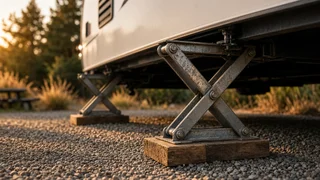
Eaz-Lift Stabilizer Jacks: What to Check Before You Buy

The Short Answer
Eaz-Lift stabilizer jacks reduce the rocking and bouncing of a parked caravan or travel trailer. They do not level or lift it. If you choose them, buy a set that fits your trailer's frame and the gap between the frame and the ground. Use them only after the trailer is level. Whether a particular Eaz-Lift jack suits you depends on three things: how it mounts to your frame, its height range, and its rated load compared with how you plan to use it.
This guide does not include confirmed specifications, prices, model numbers or availability for Eaz-Lift stabilizer jacks. Check those details on the product packaging, in the manufacturer's documentation or with the retailer before you buy.
Stabilizing Is Not Leveling
Campsite setup usually happens in two steps. Leveling comes first: you correct side-to-side tilt with ramps or blocks under the tires, then front-to-back tilt with the tongue jack. Stabilizing comes second: you lower jacks at the corners until they firmly contact the ground. This takes up the movement that springs and tires allow when people walk around inside.
Stabilizer jacks are built for that second step. Using them to raise a corner, correct a lean or lift a wheel off the ground for a tire change can put loads on the jack and the frame that they were not designed for. If your site needs leveling, plan to buy levelers or blocks separately.
What to Check Before Buying
Mounting method: Find out whether the jack bolts on, clamps on or must be welded to the frame. Then confirm that your frame rail's shape and size will accept it. Height range: Measure from the underside of your frame to level ground at each corner where a jack will go. The jack's retracted height must clear that gap when you are driving. Its extended height must reach the ground on uneven sites. Rated load: Look for the load rating on each jack and read what it covers. A stabilizing rating is not the same as a lifting rating. Operation: Most scissor-style stabilizer jacks are cranked by hand or with a drill attachment. Check which drive fitting is used and whether a crank handle is included. Quantity: Check whether the product is sold singly, in pairs or as a set of four. A typical setup uses one jack near each corner. Foot design: A wider foot spreads the load better on soft ground. Check whether pads or a broader base are included or need to be bought separately. Corrosion protection: Look at the finish on the jack and its hardware. Jacks mounted under the trailer are exposed to road spray and, in some regions, winter road salt.
Measuring Your Trailer
Park on level ground with the trailer at its normal loaded ride height. Measure from the bottom of the frame rail to the ground at each planned jack location. Clearance often differs between front and rear because of axle position, overhang and tongue height. Record each corner separately and compare all of them with the jack's stated height range. Also leave room for driveways, ramps and dips, where the rear overhang can come close to the ground.
Compatibility Gaps to Resolve
No evidence was available to confirm which trailer frames, model years or manufacturers Eaz-Lift stabilizer jacks are designed for. Before buying, check these points against your own trailer: frame rail profile and width, existing mounting points, any factory-installed stabilizers, and whether the trailer maker gives guidance on adding or welding accessories to the frame. Welding to a trailer frame may affect a manufacturer's warranty, so check your warranty terms first.
Using Them Correctly at the Campsite
Chock the wheels and level the trailer before you lower any stabilizer. Lower each jack until it is snug against the ground or a pad. Do not crank further to lift the trailer. Work around the trailer evenly instead of fully tightening one corner first. Use a pad or board under each foot on soft, sandy or wet ground. Retract every jack fully before hitching up or moving the trailer.
Choosing Your Next Step
If your trailer has no stabilizers, or its current ones are damaged, measure the frame-to-ground clearance and the frame rail profile first. Then compare those numbers with the mounting method, height range and load rating listed for the Eaz-Lift jack you are considering. If the listing does not give these details, ask the seller or manufacturer to confirm them before you buy. If the trailer itself is not level on arrival, buy levelers as well; stabilizer jacks will not fix the tilt.