How to Test for Parasitic Drain on a Car Battery

A battery that keeps going dead after the vehicle sits points to an unwanted current draw that remains active with the key off. A car battery parasitic drain test measures that residual load and helps separate a failing battery from a circuit that is staying awake. The check involves monitoring current at the battery terminals after the vehicle has gone to sleep, then narrowing the draw to a suspect circuit. This gives a repeatable way to confirm the problem before replacing parts that are not defective.
Direct answer
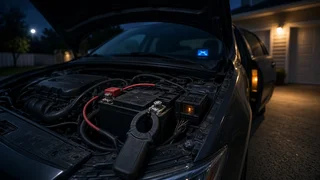
A parasitic drain is a small but steady flow of current after the ignition is off and the modules have timed out. To test for it, connect an ammeter in series with one battery terminal and measure the residual draw, then remove fuses one at a time to see which circuit lowers the reading. The meter reading shows only that current is leaving the battery; it does not identify the failed component by itself, so isolation work is still needed.
Some draw is expected because security, memory and network modules retain power. The point of the test is to compare the measured residual current with the vehicle's normal sleep load. If the reading stays high after the waiting period, the drain is excessive. Before that, a weak battery or charging output problem can mimic a drain, so system voltage and charging output should be checked early to avoid chasing a phantom load.
How to proceed
Begin with the vehicle off, the key removed, doors closed and any underhood light disabled. Secure the meter leads so they cannot separate while testing. Allow the vehicle to enter sleep mode before taking the base reading; opening a door or waking a module restarts the timer. A voltage drop check across fuses can also locate a loaded circuit without opening every connection, with the drop reading interpreted against fuse rating and wiring diagram context for that circuit.
Once the baseline draw is recorded, remove and reseat one fuse at a time while watching the meter. A noticeable drop in current identifies the active circuit, but the protected devices on that fuse still need inspection. Any circuit that controls airbags, restraint systems or high-voltage components should be left to qualified service. After the repair, repeat the shutdown procedure and confirm the draw returns to the expected sleep level before reconnecting the battery terminals normally.