How to Plan Charging When Several EVs Share One Trip
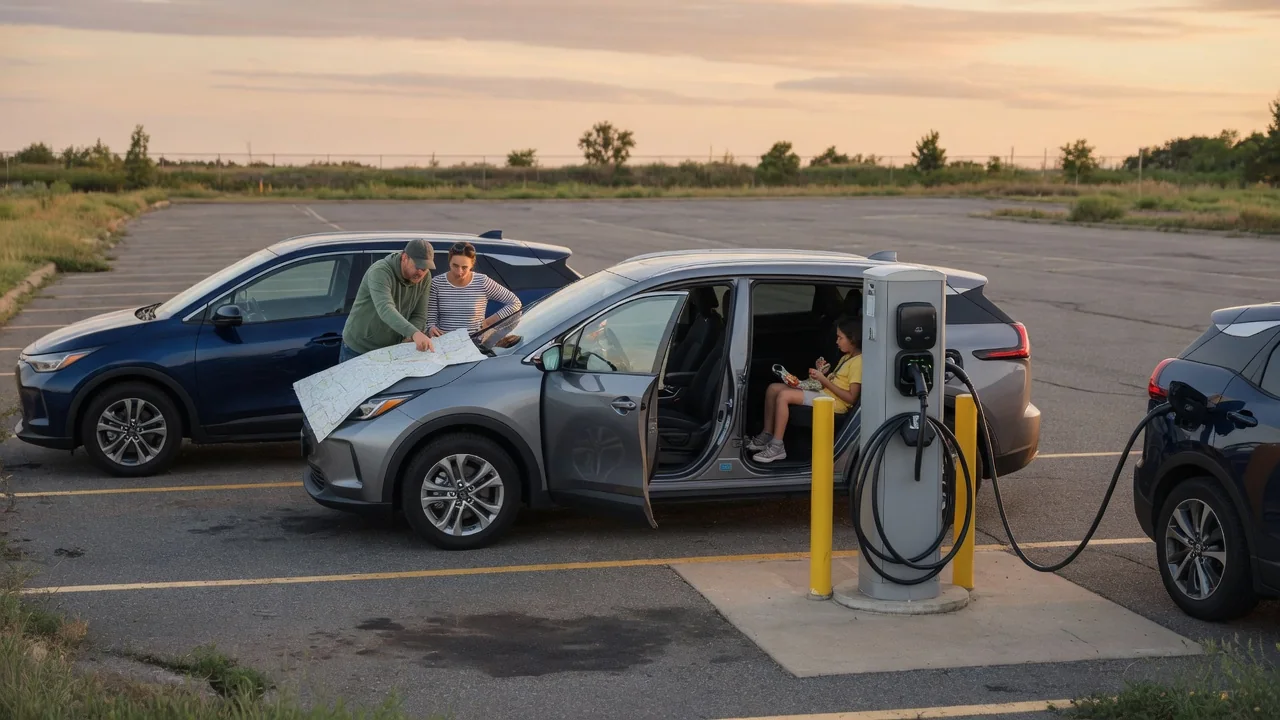
Planning charging for one electric vehicle is mostly about range and where the stations are. When several EVs share one trip, the problem changes. The group can only move as fast as its most limited car, and every stop has to work for every vehicle at once. This guide explains how to account for different ranges, check connector compatibility, and coordinate stops so a multiple EV road trip stays together without long, avoidable waits.
Different ranges: plan around the most limited car
Start by finding the vehicle with the shortest realistic range. Do not use the highest number on any window sticker. Rated range comes from standardized test conditions, while real highway range depends on speed, temperature, elevation, wind, cargo, roof boxes, and whether the car is towing. Each driver should estimate the range their own car actually delivers at the planned cruising speed, ideally from the vehicle's consumption history or trip computer. The smallest of those figures sets the maximum distance between stops for the whole group.
Add a buffer on top of that number. Plan legs so each car arrives at the next charger with a comfortable reserve rather than near empty, because a closed station, an occupied stall, or a detour can stretch a leg unexpectedly. The reserve matters most for the shortest-range car, since it has the least room to absorb surprises. If one vehicle consistently needs to stop sooner, it is usually better to schedule stops around it than to ask that driver to slow down significantly or arrive with almost no charge.
Different ranges also interact with charging speed. DC fast charging is typically quickest at lower states of charge and slows as the battery fills, often noticeably in the upper part of the range. The exact curve varies by vehicle, battery temperature, and charger output. In a group, this means the cars will rarely finish at the same time. Shorter, more frequent stops that keep each battery in its faster charging window can reduce total time compared with fewer long stops, where some cars charge slowly toward full while the others wait.
Connector needs for every vehicle
Before the trip, list the charging port and supported standards for every vehicle in the group. In North America, DC fast charging currently involves the Combined Charging System (CCS1), the North American Charging Standard standardized as SAE J3400, and CHAdeMO on some vehicles. Level 2 charging commonly uses J1772 or J3400 connectors. A station that is ideal for one car may be unusable or only partly usable for another. Check the connector type at each planned stop for each car instead of assuming compatibility from the network name.
Adapters can widen the options, but they come with their own conditions. Some vehicles can use another connector type through an approved adapter, and some networks allow access only for vehicles that have been enabled on that network. Whether a given adapter is supported, what power it allows, and whether the vehicle's software accepts that connection are vehicle-specific details found in the owner's manual or the automaker's guidance. Each driver should confirm their own setup and bring any adapter they plan to rely on, rather than counting on borrowing one from another car in the group.
Payment and access are part of connector planning too. Networks may require their own apps, accounts, or registered payment methods, and automatic plug-and-charge authentication may work only for vehicles enrolled with that network. Setting up accounts and testing logins at home avoids delays at the first stop. Also note how many stalls each station has for each connector type, because a site might offer many stalls of one kind and only one or two of another.
Stop coordination at the charger
Once range limits and compatibility are known, choose stops that can serve the whole group at once. Prefer locations with enough compatible stalls for every car, ideally with spare capacity for other drivers who arrive at the same time. A site with only a few stalls may force cars to charge one after another, which multiplies the time spent at each stop. For every planned stop, identify a backup station within the shortest-range car's reach, so the group has a fallback if the primary site is crowded or out of service.
Some charging sites split power between paired stalls. If two cars from the group plug into stalls that share a power module, both may charge more slowly than they would on separate units. Signage, network apps, or stall labels sometimes indicate pairing, but not always. When several stalls are open, spread the group's cars across different units, and have each driver watch the charging rate on their own screen to see whether sharing is reducing output.
Agree on simple rules before departure. Decide who sets the stop list, how the group communicates while driving, and what happens if one car needs to stop early. A practical convention is that the group leaves when the slowest-charging car has enough energy for the next leg plus its buffer, rather than when every car is full. Faster-charging cars can unplug earlier to free stalls for others. Scheduling meals and rest breaks at charging stops turns unavoidable charging time into planned downtime.
Practical implications and limits
In real use, the plan is only as reliable as the information behind it. Charger availability, operating status, and actual output can change between planning and arrival, and route-planning apps differ in how they model each vehicle's consumption and charging behavior. Treat app estimates as a starting point. Recheck station status at the start of each driving day and again before leaving each stop. On vehicles that support it, setting a fast charger as the navigation destination may precondition the battery for charging, but how and when this happens depends on the specific car.
Planning cannot remove every constraint of group charging. Busy travel periods can create queues at popular sites, cold weather can reduce both range and charging speed, and a problem with a single vehicle affects everyone's schedule. Larger groups run into these effects more often simply because there are more cars to accommodate. Splitting a very large group into smaller convoys with separate charging stops, or accepting a longer total travel time, can be more realistic than forcing every car through the same station at once. The goal is a schedule with slack built in, not one that only works when every stop goes perfectly.