How to Plan an EV Charge Stop With Passengers
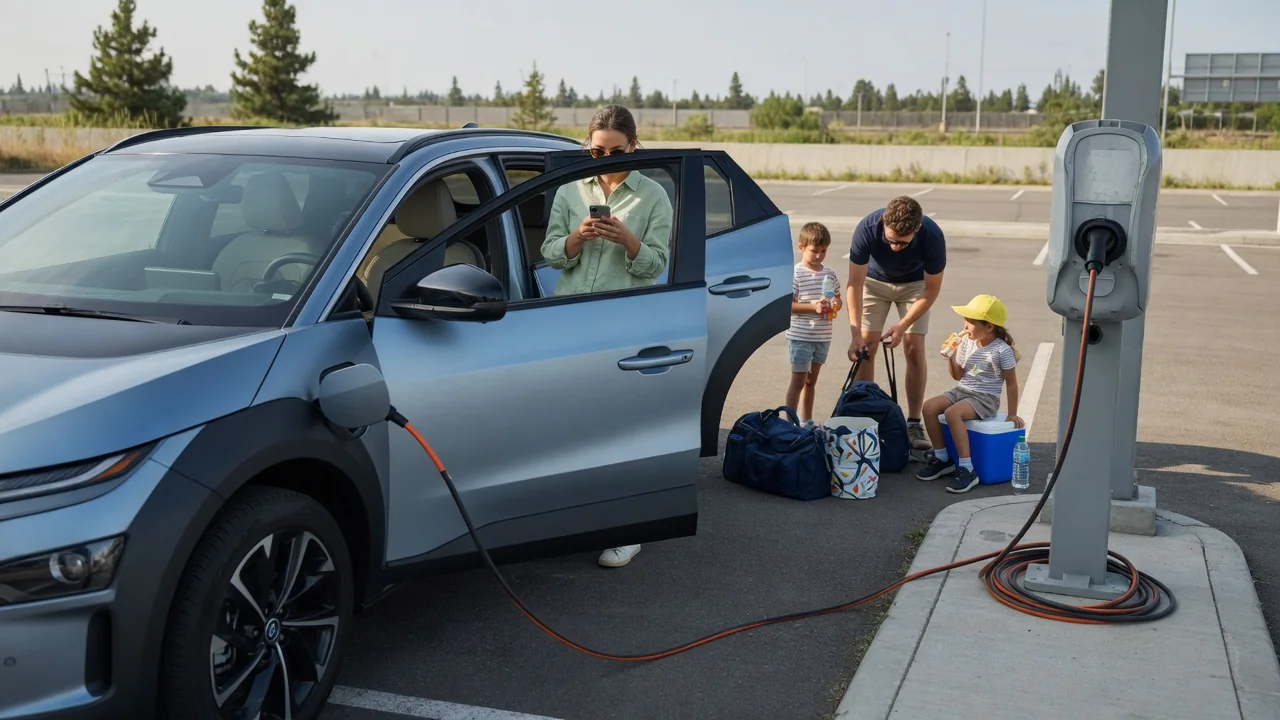
Knowing how to plan an EV charge stop with passengers is less about finding a plug and more about matching the car's charging window to what the people inside need. A stop that suits the battery but leaves everyone standing in an empty parking lot feels long, while one timed around a meal or restroom break barely registers as a delay on the trip.
Expected charging time
How long a session takes depends on the battery's state of charge on arrival, the power the station can deliver, the rate the car can accept, and battery temperature. Most electric vehicles charge fastest when the battery is fairly low and slow down progressively as it fills, a pattern known as the charging curve. For that reason, adding only enough energy to reach the next stop comfortably is often quicker overall than waiting for a full battery, especially on a fast charger.
The instrument display or companion app usually shows an estimated time to the chosen charge limit, along with a power figure that drops as the session goes on. Use that estimate to pick the activity: a short top-up fits a restroom visit and a stretch, while a longer session pairs well with a sit-down meal. Some vehicles warm or cool the battery in advance when a charger is set as the navigation destination, and cold weather can lengthen sessions noticeably, so the owner's manual is worth checking.
Access and comfort
Access starts with confirming that the station's connector suits the car, or that the right adapter is on board, and that a payment method or network account is ready before arrival. Stall layout matters more with a full cabin. Charge port position and cable length determine how the car must be parked, and tight bays can make it awkward to open rear doors for child seats or unload a wheelchair. Drivers towing a trailer or carrying a bike rack should look for pull-through stalls.
Comfort depends on what surrounds the chargers. Restrooms, food, shade or shelter, good lighting and seating turn waiting time into a real break, but only if those businesses are open when the car arrives, which matters for late-night or early-morning stops. Many EVs can keep the climate control running while plugged in, which helps when a child is asleep or the weather is harsh. That draws a little energy during the session, and how the feature operates differs from one vehicle to another.
Backup stop
A charger can be occupied, out of service or delivering less power than expected, so every planned stop deserves an alternative chosen before the car commits to it. The practical rule is to arrive with enough remaining range to reach that second site without stress. A loaded cabin, luggage, heavy heating or air conditioning use, highway speeds and headwinds all raise energy consumption, so the buffer that works for a solo commute may be too thin for a family trip.
Sites with several stalls generally offer better odds than a single unit, since one faulted or busy charger does not end the plan. Network apps and in-car maps often show live availability, though that status can lag behind reality, and holiday travel can bring queues. It helps to check the backup location's amenities as well, and to tell passengers about the alternative early. Some navigation systems reroute to another station automatically, while others leave that decision entirely to the driver.
Everyday Use and Observations
After a few trips, patterns become visible. The trip computer's consumption figure with a full cabin, loaded cargo area or roof box will usually sit above the figure seen when driving alone, and the range estimate adjusts accordingly. Comparing the battery percentage the navigation predicted on arrival with what the car actually shows is a simple way to learn how much margin a particular vehicle needs. Those observations make later charging plans more accurate than any generic estimate.
Passenger rhythm matters just as much as battery behavior. Children and older travelers often need a break at regular intervals anyway, so lining up those pauses with charging means the car is rarely the reason for stopping. Dividing tasks helps: one adult starts the session while another walks the group to the restrooms or orders food. An app notification when the charge target is reached lets the driver return promptly, freeing the stall for others and avoiding idle fees where an operator applies them.
Limits and Next Steps
Every figure used in planning is an estimate. Route planners cannot foresee a queue, a sudden change in weather or a stall that stops working mid-session, and a station's advertised power is not necessarily what a given car will draw. At some sites, output may be shared between vehicles charging side by side, and a cold or very full battery will accept energy slowly regardless of the equipment. Building in spare time keeps those variables from unsettling passengers or the schedule.
Useful preparation includes reading the manual's sections on charge limits and battery preconditioning, setting up payment accounts at home, and trying a nearby fast charger before the first long journey with a full car. That trial shows where the port sits, how the cable reaches and what the display reports. If charging is repeatedly much slower than expected under similar conditions, or a charging warning appears, a qualified technician should evaluate the vehicle rather than anyone assuming a specific component has failed.