How to Keep Basic Car Tools Organized at Home
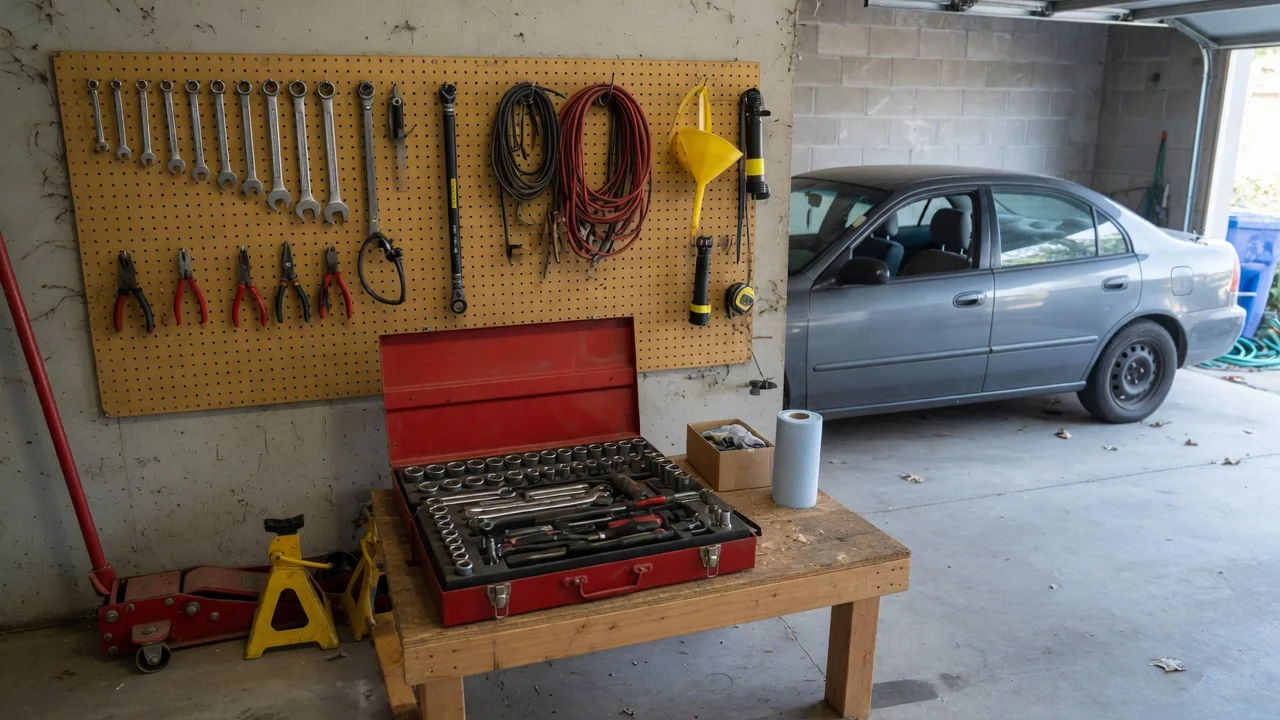
Learning how to keep basic car tools organized at home starts with a simple idea: store tools by the job they perform, not by their shape. When the wrench, drain pan, and funnel for an oil change live together, routine maintenance takes less searching and fewer missing pieces. The approach below works in a garage, a shed, or a single closet shelf.
Inventory
Begin by pulling every tool into one place, including the stray items in kitchen drawers, the trunk, and old boxes. Lay them on a tarp or workbench and sort them by the maintenance task they support. An oil change group might hold a drain pan, funnel, filter wrench, and the socket that fits the drain plug. A tire group could contain a pressure gauge, tread depth gauge, lug wrench, and torque wrench. Seeing everything together reveals duplicates and exposes gaps you never noticed.
Write the inventory down, even on a single index card taped inside a toolbox lid. Note which sizes your own vehicle actually uses, because fastener sizes, filter styles, and jacking points differ between makes and model years. Many vehicles rely on metric fasteners, while some older domestic models use fractional sizes, so check the owner's manual and the hardware itself before deciding what earns a place. Tools that fit nothing you own can move to a labeled overflow bin instead of crowding the main kit.
Clean storage
Tools stored dirty tend to stay dirty and spread grime to everything they touch. Wipe wrenches, sockets, and pliers with a rag after each job so oil and brake dust do not migrate into the next task. Fluid-handling items deserve their own container; a drain pan and funnel used for engine oil should sit apart from anything used for coolant or brake fluid, since cross-contamination between fluids can harm the systems they serve. Label funnels by fluid so the separation survives a hurried weekend.
Choose a storage spot that stays dry, because garages and sheds often swing between damp and hot, and bare steel rusts quickly in humid air. A closed toolbox, lidded plastic totes, or a wall cabinet keeps dust and moisture off better than open shelving. Dedicate one container or drawer to each task group and label it plainly, such as tires, fluids, battery and electrical, or lighting and wipers. Foam liners or socket rails make a missing piece obvious the moment you open the drawer.
Check before use
A quick inspection before each job protects both you and the car. Look over sockets and wrenches for cracks or rounded jaws, since a worn tool can slip and damage a fastener. Check that the ratchet reverses cleanly and that screwdriver tips are not chipped. For lifting equipment, examine the jack for fluid leaks and the jack stands for bent legs, damaged welds, or a locking mechanism that fails to seat firmly. Anything questionable should be set aside rather than trusted under load.
Measuring tools need attention too, because their value depends on accuracy. A tire pressure gauge that has been dropped may read differently than before, so compare it against another gauge occasionally. Torque wrenches are generally stored at their lowest setting and handled gently, following the maker's instructions. Batteries in flashlights, multimeters, and code readers drain in storage, so test them before you need them. Confirm the correct socket size and lifting points for your particular vehicle in the owner's manual before starting.
Everyday Use and Observations
Task-based kits prove their worth during ordinary jobs. Checking tire pressure on a cold morning means grabbing one small pouch rather than hunting through three drawers. Replacing a wiper blade or a bulb goes faster when trim tools, gloves, and a small screwdriver share a bin. Keep the most frequent kits at waist to eye level near the garage door, and store seldom-used items, such as a breaker bar or specialty pullers, higher or farther back.
Pay attention to what your habits reveal. If the same socket keeps traveling from the oil change kit to the battery kit, it may be worth owning a second one, or the two groups may belong in neighboring drawers. Greasy fingerprints on a clean kit suggest the wipe-down step is being skipped. Returning each tool to its place immediately after a job, before the hood closes, is the habit that keeps the system intact, and an empty slot tells you something stayed in the engine bay.
Limits and Next Steps
An orderly basic kit supports routine upkeep, yet it does not make every repair suitable for a home garage. Work involving airbags, high-voltage hybrid or electric components, fuel systems, or brake hydraulics calls for training, specific equipment, and service information for the exact vehicle. Even a code reader has limits: a stored fault code points toward a system worth investigating and does not prove a particular part has failed, and manufacturer-specific codes need vehicle-specific confirmation before any parts are purchased.
Treat the system as something that evolves with your vehicles and skills. Review the inventory card when you change cars, since a different model may need other socket sizes, a different filter tool, or another jack adapter. Add tools only when a real task demands them, and give each new item a home in the appropriate group on the day it arrives. When a job exceeds your tools or confidence, a qualified technician is the sensible next step, and tidy records of what you have done help that conversation.