How to check your car’s engine size
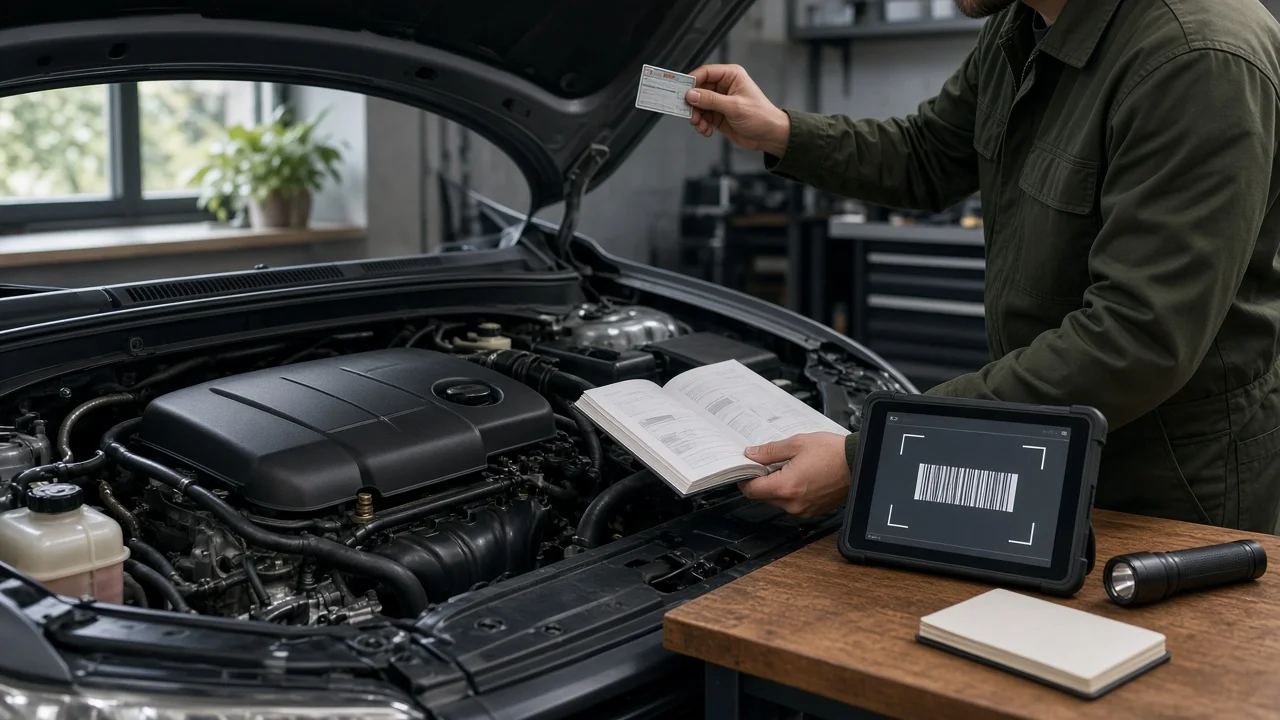
The quickest reliable ways to find your car’s engine size are to look in the specifications section of the owner’s manual, decode the vehicle identification number (VIN), or read the emissions label under the hood. Engine size means displacement: the combined volume swept by all the pistons inside the cylinders. In the US it is usually given in liters (for example, a figure followed by L), sometimes in cubic centimeters (cc), and on older American vehicles often in cubic inches. One condition changes the answer. Your paperwork and VIN describe the engine the car left the factory with, so if the engine has been replaced with a different one, only a physical inspection of the engine itself will tell you what is installed now.
What engine size means
Displacement is calculated from the cylinder bore (diameter), the piston stroke (how far it travels) and the number of cylinders. It describes the engine’s internal capacity, not its power output. Two engines with the same displacement can produce very different horsepower depending on design, turbocharging and tuning.
Displacement = 3.1416 ÷ 4 × bore² × stroke × number of cylinders; 1 liter = 1,000 cc; 1 liter ≈ 61 cubic inches
You do not need to measure anything to use this guide. Measuring bore and stroke requires taking the engine apart, which is a job for a qualified machinist or technician. The formula is here only to explain what the number on your paperwork represents.
What you need before you start
Your vehicle’s year, make and model; The 17-character VIN, used on vehicles from the 1981 model year onward; The owner’s manual, in print or as a digital copy from the manufacturer; A flashlight for reading labels under the hood; About 10 minutes and a cool, parked vehicle if you plan to open the hood
Step 1: Check the owner’s manual
Open the specifications or technical data section, usually near the back of the manual. Many manuals list every engine offered for that model, so the manual alone may not tell you which one your car has. Note every possible engine listed, then use the next steps to narrow it down.
Step 2: Find and decode the VIN
The VIN is usually visible through the lower corner of the windshield on the driver’s side and on a label in the driver’s door jamb. It also appears on the title, registration and insurance card. Copy all 17 characters carefully. The letters I, O and Q are not used in VINs, so a character that looks like an O is a zero.
Enter the VIN into a decoder. The National Highway Traffic Safety Administration (NHTSA) offers a free VIN decoding tool, and many manufacturers and dealers provide lookups too. On many vehicles built for the North American market, the eighth character identifies the engine, but each manufacturer defines its own codes, so rely on the decoded result rather than guessing from a single character. Some decoders return incomplete engine data for certain vehicles. If the engine field is blank or vague, move on to Step 3.
Step 3: Read the emissions label under the hood
Most US-market vehicles have a Vehicle Emission Control Information label under the hood. It is often on the underside of the hood, on the radiator support or on a strut tower. It commonly states the engine displacement and the engine family code.
Park on level ground, set the parking brake and switch the engine off. Let the engine cool. Exhaust parts and the radiator can cause burns shortly after driving. Open the hood and secure it with the prop rod or confirm the hood struts hold it firmly. Keep hands, hair and loose clothing away from the cooling fan. On some vehicles an electric fan can start even with the engine off. Use a flashlight to find and read the label. Do not remove any components to reach it. If the label is missing, painted over or unreadable, stop and use the other methods instead. A replaced hood or radiator support may not carry the original label.
Step 4: Look at the engine cover and badges, with caution
Some engine covers show the displacement, and many cars carry a badge on the trunk or fenders. Treat these as clues, not proof. Badges can be removed, added or swapped, and some model badges use numbers or labels that are marketing names rather than an exact displacement.
Step 5: Check your paperwork or ask a dealer
Registration, title, insurance and original sales documents sometimes list engine details. What appears varies by state and by insurer. If you still have no clear answer, a franchised dealer’s service or parts department can usually look up the factory build specification from the VIN.
How to confirm you have the right answer
Your result is reliable when two independent sources agree. A good pairing is the VIN decode and the under-hood emissions label, both checked against an engine listed for your model year in the owner’s manual. If the sources disagree, especially if the label or the engine itself does not match the VIN, the engine may have been replaced. Have a qualified technician identify it from markings on the engine block before you buy parts or fluids.
Source | What it tells you | Main limitation; Owner’s manual | Engines offered for the model | May list several options; VIN decode | Factory-installed engine | Does not reflect later engine swaps; Under-hood emissions label | Displacement and engine family | Can be missing on replaced parts; Engine cover or badges | Quick visual clue | Easily changed or not literal; Dealer lookup | Factory build specification | Same limits as the VIN
When these methods don’t apply
Fully electric vehicles have no engine displacement. Their equivalent specifications are motor output and battery capacity. Hybrids have a gasoline engine with a displacement plus one or more electric motors, so look for the engine figure specifically. Vehicles originally built for another market may use different VIN conventions and labeling, so a US-focused decoder may not return accurate results for them.
This guide covers general identification methods. It does not give model-specific VIN codes, label locations or engine figures, because those depend on the manufacturer, model year and market. Confirm details for your exact vehicle with the manufacturer’s documentation.