How to look up a car’s make and model by VIN

The short answer
You can identify a car's make and model by entering its Vehicle Identification Number (VIN) into a VIN decoder. A VIN is the unique 17-character code assigned to each road vehicle. On cars sold in the US from the 1981 model year onward, it follows a standard layout: the first three characters identify the manufacturer, and the next several describe the vehicle, typically including model, body style and often engine. A decoder translates those characters into readable details. The National Highway Traffic Safety Administration (NHTSA) provides a free public decoder, and many manufacturers, dealers and commercial services offer their own.
Two conditions change this answer. Vehicles built before the 1981 model year do not follow the 17-character standard, so general decoders often cannot read them and you may need manufacturer-specific references or a marque club. Vehicles built for markets outside North America may also encode information differently, so a US-focused decoder may return incomplete results.
What the 17 characters mean
Knowing the structure helps you sanity-check a decoder's output and spot transcription errors. The letters I, O and Q are never used, which prevents confusion with the digits 1 and 0.
Position Section What it identifies; 1-3 World Manufacturer Identifier Country/region and manufacturer; 4-8 Vehicle Descriptor Section Model, body, restraints, often engine; 9 Check digit Calculated value that validates the VIN; 10 Model year code Model year (code cycle repeats every 30 years); 11 Plant code Assembly plant; 12-17 Production sequence Individual vehicle's serial number
The meaning of positions 4 through 8 is defined by each manufacturer, not by a universal table. That is why you need a decoder with manufacturer data rather than a generic chart to read the model reliably. Because the model year code repeats on a 30-year cycle, a decoder relies on other characters to decide which cycle applies. If the reported year looks implausible, check it against the vehicle's title.
Step-by-step: finding the make and model
What you need
Access to the vehicle, or a document showing its VIN; A flashlight, which helps with stamped or dim labels; A device with internet access to run a decoder; A way to record the VIN accurately, such as a photo or written note
1) Locate the VIN
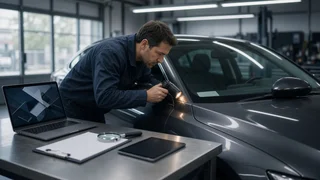
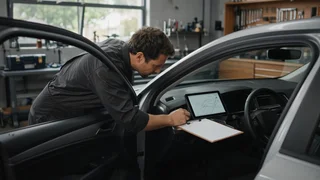
On most modern US-market cars, the VIN appears on a plate at the lower corner of the dashboard on the driver's side, readable from outside through the windshield. It is also commonly printed on a label on the driver's door jamb. The title, registration and insurance documents list the VIN too. Some vehicles carry it in additional locations, such as the engine bay or frame. These locations vary by manufacturer and model, so check the owner's manual if you cannot find it.
Safety note: if you check the engine bay, do so with the engine off and cool. Keep the vehicle out of traffic while you inspect the door jamb or exterior.
2) Record it carefully
Copy all 17 characters exactly, or photograph the plate or label. Common misreadings include 8 versus B, 5 versus S, and 2 versus Z. If you have written down an I, O or Q, you have made an error, because those letters are not used.
3) Enter it into a decoder
Use NHTSA's free decoder or a manufacturer or dealer tool. The output usually includes make, model, model year, body style and manufacturer, and often engine details and plant of assembly. How much detail you get depends on what the manufacturer has reported.
4) Check the result
If the decoder flags an invalid check digit or returns no match, re-read the VIN from the vehicle itself. Repeated failures on a post-1981 US-market vehicle mean the VIN needs further investigation. Then compare the decoded make, model and year against three things: the badges and body style on the car, the title and registration, and the VIN at a second location on the vehicle. All of them should agree.
Stop condition: if the VIN plates on the vehicle do not match each other or the paperwork, or if a plate looks altered, loose or replaced, do not complete a purchase or registration based on that VIN. Contact your state's motor vehicle agency or local law enforcement, which handle VIN verification and inspection. Requirements vary by state.
Your lookup is complete when the decoder returns a make, model and year that match both the physical vehicle and its documents.
Limits: engine, transmission and trim details
Many manufacturers encode the engine within positions 4 through 8, so a decoder can often report engine type or displacement. Transmission type is frequently not encoded, and exact trim level and factory options may be missing or only partly shown. If you need confirmed engine or transmission codes, for example to order parts, these sources usually go further than a decoder:
A franchised dealer for the brand, who can typically retrieve factory build data from the VIN; A service-parts or option label on the vehicle, often in the door jamb, glovebox, trunk or under the hood, depending on manufacturer; Codes stamped or tagged on the engine or transmission itself, whose locations vary by manufacturer and are described in the factory service information
When ordering parts or following service procedures, confirm the specification for your exact model year, market and powertrain with the manufacturer's information. Do not rely on a decoded model name alone, because one model can be built with several different engines and transmissions.
Decoding versus a vehicle history report
A decoder only tells you what the vehicle was when it was built. It does not reveal accident records, title brands, odometer history or open recalls. NHTSA offers a separate free recall search by VIN. Ownership and title history come from state records and commercial history-report providers, and coverage differs between providers.