How to Check a Car's Engine Size
The short answer
Engine size, also called displacement, is the total volume swept by all of an engine's pistons. In the US it is usually given in liters, such as 2.0L or 5.7L. Some older or performance vehicles list it in cubic inches, and motorcycles and some imports often use cubic centimeters (cc). One liter equals 1,000 cc, or about 61 cubic inches.
The quickest reliable way to check it is to read the Vehicle Emission Control Information label under the hood, which normally states displacement in liters. You can then confirm it by decoding the vehicle identification number (VIN) or checking the owner's manual or original window sticker.
One condition matters: the VIN, window sticker and factory paperwork describe the engine the car was built with. If the engine has been replaced or swapped, only a physical check of the installed engine, or a qualified technician's inspection, will tell you what is actually in the car.
What you need
The vehicle, parked on level ground with the engine off; The 17-character VIN, found on the driver's side of the dashboard where it meets the windshield, on the driver's door jamb, or on the title, registration or insurance card; The owner's manual, if available; A flashlight for reading labels in the engine bay; Optional: the original window sticker, or service records from a dealer
Step-by-step: checking engine size
Step 1: Check the emissions label under the hood
Park the car, turn the engine off, set the parking brake and let the engine cool before you open the hood. Exhaust parts and the engine block can stay hot enough to burn skin well after a drive. Keep hands, hair and loose clothing clear of the cooling fan, because on some vehicles electric fans can start even with the engine off.
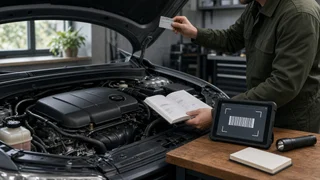
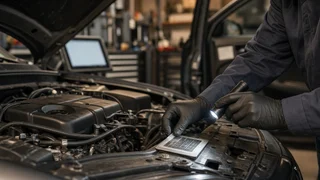
Open the hood and support it with its prop rod or confirm the gas struts hold it securely. Look for a white or silver sticker labeled Vehicle Emission Control Information. It is commonly on the underside of the hood, the radiator support or a strut tower. It usually lists the engine displacement in liters along with an engine family code. If the label is missing, faded or painted over, move to the next step.
Step 2: Decode the VIN
Vehicles sold in the US since the 1981 model year use a standardized 17-character VIN. Characters 4 through 8 describe the vehicle, and many manufacturers use one of these, often the 8th character, as an engine code. What that code means is set by each manufacturer and can change between model years, so the character alone cannot be read without the maker's decoding chart.
The practical approach is to enter the full VIN into a VIN decoder, such as the free tool run by the National Highway Traffic Safety Administration, or to ask a franchised dealer for that brand to look it up. A decoder may return displacement, cylinder count and fuel type. Some decoders leave engine fields blank for certain vehicles, so treat an empty result as a gap, not an answer. Vehicles built before 1981 have shorter, non-standard VINs that general decoders often cannot read.
Step 3: Check the owner's manual or window sticker
The specifications section of the owner's manual lists the engines offered for that model. If more than one engine was available, the manual alone will not tell you which one your car has, so match it against the emissions label or the VIN result. The original window sticker, if the seller or previous owner kept it, normally names the specific engine fitted to that car.
Step 4: Look at the engine itself (optional)
Many engine covers or intake manifolds have the displacement molded or printed on them. This is useful as a cross-check but not as proof on its own, because covers and parts can be swapped. Do not remove covers, hoses or components to look for markings; that adds risk without improving accuracy. Exterior badges on the trunk or fenders are the least reliable source, since some manufacturers use badge numbers that reflect trim or performance level rather than true displacement.
Step 5: Confirm the result
You have a dependable answer when at least two independent sources agree, for example the emissions label and the VIN decoder. Note the displacement and unit (liters, cc or cubic inches), and the cylinder count if shown.
Stop and seek professional help if the sources disagree, if the emissions label is missing on a car the VIN identifies as a different engine, or if you suspect an engine swap. A qualified technician or dealer service department can identify the installed engine from stamped codes or tags on the block, which are often hard to reach and vary by manufacturer.
Where the answer has limits
No specific engine codes, displacement figures or label locations are given here for individual makes or models, because those depend on the manufacturer, model year, market and powertrain. Electric vehicles have no displacement, so these checks do not apply to them; hybrids do have a gasoline engine with a listed displacement. If you need the exact engine to order parts, choose fluids or confirm a purchase, verify it against the manufacturer's documentation or a dealer lookup for your specific VIN before acting.