How Are Door Gaps Set on a Restored Car?
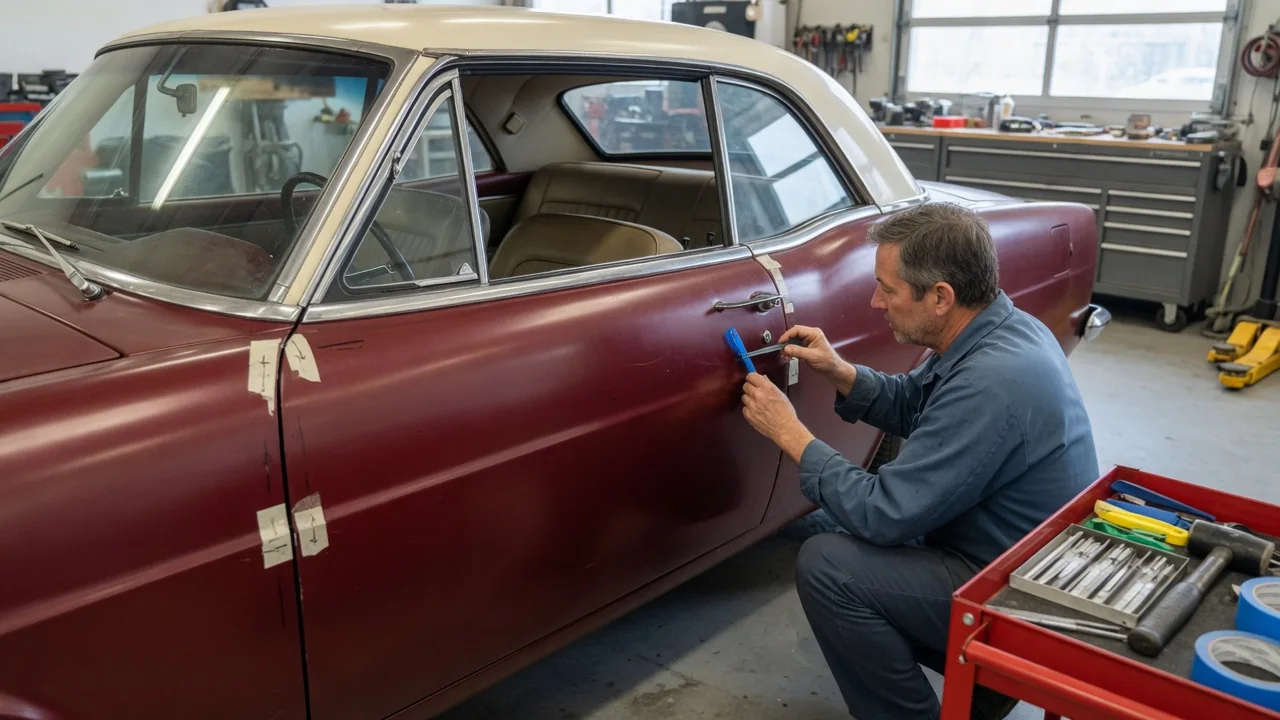
Door gaps on a restored car are set by working through three linked systems in order: the hinges that carry the door, the body structure that defines the opening, and the latch that holds the door closed. Classic car door gap alignment is less about chasing one number than about producing even, parallel gaps and a flush surface across door, fender, rocker and quarter panel. The general approach below applies broadly, but exact procedures and factory tolerances vary by vehicle.
Hinges: Where Door Fit Begins
The hinges determine where the door hangs before anything else is adjusted, so they come first. Worn hinge pins and bushings let a door drop at its rear edge, which typically tightens the gap at one corner and opens it at another. On a restoration, the usual first step is to rebuild or replace the pins and bushings so the door no longer moves when lifted at its trailing edge. Adjusting a door on worn hinges only hides the problem, and the sag tends to return once the door is used. Many restorers also remove the striker at this stage so it cannot drag the door into position and mask a hinge fault.
On many cars the hinges bolt to the door and to the body pillar through oversized or slotted holes, often with floating or caged nuts behind the sheet metal. Loosening the bolts on one side generally allows the door to move up, down, forward or rearward; loosening the other side typically allows in-and-out movement and tilt. Shims placed behind a hinge can push one end of the door outward or draw the opposite end in, which is how the door is rotated to match the body line. Not every car works this way. Some designs use hinges welded to the door or pillar, and on those vehicles adjustment may involve careful bending with specialized tools rather than bolt movement. The service manual for the specific vehicle is the reference for which method applies.
Because a door is heavy and awkward, it is normally supported on a padded jack or stand while bolts are loose, then snugged and checked by closing it slowly. Changes are made in small increments, one hinge at a time, while watching how the top, front and bottom gaps respond. A door that looks right at one corner but wrong at the opposite one usually needs rotation through shimming rather than a straight shift.
Body Position: The Opening the Door Must Match
A door can only fit as well as the opening around it. If the body shell is twisted, sagged or out of square, no amount of hinge adjustment will produce even gaps on every edge. On body-on-frame vehicles, the body sits on mounts and often on shims between body and frame, and the shim stack at each mount affects whether the door openings close up or spread. Restorers commonly hang the doors and check gaps before the body is lifted off the frame, and again after it is reinstalled, so they can see whether mount positions or shim stacks have changed the opening. Tightening body mounts in a different sequence or with different shims can visibly alter a gap.
Unibody cars have no separate frame, so the shell itself carries the alignment. After rust repair or panel replacement, the structure is typically checked against the manufacturer's body dimension information, often on a frame bench or jig, before doors are hung. Welding in new rockers, floors or pillars without bracing the door openings can let the structure move, which is why openings are often braced during repairs and doors test-fitted before final welding. Gaps also depend on neighboring panels: fenders and quarter panels are fitted together with the doors so each door is aligned to them rather than in isolation.
When the opening is correct but an edge still will not match, restorers sometimes reshape the panel edge itself. Common techniques include adding weld or welding rod along a door or fender edge to close a wide gap, or carefully dressing an edge to open a tight one. This is metalwork rather than adjustment, and it is done in bare metal before paint.
Latch: Striker Adjustment and Final Closure
The latch and striker are set last. Their job is to hold the door where the hinges and body have already placed it, not to correct its position. With the door aligned, the striker is reinstalled loosely and adjusted until the door closes fully into its latched position without being lifted, pushed down, or drawn in or out. If the door rises or drops as it engages, the striker is too low or too high relative to the latch; if the closed door sits proud of or below the surrounding panels at the rear edge, the striker generally needs to move outward or inward. On some designs, shims behind the striker set how deeply the latch engages.
Weatherstripping changes the result. New seals are often firmer than old ones and can push a door outward or make it hard to latch, so a final check with the weatherstrip installed is normal practice. Small striker moves may be needed once seals are fitted, but a large correction at the latch usually signals a hinge or body problem that should be fixed at its source. Latch condition matters as well: a worn latch or striker can let the door rattle or settle, making otherwise good gaps look inconsistent in use.
Practical Implications and Limits
In practice, door gaps are usually established in bare metal, then the doors and other panels are removed for paint and reinstalled afterward. Primer and paint add thickness to every edge, and reinstalled hinges rarely return exactly to their earlier positions, so a final fine adjustment after paint is expected. Marking hinge outlines and keeping shims labeled during disassembly can reduce how much work that last pass takes. Care is also needed the first few times freshly painted doors are closed, since tight edges can chip new finish.
There is no single correct gap width that applies to every classic car. Factory tolerances differ by manufacturer and era, and some original cars left the factory with gaps less even than a modern restoration standard would accept. Owners restoring to original specification may choose factory-like fit, while others aim for tighter, more uniform gaps. What generally matters most is consistency along each edge, a flush surface across adjoining panels, and a door that opens and closes without binding. Where exact specifications are needed, the vehicle's factory service information remains the reliable source.