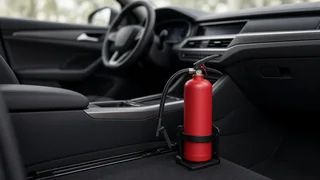
Hanging a Fire Extinguisher in Your Car: How to Mount It Securely
The short answer
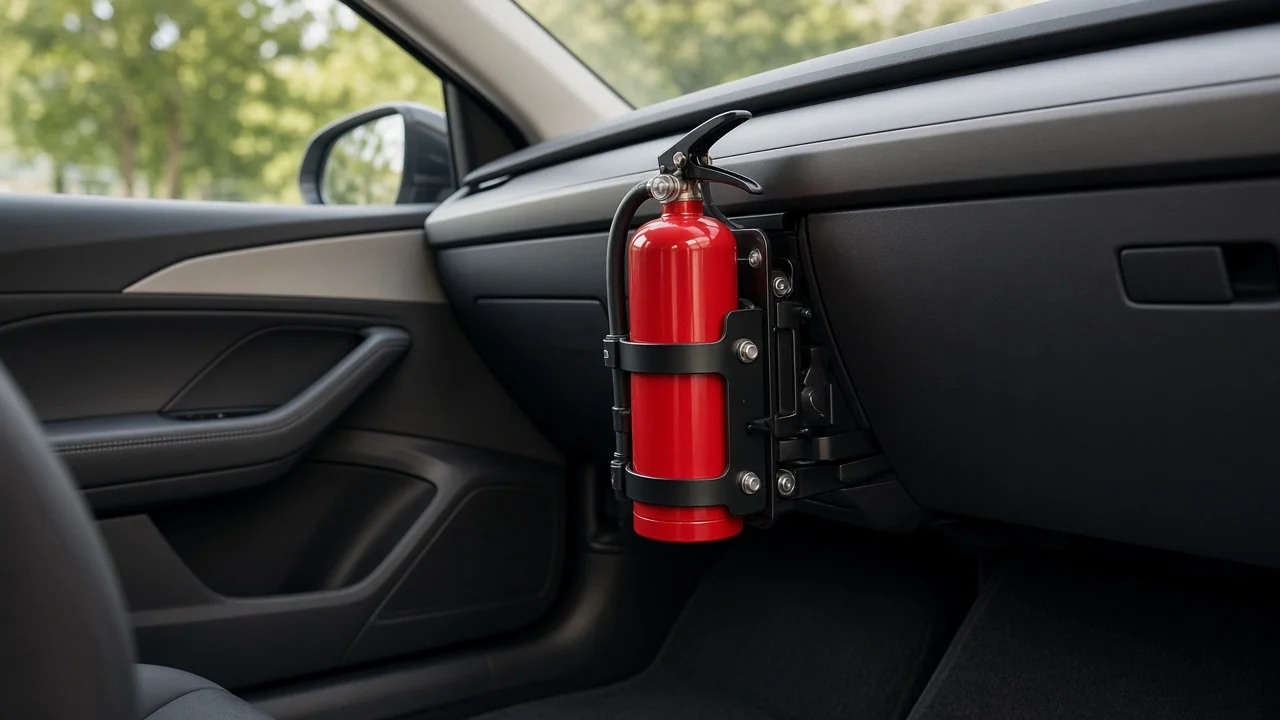
To hang a fire extinguisher in a car, fasten it in a bracket made for vehicle use, one with a strap or positive latch that holds the cylinder tight under hard braking, bumps and a collision. Mount it somewhere you can reach quickly but where it will not block a seat, pedal, airbag or exit. A plain wall hook of the kind that often comes with home extinguishers is not enough in a moving vehicle. Neither is leaving the extinguisher loose on the floor or in the trunk. An unsecured cylinder can roll under the pedals or become a projectile in a crash.
Two conditions change the details. The right mounting spot depends on your vehicle's body style, seating and interior layout. Legal requirements depend on the vehicle's use and jurisdiction. In the US, private passenger cars are not generally required to carry an extinguisher. Commercial motor vehicles are covered by federal motor carrier safety rules that address extinguisher carriage and mounting. If the vehicle is used for work, transports passengers for hire or carries hazardous materials, check the federal, state and employer requirements that apply to it.
Key terms
Vehicle bracket: a mount designed to hold an extinguisher against vibration and impact, usually with a metal band, strap or quick-release latch rather than an open hook. Quick-release: a latch or buckle that lets you free the extinguisher with one motion without tools. Pressure gauge: the dial on many stored-pressure extinguishers that shows whether the unit is charged. UL listing: a sign that the extinguisher model has been tested to recognized safety standards. Look for it on the label.
Choosing where to mount it
A good location meets all of the following conditions:
Reachable from the driver's seat or immediately after you step out of the vehicle. Clear of airbag deployment zones, seat rails, seat-adjustment travel and pedals. Not in the engine compartment. That is where a fire is likely to start. Away from direct heat sources and, where practical, out of prolonged direct sun. On a solid surface, such as a floor panel, a seat-base mounting point or a structural trunk or cargo area panel, not on thin trim alone. Positioned so the gauge can be read without removing the unit.
Common choices include the floor area in front of the front passenger seat, the side of a seat base, and the side wall or floor of the trunk or cargo area. A trunk mount keeps the cabin clear, but it is slower to reach. In a sedan, it may be impossible to reach if the trunk lid is damaged or jammed. Which locations suit a particular make and model cannot be confirmed here. Consult the owner's manual or a qualified installer, especially before drilling.
Step-by-step mounting
1) Get a bracket matched to your extinguisher's size and cylinder diameter. Check that it is intended for vehicle use. 2) Hold the extinguisher and bracket in the planned spot. Confirm that seats move through their full range, doors and pedals are unobstructed, and you can release the unit easily. 3) Before drilling or screwing into any panel, inspect behind and beneath it for wiring harnesses, fuel lines, brake lines, airbag components and sensors. If you cannot see what is behind a panel, do not drill blind. 4) Where possible, use existing bolt points or a no-drill mounting plate designed for your vehicle. If you must drill, use hardware suited to the panel material and seal any holes that pass through the floor to keep water out. 5) Fasten the bracket firmly with the supplied or appropriate bolts, washers and nuts. Self-tapping screws into thin sheet metal or plastic trim may not hold in a crash. 6) Seat the extinguisher in the bracket and close the strap or latch fully.
Verifying the installation
Pull and twist the extinguisher firmly by hand. It should not shift, rattle or slide in the bracket. Push on the bracket itself. It should not flex away from the mounting surface. From the driver's seat, or standing beside the vehicle for a trunk mount, practice releasing the extinguisher. It should come free with one hand and no tools. Make sure the gauge, label and operating instructions face outward and are readable. After the first few drives, recheck for loosened fasteners or new rattles.
Ongoing checks
Look at the extinguisher periodically, as the manufacturer recommends. Check that the gauge reads in the charged range, the safety pin and tamper seal are intact, and the cylinder, hose and nozzle show no damage or corrosion. Vibration can loosen hardware over time, so recheck the bracket fasteners too. Follow the label's guidance on servicing or replacement. If the unit has been discharged even briefly, have it recharged or replace it.
Limits of an onboard extinguisher
A mounted extinguisher is for small fires caught early. If a vehicle catches fire, the priority is to stop, switch off the engine, get everyone out, move well away and call 911. Do not fully open the hood on a suspected engine fire, because a sudden rush of air can make it worse. Do not attempt to fight a fire that is spreading, involves the fuel system, or involves the high-voltage battery of an electric or hybrid vehicle. Leave those to firefighters.
What this guide does not cover
No verified product specifications, bracket models, extinguisher sizes, prices or vehicle-specific mounting points were available for this guide, so none are given. Check sizing and rating against the extinguisher label and bracket documentation. Confirm mounting points for your model with its manual or a qualified installer. For commercial vehicles, confirm requirements with the applicable regulator.