Choosing a Vehicle Fire Extinguisher Mount
The best fire extinguisher mount for a vehicle holds the extinguisher firmly in a crash or on rough roads, keeps it within reach of the driver, and releases quickly when you need it. For most passenger cars, trucks and SUVs, that means a metal bracket with a positive latch or strap, sized to your extinguisher's cylinder diameter and fixed to solid structure such as seat-rail bolts, a floor pan or a roll bar. The loose extinguisher in the trunk or the light plastic wall bracket that came in the box is usually the weakest choice. Two conditions change the answer: if your vehicle is a commercial vehicle or competes in a sanctioned motorsport event, the applicable rules may dictate the extinguisher type, location and mounting method, so check those first.
Why the Mount Matters as Much as the Extinguisher
An unsecured extinguisher is a heavy, hard object. In a sudden stop or collision it can become a projectile inside the cabin. On rough roads, a poorly held extinguisher can rattle, wear through its label, or damage its valve and gauge. A good mount solves both problems while still letting you pull the extinguisher free in seconds.
Access is the other half of the equation. Vehicle fires often start in the engine bay, where fuel, oil and other combustible material sit close to an ignition source such as a hot exhaust component or an electrical fault. If the extinguisher is buried under luggage in a locked trunk, you may not be able to reach it safely once you are out of the vehicle.
Common Types of Fire Extinguisher Mounts for Vehicles
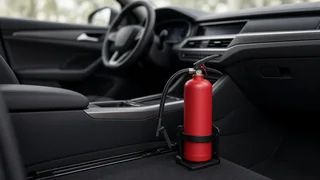
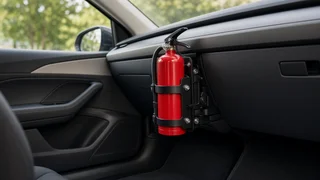
Supplied hook or strap brackets: the bracket packed with many household extinguishers. Often intended for wall mounting, and may not be designed for constant vibration or crash loads. Metal strap or band brackets: one or two adjustable bands around the cylinder, usually with an over-center latch. A common, versatile vehicle option. Quick-release brackets: metal brackets with a lever or pin release designed for one-handed removal. Popular in off-road, track and work vehicles. Seat-rail or seat-base mounts: adapter plates that bolt to existing seat mounting points, placing the extinguisher beside or in front of a seat. Roll-bar and tube clamp mounts: clamps that wrap around a roll cage, sport bar or headache rack tube, with a bracket attached. Bolt-in floor or cargo mounts: brackets fixed directly to the floor, bed or cargo area, sometimes requiring drilling. Vehicle-specific mounts: brackets made for a particular model and model year, often using factory threaded holes so no drilling is needed.
Comparing Mount Types
Mount type | Retention on rough roads | Speed of access | Installation effort | Vehicle modification; Supplied plastic or hook bracket | Often limited | Fast if well placed | Low | Usually screws into trim or panels; Metal band bracket with latch | Good when properly sized | Moderate to fast | Moderate | Depends on mounting point; Quick-release metal bracket | Good | Fast | Moderate | Depends on mounting point; Seat-rail adapter | Good, uses factory structure | Fast from the front seats | Moderate | Usually none beyond reusing bolts; Roll-bar clamp | Good on a solid tube | Fast | Low to moderate | None to the body; Bolt-in floor or cargo mount | Good with proper backing | Varies with location | Higher | Often drilling; Vehicle-specific bracket | Good if made for your exact vehicle | Varies | Low to moderate | Often none
Use the table as a set of trade-offs rather than a ranking. Retention, access and modification pull in different directions, and the right balance depends on how you use the vehicle.
Which Mount Fits Your Use
Daily driver car or crossover: a seat-rail adapter or a vehicle-specific bracket keeps the extinguisher reachable from the driver's seat without drilling. A latching metal band bracket is the main alternative. Pickup truck or work van: a quick-release metal bracket on a seat base, bulkhead or cab structure suits frequent rough use. If the extinguisher lives in the bed or a toolbox, make sure it is protected from weather and sun. Off-road vehicle: a quick-release metal mount on a roll bar or sport bar gives fast access and resists vibration. Avoid locations where mud or debris can jam the release. Track or competition car: follow the sanctioning body's rules on extinguisher type, size and mounting first; many require metal quick-release mounts fixed to the cage or structure. RV, trailer or tow vehicle: consider a mount near the main entry door and a separate one in the tow vehicle cab, since a fire in one may block access to the other. Commercial vehicle: check the regulations that apply to your vehicle class before choosing any hardware.
What to Check Before You Buy
Match the Mount to Your Extinguisher
Start with the extinguisher, not the bracket. Measure the cylinder diameter and note the overall height and weight. Mount listings usually state a diameter range or the extinguisher sizes they accept; confirm that your cylinder falls within it. A band that is too large will let the extinguisher slide, and one that is too small will not close or will crush the cylinder. Also check that the bracket clears the valve, handle, pressure gauge and hose, and that you can read the gauge without removing the extinguisher.
If you have not bought the extinguisher yet, choose it first by its fire extinguisher rating. In the US, extinguishers are labeled by the classes of fire they are rated for, such as A for ordinary combustibles, B for flammable liquids and C for energized electrical equipment. A multi-class extinguisher covering B and C, and ideally A, is a common choice for vehicles because fuel and wiring are the usual concerns. Then select a mount built for that size.
Construction and Release Mechanism
Material: metal brackets, typically steel or aluminum, generally handle vibration and impacts better than light plastic. Retention: look for a positive latch, locking pin or over-center clamp rather than a simple friction hook. Release: test whether you can free the extinguisher with one hand, and whether the release is intuitive for a passenger who has never used it. Corrosion resistance: coatings or corrosion-resistant metals matter if the mount sits in a truck bed, near a door opening or in a salty-road climate. Noise: rubber or padded contact points help prevent rattles and protect the cylinder finish.
Vehicle Compatibility
Seat-rail adapters and vehicle-specific brackets depend on the exact model, model year, body style and seat type. Power seats, heated or ventilated seats, and seats with integrated side airbags can differ from manual seats in the same model line. Confirm the listing names your vehicle precisely, and treat any difference in trim or market as unresolved until checked. For roll-bar clamps, confirm the clamp size matches your tube's outside diameter.
Placement
Reachable: ideally the driver can grab it, and it can also be reached from outside through an open door. Secure: fixed to structure, not to thin plastic trim or carpet alone. Out of the way: it must not interfere with pedals, seat adjustment, seat belts, the gear selector or passenger legroom. Clear of airbags: never mount anything in an airbag deployment path, including side airbags in seats and curtain airbags along the roof rails. Away from heat and sun: avoid mounting near heater outlets or in spots that bake in direct sunlight, and check the extinguisher label for its storage temperature range.
Installation and Total Cost
The price of the bracket is only part of the cost. Factor in any adapter plate or clamp the bracket needs, longer bolts if you reuse seat-rail fasteners, and professional installation if you are not comfortable working near seats, wiring or airbags. Drilling into the floor or body creates permanent holes that need sealing against water and corrosion, and may matter on a leased vehicle or at resale. No-drill options such as seat-rail adapters, vehicle-specific brackets and tube clamps avoid this.
If you drill, check the underside first for fuel lines, brake lines, wiring harnesses and exhaust components. Use backing plates or large washers on thin sheet metal so the bracket cannot tear out under load. If you remove seat bolts to fit an adapter, tighten them to the vehicle manufacturer's specification afterward; seat mounting points are safety-critical.
Using the Extinguisher Safely
A well-placed mount makes the extinguisher available, but safe evacuation always comes first. If a fire starts, pull over, switch off the ignition to cut fuel delivery and help with electrical isolation, get everyone out and away from the vehicle, and call emergency services. Only attempt to fight a small fire if you have a clear escape route and can do so without opening the hood fully, which can feed a fire with air. Leave large or spreading fires, and any fire involving an electric vehicle's high-voltage battery, to firefighters; battery fires behave differently and a portable extinguisher is unlikely to control them.
Quick Buying Checklist
Extinguisher chosen first, with a rating suited to vehicle fires; Mount accepts your cylinder diameter, height and weight; Metal construction with a positive latch or locking release; One-handed release that a passenger can operate; Compatibility confirmed for your exact model year, trim and seat type, if vehicle-specific; Mounting location reachable, secure and clear of airbags and controls; Installation plan that avoids hidden lines and wiring, or a no-drill alternative; Any commercial or motorsport rules that apply to your vehicle checked