Group 78 Car Battery: What to Check Before You Buy

A Group 78 battery is a standard battery size defined by the Battery Council International (BCI) group numbering system. The number tells you the case dimensions, terminal type and terminal placement, not the battery's power or quality. A 78-series battery uses side-mounted threaded terminals and is specified for many General Motors cars, trucks and SUVs, along with some other vehicles. If your owner's manual, the label on your current battery, or a reliable fitment lookup for your exact model year, engine and trim calls for Group 78, any Group 78 battery should physically fit. Choosing the right one comes down to cold cranking amps, reserve capacity, battery type, freshness and warranty. The main conditions that change this answer are a vehicle that requires an AGM battery, such as one with start-stop, and a car whose original battery was replaced with a different group size by a previous owner.
Confirm that Group 78 is actually right for your vehicle
Battery fitment can differ within the same model name depending on model year, engine, market and optional equipment such as heavy-duty electrical or cold-climate packages. A battery that fits one version of a vehicle may not be the specified size for another. Before buying, check these sources:
Your owner's manual, which usually lists the battery group size or a minimum cold cranking amp rating. The label on the battery currently installed, but only if you know it is the original or correct size. A retailer or manufacturer fitment lookup, entered with the exact year, make, model, engine and trim. The battery tray and hold-down in the engine bay, to confirm the space and mounting style match.
If these sources disagree, treat the owner's manual or the vehicle manufacturer's specification as the reference point and resolve the difference before purchasing. A previous owner may have installed a different size that happened to fit.
Size and terminal layout
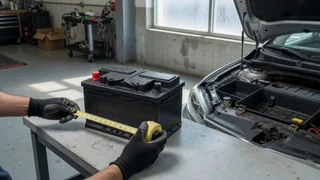
Group 78 cases are roughly 10¼ inches long, 7 inches wide and 7¾ inches tall. Individual products can vary slightly with case design, so check the listed dimensions if your battery compartment is tight.
The defining feature is the side terminal. The cables bolt into threaded sockets on the side of the case rather than clamping onto posts on top. Polarity matters here. The positive and negative terminals must sit on the correct sides so your cables reach without stretching and are not reversed. Because group size standardizes terminal position, a correct Group 78 battery should line up with your existing cables. Still, compare the terminal arrangement on the new battery with the old one before installation.
Some batteries are sold as dual-terminal units with both side terminals and top posts, and some are labeled as combination sizes such as 34/78. These are designed to work in vehicles that use either group size. They are a reasonable option when they match your vehicle's listing, but confirm that the height and hold-down still fit, and cover or protect the unused terminals.
Ratings that actually matter
Rating | What it means | How to use it; Cold cranking amps (CCA) | How much current the battery can deliver for starting in cold conditions | Meet or exceed the CCA your vehicle maker specifies; more helps in cold climates; Reserve capacity (RC) | How many minutes the battery can supply a steady electrical load if the alternator stops charging | Higher is useful for vehicles with heavy electrical loads or frequent short trips; Amp-hours (Ah) | Total stored energy over a set discharge period | Most often listed on AGM batteries; useful for comparing similar batteries; Cranking amps (CA) or marine cranking amps (MCA) | Starting current measured at a warmer temperature | Higher than CCA by design; do not compare it directly with a CCA figure
The most common buying mistake is choosing on price alone or comparing a cranking amps figure from one battery with a cold cranking amps figure from another. Compare like with like, and treat the manufacturer's minimum CCA as a floor rather than a target. Going above it is generally fine. Going below it can lead to slow or failed starts in cold weather.
Flooded or AGM
Group 78 batteries come in two main constructions. A conventional flooded lead-acid battery holds liquid electrolyte. It is usually the lower-cost option and is suitable for many older or simpler vehicles. An AGM (absorbent glass mat) battery holds its electrolyte in fiberglass mats. AGM batteries are sealed and resistant to vibration, and they generally handle deep discharges and high electrical loads better. They also usually cost more.
If your vehicle came with an AGM battery, replace it with an AGM battery. Charging systems on these vehicles may be calibrated for AGM, and a flooded battery can wear out quickly. If your vehicle has automatic start-stop, an AGM or another start-stop-rated battery is normally required. If your vehicle originally used a flooded battery, upgrading to AGM is usually allowed and can help with heavy accessory loads, aftermarket audio, or long periods of short-trip driving. Check your owner's manual first. Some vehicles need the new battery to be registered or the battery monitoring system reset after replacement. Check whether this applies to your model.
Freshness, warranty and practical details
Manufacture date: Batteries slowly lose charge on the shelf. Look for a date code on the case or label and favor a recently made battery. Date code formats vary by brand, so ask the seller to read it if it is unclear. Warranty: Look at the free-replacement period separately from any prorated period. The free-replacement period is the more meaningful number when comparing batteries. Core charge: Many sellers add a refundable charge that you get back when you return the old battery. Lead-acid batteries should be recycled rather than thrown away. Hold-down: Many vehicles that use side-terminal batteries secure them with a clamp at the base of the case. Make sure the new battery's base matches your hold-down so it cannot shift. Terminal hardware: Side terminals use bolts that thread into the battery. Inspect the cable ends and bolts for corrosion or stripped threads, and tighten them firmly without overtightening, which can damage the terminal.
Make sure the battery is really the problem
A dead or weak battery is often the symptom rather than the cause. If a fairly new battery keeps going flat, or the battery or charging warning light comes on while driving, the alternator, a loose or worn drive belt, corroded or loose cables, or a parasitic drain from something staying on with the ignition off could be responsible. A new Group 78 battery will not fix any of these and may be damaged by them.
Have the battery load-tested rather than relying only on a voltage reading. Many parts stores offer this. Ask for a charging system test with the engine running to confirm the alternator is charging within the normal range. Check that the battery cables and terminals are clean and tight, especially the side-terminal bolts, which can loosen or corrode where they meet the case. If the battery drains overnight with everything switched off, look into a parasitic draw before replacing anything.
Quick buying checklist
Group 78 confirmed for your exact model year, engine and trim; Side terminals in the correct polarity orientation, or a dual-terminal or combination battery listed for your vehicle; CCA at or above the vehicle maker's specification; Reserve capacity suited to your electrical load and driving pattern; AGM if the vehicle came with AGM or has start-stop; Recent manufacture date; Clear free-replacement warranty period; Compatible hold-down and good-condition terminal bolts; Charging system checked if the old battery failed early