Group 26R Car Battery: What to Check Before You Buy
A Group 26R car battery is a standard size defined by the Battery Council International (BCI) group system. It has the same case dimensions as a Group 26 battery, but the terminal positions are reversed. That is what the "R" means. If your vehicle's owner's manual, the label on the original battery, or a reliable fitment lookup for your exact model year, trim and engine calls for a 26R, buy a 26R. Then compare cold cranking amps, battery type and warranty within that size. The main exception is a vehicle that was refitted with a different battery or modified cables. In that case, check what is actually installed and how the cables are routed before ordering.
What the "R" in 26R means
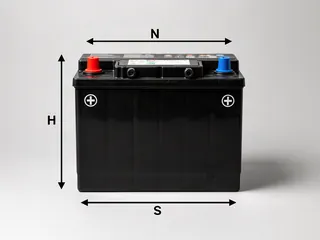
BCI group numbers describe a battery's physical size, terminal type and terminal layout. In a reversed-terminal group, the positive and negative posts swap sides compared with the standard version. A common way to describe it is to view the battery with the terminals nearest you. On an R battery, the positive terminal is on the right. Retailers and manufacturers do not always describe orientation the same way, so compare the product diagram with your old battery rather than relying on wording alone.
Feature | Group 26 | Group 26R; Case dimensions | Same BCI group footprint | Same BCI group footprint; Terminal type | Typically top-post | Typically top-post; Terminal positions | Standard layout | Positive and negative swapped; Interchangeable? | Only if your cables reach and polarity is correct | Only if your cables reach and polarity is correct
Because the footprint matches, a Group 26 battery will usually drop into a 26R tray. That does not make it a correct substitute. The battery cables are cut to length for one terminal layout. With the wrong layout, the positive cable may not reach, may have to stretch across the battery, or may sit close to the hood or other metal parts. Connecting the cables in reverse to make them fit can damage fuses, electronics and the charging system. Stay with the orientation the vehicle was designed for.
How to confirm a 26R is right for your vehicle
Read the label on the battery currently installed. Most show the group size near the brand name or ratings. Check the owner's manual. The battery section often lists the group size and a minimum cold cranking amp rating. Use a fitment lookup with your exact model year, trim and engine. Battery requirements can change between engine options, between years, and between vehicles with and without start-stop. Match the hold-down style. Some trays use a clamp at the base of the case and others use a bracket across the top. The new battery should seat securely with the original hardware. If the old battery is a different group from the one the lookup recommends, find out why before you buy. A previous owner may have installed the wrong size, or the vehicle may have been modified.
Ratings to compare within Group 26R
After the size is confirmed, batteries of the same group can still differ a lot. These are the specifications worth comparing.
Cold cranking amps (CCA): how much current the battery can deliver for engine starting in cold conditions. Meet or exceed the figure in your owner's manual. More CCA can help in cold climates, but it is not a reason to change group size. Reserve capacity (RC): roughly how long the battery can support essential electrical loads if the charging system stops working. Higher reserve capacity gives more margin for vehicles with many electronics or short-trip driving. Amp-hour rating (Ah): sometimes listed instead of or alongside reserve capacity, especially for AGM batteries. It is another way to express stored energy. Terminal type: Group 26R batteries normally use top posts. Confirm the posts match your cable clamps.
Flooded, EFB or AGM?
Group 26R batteries come in more than one construction type. Match what your vehicle requires first, then decide whether an upgrade makes sense.
Conventional flooded: the traditional lead-acid design and usually the least expensive. It suits many older vehicles without start-stop systems. Enhanced flooded battery (EFB): built to handle more frequent cycling than a standard flooded battery. It is often specified for entry-level start-stop systems. Absorbent glass mat (AGM): sealed and more resistant to vibration and deep cycling. It is generally required for vehicles that came with AGM from the factory, and it is often chosen as an upgrade for vehicles with heavy electrical loads.
If your vehicle came with an AGM or EFB battery, do not downgrade to a conventional flooded unit. The charging strategy and start-stop logic may expect the original type, and a lesser battery can wear out early. Some vehicles with a battery management system also need the new battery registered or the battery type set with a scan tool after installation. Check this for your specific model before you start the job.
Freshness and warranty
Batteries slowly self-discharge on the shelf, so look for the manufacturing date code on the case or label. Brands encode this date differently, often with a letter for the month and a digit for the year. If you cannot read the code, ask the seller. A recently made battery is the better choice.
Warranties usually combine a free-replacement period with a longer prorated period. Under the prorated portion, you receive only partial credit toward a new battery. Compare the length of the free-replacement period, not just the headline total. Also check whether a claim requires the original receipt or a test performed by the seller.
Make sure the battery is actually the problem
A dead or weak battery is sometimes a symptom rather than the cause. If you put a new 26R into a car with a charging or drain fault, the new battery can fail quickly too. These checks help separate a worn battery from a wider electrical problem.
Battery terminals: look for corrosion, loose clamps or damaged cable ends. A poor connection can mimic a failing battery. Cleaning and tightening the terminals sometimes solves a no-start. Resting voltage: with the engine off and the car rested for a while, a fully charged 12-volt battery generally reads around 12.6 volts. A noticeably lower reading means the battery is discharged, but it does not tell you why. Charging output: with the engine running, system voltage should rise above resting voltage. On many vehicles it settles somewhere in the low-to-mid 14-volt range. Vehicles with smart charging may vary this on purpose, so compare with the expected behavior for your model. A reading that barely rises, or rises too high, points toward the alternator or its regulation. Voltage drop: measuring voltage across a cable or connection while it carries current shows whether a corroded ground, a cable or a connection is wasting power. Excessive drop can cause slow cranking even with a good battery. Parasitic draw: some current flows with the car off, to keep memory and modules alive. If a module, light or accessory stays awake, it can drain a healthy battery overnight. Measuring draw with an ammeter, then pulling fuses one at a time while referring to the vehicle's wiring diagram, helps isolate the circuit responsible.
Many parts stores will test a battery and the charging system. A load test is more telling than a voltage reading alone, because a battery can show normal voltage and still collapse under starting load.
Installation points that affect the outcome
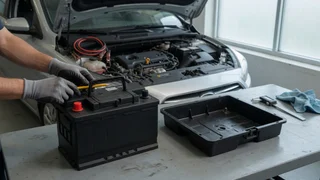
Disconnect the negative cable first and reconnect it last. This lowers the risk of shorting a wrench against the body while the positive terminal is exposed. Before removing the old battery, confirm the new one's positive and negative posts line up with the cables. This is where a 26 and 26R mix-up becomes obvious. Clean the cable clamps and tighten them so they cannot rotate on the posts. Do not overtighten. Secure the hold-down. A loose battery can vibrate, crack internally or contact the hood. If your vehicle loses radio presets, clock settings or learned idle values when power is removed, a memory saver can help. Some vehicles relearn on their own after a short drive. If you are adding accessories while the battery is out, wire them through an appropriately sized fuse close to the battery. Never increase a fuse rating to stop a fuse from blowing. A blowing fuse indicates a fault or an undersized circuit. Return the old battery to the retailer or a recycling point. Many sellers add a core charge that is refunded when you bring the old battery back.
Quick buying checklist
Group size confirmed as 26R for your exact model year, trim and engine; Terminal orientation matches your cables, with positive on the correct side; CCA meets or exceeds the owner's manual figure; Battery type matches the original: flooded, EFB or AGM; Hold-down hardware fits the case; Recent manufacturing date; Warranty terms understood, especially the free-replacement period; Charging system and parasitic draw checked if the old battery died early or unexpectedly; Battery registration requirement checked for vehicles with battery management systems