Choosing a Front-Mount Intercooler for a Mk7 GTI
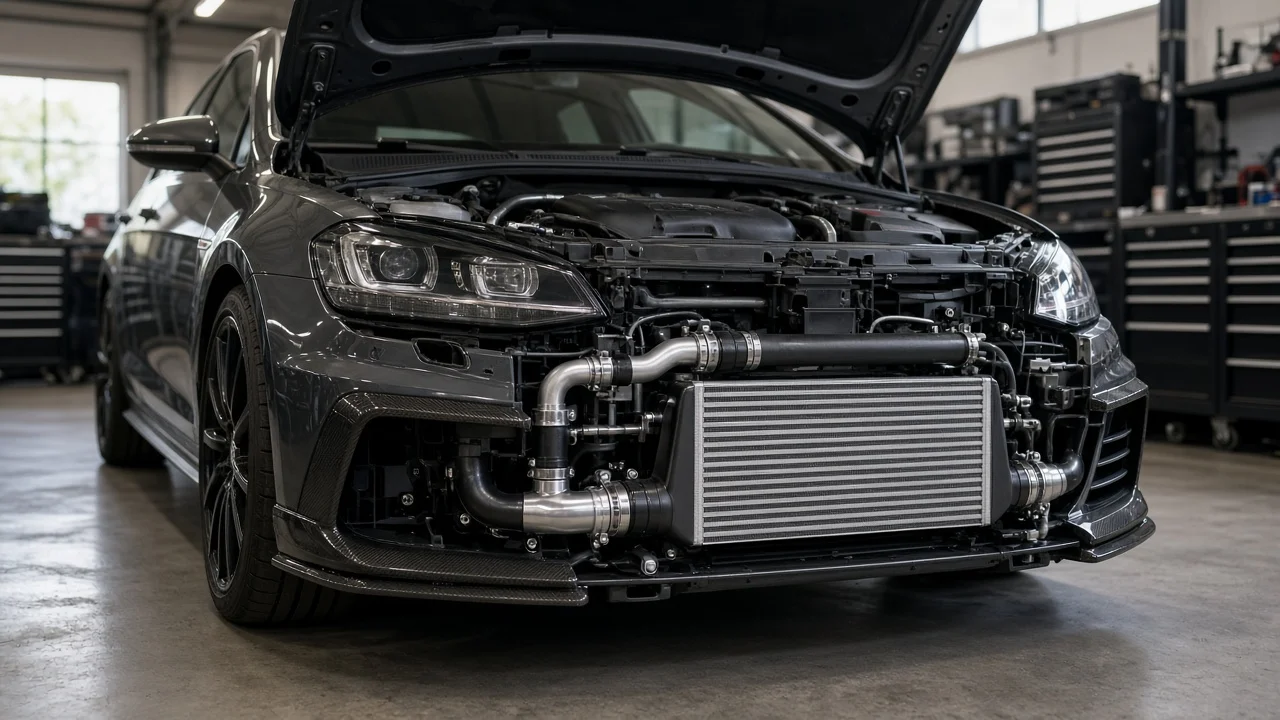
Every Mk7 GTI leaves the factory with a front-mounted intercooler, so an aftermarket unit is a larger replacement, not a new layout. Whether one is worth buying depends on how the car is driven, how it is tuned and whether heat soak has actually been measured. This guide covers how to confirm the need, check fitment for your model year, weigh the features that matter and plan for the real cost of ownership.
Define the job the product must do
Start with how the car is used. A stock daily driver, a Stage 1 tuned commuter, a Stage 2 car with intake and downpipe, and a car that sees track days or autocross put very different heat loads on the charge air system. US-market Mk7 GTIs from 2015 through 2017 and the Mk7.5 cars from 2018 through 2021 all use a version of the EA888 Gen 3 2.0-liter turbocharged engine, but power output, tune and turbo choice change how hard the intercooler works. The factory unit is compact and often adequate for short bursts on a stock or mildly tuned car. Its limits tend to appear during repeated pulls, sustained high load, track sessions and hot ambient temperatures, when the core absorbs heat faster than airflow can remove it.
Separate symptom reports from verified problems. A car that feels slower in summer is a symptom, not proof of an intercooler limit. Verification means datalogging intake air temperature after the intercooler, ignition timing corrections and actual versus requested boost across several consecutive pulls under consistent symptom conditions. If temperatures climb steadily pull after pull while timing is pulled, heat soak is a reasonable conclusion. Before buying anything, read diagnostic codes and rule out boost leaks, a cracked charge pipe or an underboost condition such as P0299. Review the service history too: worn spark plugs, failing ignition coils or a faulty diverter valve can mimic the power loss owners blame on heat.
Check compatibility
The GTI sits on the MQB platform, and many intercooler kits are listed for the Mk7 and Mk7.5 GTI alongside the Golf R and some related Audi models. Do not assume a broad platform listing covers your exact car. Confirm the model year, trim and whether the listing explicitly includes the facelifted Mk7.5. Front-end equipment matters as much as the chassis: adaptive cruise control radar, parking sensors, fog lights and bumper or lower grille differences between years and trims can affect brackets, ducting and clearance. Read the vendor's fitment notes for any required bumper trimming, crash bar modification or sensor bracket relocation, and treat vague answers as a reason to ask before ordering.
Next, check the interfaces. Compare inlet and outlet diameters and connection style with your existing charge pipe and throttle pipe, and find out whether the kit reuses factory pipes or requires upgraded ones. The plastic factory charge pipe is a commonly reported weak point on tuned cars, so many owners replace it at the same time. Confirm that factory sensor provisions are retained or properly relocated, and that a thicker core leaves adequate clearance to the AC condenser and radiator. If the engine configuration has changed, for example with a hybrid turbo or a larger turbo swap, size the intercooler for that airflow rather than the stock rating, and compare kit dimensions against the manufacturer specifications for your car.
Features that affect the choice
Core size drives most of the trade-offs. Greater frontal area exposes more surface to incoming air, while greater thickness and internal volume add thermal mass that resists heat soak during repeated pulls. The cost is more volume to pressurize and, with a poorly designed core, more pressure drop between the turbo and throttle body. Bar-and-plate cores are common in this market and generally durable and resistant to debris damage. Tube-and-fin designs can be lighter and may offer lower pressure drop, but they are often more easily damaged. Neither construction is automatically better; core dimensions and internal fin design matter more than the label.
End tank design deserves attention because it controls how evenly air spreads across the core. Cast end tanks with shaped internals usually distribute flow better than simple boxes, and weld quality matters on fabricated tanks. Look at the included hardware as well: multi-ply silicone couplers, good clamps or factory-style quick-connect fittings, and complete mounting brackets reduce installation problems. Surface finish is mostly cosmetic and plays a minor role in heat rejection.
Be careful with marketing evidence. A single dyno chart or a claimed horsepower gain says little, because an intercooler does not create power; it limits the power loss caused by hot intake air. Useful data shows intake air temperature over several back-to-back pulls, with ambient temperature, boost level, tune and test conditions stated, plus measured pressure drop. Labels such as race-proven or maximum flow carry no weight without that context.
Limitations and ownership costs
Installation usually means removing the front bumper, taking out the factory intercooler and its ducting, transferring or replacing brackets and, on some kits and trims, trimming plastic. An experienced owner with basic tools can do the job, but plan on several hours; shop labor is a real line item. Afterward, perform a boost leak or smoke test, recheck clamps after a few heat cycles and datalog again to confirm the change. Budget for an upgraded charge pipe or couplers if the kit does not include them.
Understand what the part cannot do. It does not raise boost, cure misfires, fix boost leaks elsewhere in the system or compensate for a turbo or diverter valve that is failing. Some tuners offer calibrations that take advantage of lower intake temperatures, which can be an added cost. A larger charge air volume can slightly delay boost onset; owners often report the change as minor, but it is a real trade-off on a daily driver.
Ongoing maintenance is modest but not zero. The intercooler sits low and forward, so periodic inspection for bent fins, road debris and corrosion is worthwhile. Crankcase ventilation can leave oil residue in the charge pipes and core over time, which is worth checking when couplers are off. Before installation, confirm any warranty implications with your dealer and check whether local inspection or emissions rules require documentation for the part.
Build a practical shortlist
Run each candidate through the same checklist. Does the listing explicitly cover your model year, trim and front-end equipment? Is the need confirmed by logged intake temperatures and timing corrections rather than impressions? Do the inlet and outlet sizes and connection types match your current or planned pipes, and are factory sensor provisions handled? What are the core dimensions, construction type and end tank design? Which couplers, clamps and brackets are included, and what extra parts will you need? Does the vendor publish test conditions with its data? What trimming or modification does installation require, and is technical support or warranty coverage clearly stated?
Narrow the field to two or three kits that pass every fitment question, then compare them on evidence quality, total cost including pipes and labor, and how well their size matches your power goals. A modestly tuned street car rarely benefits from the largest core available, while a frequently tracked or heavily modified car justifies more capacity. After installation, a repeat of your original datalog under the same conditions is the only reliable way to confirm the upgrade did its job.