Fix Ford F-150 that has dash power but will not start or move
A Ford F-150 that lights the instrument cluster but refuses to crank or move points to a specific interruption between the low-current cabin electronics and the high-current starting or driveline path. Dash illumination only proves the battery has enough reserve for small loads; it does not confirm the battery state of charge, starter circuit, ignition switch output, or transmission interlock can support engine rotation. The Spanish-language symptom “no da marcha pero sí prende el tablero” describes this exact split. Working through the vehicle starting chain from battery terminals to cranking speed and fuel delivery separates a weak electrical connection from a failed starter, security lockout, or shift-position fault.
Essential answer
When an F-150 shows dash power but will not start or move, the key distinction is between accessory voltage and cranking voltage. The cluster, radio, and warning lamps can operate on a small fraction of the current required by the starter motor. A battery with enough surface charge for the dashboard may still collapse when the ignition switch requests starter engagement. Corroded battery terminals, a loose ground cable, or a discharged battery are therefore common reasons the truck remains silent after the key turn.
The no-crank condition may also come from the starter circuit rather than the battery itself. A failed starter relay, worn ignition switch contact, or open neutral safety switch prevents the trigger signal from reaching the starter solenoid. In automatic-transmission trucks, moving the shifter firmly into Park or Neutral or trying the other position is a practical check. Because the dashboard still lights, the primary diagnostic focus is the path that carries high current and the low-current command that closes it, not the cluster or body modules.
Diagnosing a problem
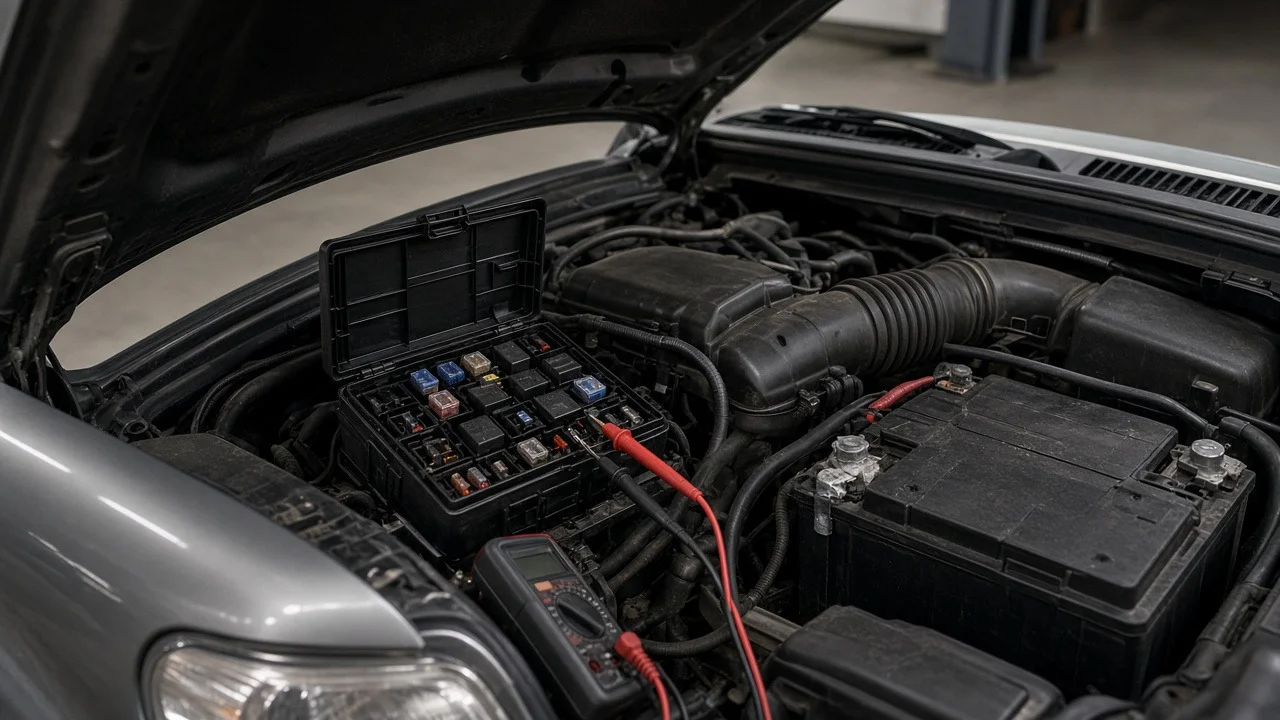
Begin with battery state of charge and terminal condition. Measure resting voltage at the battery posts; a healthy charged battery sits well above twelve volts, while a deeply discharged unit may still run lamps but not supply starter amperage. Inspect both terminal connections for white or green corrosion and confirm they are tight. A voltage reading taken at the cable clamp while an assistant turns the key can reveal whether cranking demand pulls the system down sharply, suggesting a weak cell or high-resistance connection.
If battery voltage remains stable but the starter does not engage, listen during the key turn. A single click often indicates the starter solenoid is receiving a command but the motor cannot rotate, perhaps from a seized starter, engine mechanical bind, or insufficient cable current. No click may point to the ignition switch or transmission range sensor. Diagnostic checks with a scan tool can identify security or range-sensor data, but a stored fault code only directs testing; it does not prove a component has failed on that specific vehicle.