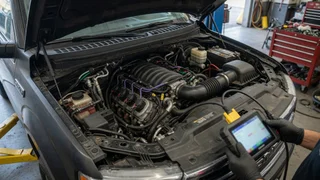
Diagnose F-150 engine failsafe mode

An F-150 entering engine failsafe mode can feel alarming, but the behavior is a protective response rather than a single mechanical failure. The powertrain control module reduces performance, limits throttle response, or locks out gears when sensor data falls outside expected ranges. Drivers may notice reduced acceleration, warning messages, or harsh shifting. This guide explains what engine failsafe mode means, how the truck communicates the condition, and which observable checks help narrow the cause. The goal is a clearer diagnosis before parts are replaced or the vehicle is driven further.
Essential answer
Engine failsafe mode, sometimes called limp mode or failsafe cooling mode, is a self-preservation strategy. When the control module sees conflicting or implausible signals from critical systems, it restricts engine output to prevent heat or mechanical damage. In an F-150, this can stem from a throttle actuator disagreement, a transmission range sensor issue, a charging system fault, or a coolant temperature reading that suggests overheating. The essential answer is that the truck is limiting itself because the computer cannot safely command normal operation based on the available data.
This condition is not a diagnosis itself. It is a symptom with stored diagnostic codes and real-time data behind it. Two trucks showing the same dashboard warning may have entirely different causes, so model-specific confirmation matters. While some failsafe events are electrically triggered and may reset after a restart, repeated activation indicates an unresolved fault. Understanding the scope helps owners avoid guessing and instead treat the mode as the starting point for systematic evaluation.
Diagnosing a problem
A useful first step is to record the exact conditions when the failsafe mode engages. Note whether it occurs at idle, during acceleration, after hitting a bump, or when the engine reaches operating temperature. Symptom conditions often point toward specific circuits: a heat-related trigger suggests a cooling or sensor issue, while a rough-road trigger may indicate a loose connector or chafed harness. Diagnostic codes are the strongest evidence, but a code such as a throttle position correlation error does not prove the throttle body is failed. It only shows the control module received values that did not match its expected range.
Inspection should focus on visible and verifiable items: coolant level, battery voltage, charging output, and the condition of accessible connectors. Service history also matters, because recent repairs or fluid services can introduce loose grounds or pinched wiring. If the truck is actively overheating, leaking coolant, or showing severe misfire symptoms, continued driving is unsafe. For an intermittent electrical fault, a professional scan tool can read manufacturer-specific data and perform bidirectional tests. The goal is not to replace a part because a code mentions it, but to locate the condition that made the computer restrict engine output.