Find SoCalGas CNG Stations: How to Locate and Use Them
The Short Answer
SoCalGas, the natural gas utility serving much of Southern California, has operated and supported compressed natural gas (CNG) fueling stations in its service territory. The most dependable way to find a current station is to use an up-to-date station locator, either the utility's own natural gas vehicle listing or the U.S. Department of Energy's Alternative Fuels Data Center station locator. Filter for CNG and public access, then confirm the details for the specific site before you drive there.
One qualification matters. A station inside SoCalGas territory is not necessarily owned or run by SoCalGas. Many CNG stations in the region belong to private fueling networks, transit agencies, municipalities, or fleet operators. Station ownership, access rules and operating status can change over time. If you specifically need a SoCalGas-operated site, for example because of a payment or account arrangement, confirm the operator in the locator listing or with the utility rather than assuming it from the location.
What Counts as a CNG Station
Compressed natural gas is mostly methane stored on the vehicle in high-pressure cylinders. A CNG station compresses pipeline gas and dispenses it through a sealed nozzle that locks onto the vehicle's fill receptacle. Some stations dispense renewable natural gas (RNG), which is methane from sources such as landfills or digesters. RNG is chemically interchangeable with fossil natural gas for fueling purposes, so a CNG vehicle can use either.
Retail CNG is usually priced per gasoline gallon equivalent (GGE), the amount of gas holding roughly the same energy as a gallon of gasoline. Truck-oriented sites may also show diesel gallon equivalents (DGE). Prices differ by station and change over time, so check the current price at the pump or in the locator.
How to Find a Station
Use a station locator and select compressed natural gas as the fuel type. Filter for public access. Many CNG sites serve only private or fleet users. Check the listed operating hours. Some stations are available around the clock and others are not. Review the accepted payment methods. Some sites take ordinary bank cards, while others require a fleet card or a network account. Note the dispenser pressure ratings listed for the site, and match them to your vehicle. For heavy-duty vehicles, check whether the site has truck access and enough clearance for your vehicle. Shortly before the trip, confirm that the station is operational. Compressors and dispensers can be down for maintenance.
Navigation apps sometimes list CNG stations, but their fuel-type data is not always current. A dedicated alternative-fuel locator is usually the better first check. Treat any listing as a starting point, not a guarantee.
Public, Limited-Access and Fleet-Only Sites
Access type | What it usually means | What to check; Public | Any compatible vehicle can fuel during posted hours | Hours, payment methods, pressure rating; Limited or card-access | Open to the public, but you need a specific card or account | Card or account requirements before arrival; Private or fleet-only | Reserved for the owner's vehicles, such as a transit or utility fleet | Generally not available to private drivers
Recognizing a CNG Dispenser
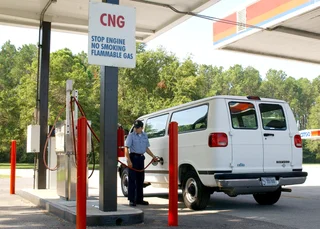
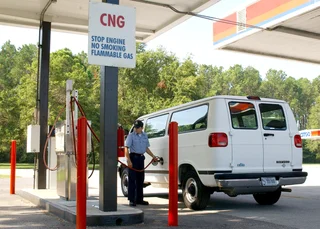
At a mixed-fuel station, CNG dispensers are usually marked with "CNG" or "Natural Gas" signage and show prices in GGE rather than gallons. The nozzle is a pressurized coupling that latches onto the vehicle receptacle. It does not look like a liquid-fuel nozzle that sits loosely in a filler neck. Dispensers commonly display warnings about high pressure and no smoking.
Several other fuels are easy to confuse with CNG:
LPG (propane, autogas) is a different fuel stored as a liquid at much lower pressure. It uses different equipment and is not interchangeable with CNG. LNG (liquefied natural gas) is natural gas cooled to a cryogenic liquid. It is used mainly by some heavy trucks and needs specific LNG-equipped vehicles. Hydrogen dispensers are also high-pressure gaseous fuel pumps and can sit at the same sites, but they are incompatible with CNG vehicles.
Checking Vehicle Compatibility
Light-duty CNG vehicles in North America generally use the NGV1 receptacle standard. This standard has separate nozzle profiles for systems rated at 3,000 psi and 3,600 psi. The fuel system label is typically found near the fill receptacle or on the fuel door, and it states the vehicle's service pressure and the cylinder inspection or expiration information. Use only a dispenser whose rating matches or is designed for your system. Heavy-duty vehicles may use different receptacles or high-flow nozzles, so check the vehicle documentation for your specific configuration.
Fill amounts can vary with the weather. Hot gas occupies more volume, so on a hot day the cylinders may show full while holding somewhat less fuel than on a cool day. This is normal behavior, not a station fault.
Next Step
Open a current alternative-fuel station locator and filter for public CNG near your route. Shortlist two or more stations in case one is offline. Confirm hours, payment requirements and pressure rating for each. If you specifically need a SoCalGas-run site, verify the operator in the listing or with the utility before relying on it.