EV Charger Extension Cable: What to Check Before You Buy One
The short answer
An EV charger extension cable can make sense, but only one kind is designed for the job. A connector-to-connector extension, which plugs into the charging handle on one end and into your car on the other, can add reach if it uses the same connector standard as your charger and vehicle, carries a current rating at or above what your charger delivers, and is safety-certified. A household extension cord placed between the wall outlet and a portable charger is a different matter: many charger and vehicle manufacturers advise against it, because a long charging session can push an ordinary cord past what it safely handles. Two conditions change the answer most: whether you are extending the vehicle side or the wall side, and whether you are charging on AC (Level 1 or Level 2) or at a DC fast charger, where user-added extensions are not an option.
Two products that share one name
Shoppers searching for an EV charger extension cord often find two unrelated product types mixed together. Knowing which one you need settles most of the compatibility question.
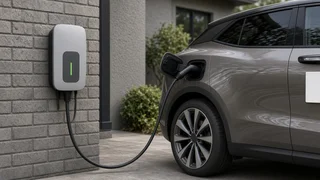
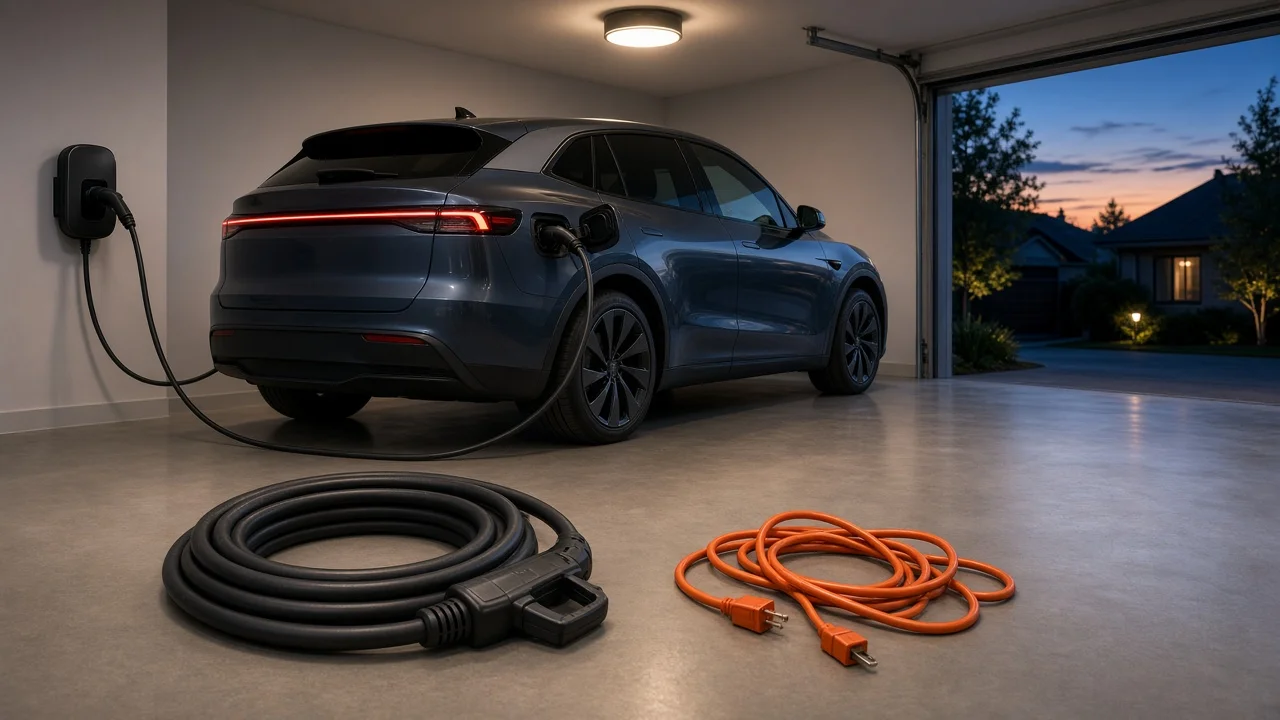
Vehicle-side extension cable: a cable with a charging connector on one end and a matching vehicle inlet on the other. It sits between the charging handle and the car, so the charger itself stays where it is. Wall-side extension cord: a general-purpose power cord that sits between a household outlet and the plug of a portable charger, often called EVSE (electric vehicle supply equipment), the box-and-cable unit that supplies power to the car.
Why a household extension cord is the riskier choice
EV charging is a continuous load: the charger draws close to its full current for hours at a time, unlike a power tool that runs in short bursts. Ordinary extension cords and the plug-to-socket joints along them can heat up under that kind of sustained draw, especially if the cord is undersized, coiled, worn or exposed to moisture. For that reason, many portable charger and vehicle owner's manuals tell owners not to use an extension cord at all. Check your own manual first, since its instructions take precedence over any general guidance.
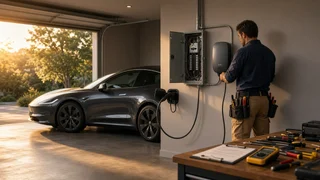
If your manual does not prohibit it and you still consider a cord as a stopgap, the general precautions are well established: use a single heavy-duty, outdoor-rated cord whose rating meets or exceeds the charger's draw; keep it as short as possible and fully uncoiled; avoid daisy-chaining cords, power strips or plug adapters; keep connections off wet ground; and feel the plug and outlet after a session for warmth. A dedicated outlet or a properly installed charger placed closer to where you park is the more durable fix, and a licensed electrician can advise on that.
Compatibility checklist for a vehicle-side extension cable
Connector standard on both ends: in the US, AC charging uses either the J1772 connector or the NACS connector (standardized as SAE J3400). The extension's male end must match your charger's handle and its female end must match your car's inlet. Current and voltage rating: the cable's rating should equal or exceed the maximum output of the charger you will use with it, not just your car's onboard charging limit. Safety certification: look for a listing from a recognized testing laboratory on the product and its documentation, not just a claim in the listing title. Signal pass-through: charging handles use small signal pins to confirm the connection before power flows. A properly built extension passes these through so the car and charger still communicate and the latch and release still work. Weather and handling: check the stated weather resistance, how the connectors seal when mated, and whether the cable stays flexible in cold weather if you charge outdoors. Length: buy only the length you need. Extra cable adds weight, a trip hazard and more conductor to warm up.
Combining an extension with an adapter
Some owners pair an extension with a connector adapter, for example to use a J1772 charger with a NACS-equipped car or the reverse. Every added link is another joint that must carry full current and pass the signal pins correctly. Before stacking an adapter and an extension, confirm that your vehicle maker permits adapters for your specific model, model year and market, and that both pieces carry ratings that cover the charger's output. Policies can differ between trims and model years, so check documentation for your exact vehicle rather than a related model.
Where an extension will not help
Extension cables are an AC-charging accessory. DC fast chargers deliver power through cables built and managed by the station, and adding your own extension between a fast-charging handle and the car is not a supported use. Public Level 2 stations also have their own terms of use, so check the network's rules before attaching third-party equipment. If a public station's cable does not reach, repositioning the car is usually the practical answer.
Information gaps to close before buying
No specific products, prices, ratings or test results were available for this guide, so it cannot recommend a particular cable or confirm any brand's claims. Before buying, gather three things: your charger's maximum output and connector type from its label or manual, your vehicle's inlet type and any stated policy on adapters or extensions for your model year, and the extension's certification and rating from the manufacturer's own documentation. If any of those three cannot be confirmed, treat that as a reason to wait or to choose a different product.
Choosing your next step
Your charger is fixed in place and the cable falls just short: a certified vehicle-side extension with matching connectors and an adequate rating is the targeted fix. Your portable charger cannot reach an outlet: check your manual on extension cords first; a closer dedicated outlet or a relocated charger is the safer long-term solution. You need a different connector as well as more length: confirm adapter support for your exact vehicle before combining pieces. You are at a DC fast charger: an extension is not an option; move the car instead.