Enphase Bidirectional Home EV Charger: What It Is and How It Differs
The Enphase bidirectional charger is a home EV charger designed to move energy both ways: from your house into the car, and from the car's battery back into your home or, where permitted, the grid. Enphase, best known for solar microinverters and IQ home batteries, has positioned it as part of its integrated home energy system rather than as a standalone wall charger. The short answer to whether it suits you depends less on the charger than on two other things: whether your vehicle is approved for bidirectional power export, and whether your home's electrical setup and local utility rules allow the configuration you want. Availability, final specifications and pricing can vary by market and over time, so treat any figures you see as something to confirm with an Enphase installer for your location.
What the Enphase Bidirectional Charger Is
Most home chargers, including Enphase's own IQ EV Charger, are unidirectional Level 2 AC units. They supply alternating current to the car, and the vehicle's onboard charger converts it to direct current for the battery. Power flows one way only.
Enphase's bidirectional design takes a different approach. It is a DC charger, meaning the conversion between AC and DC happens inside the wall unit rather than inside the car. Because the charger contains its own power electronics, it can also take DC energy out of the vehicle's high-voltage system and convert it to AC for household use. Enphase has framed this as an extension of the semiconductor and inverter technology it already uses in its microinverters and batteries, with the aim of letting the EV behave like a large backup battery inside the same managed system as rooftop solar and stationary storage.
How Bidirectional Charging Works
In normal charging, the charger draws from your home's electrical service and feeds the vehicle. In discharge mode, the process reverses: the car's battery management system releases energy through the DC charging port, the charger's inverter converts it to grid-compatible AC, and that power supplies household circuits.
Several systems must cooperate for this to work safely:
Battery management: the vehicle's battery management system decides how much energy can be exported, sets a minimum state of charge to protect driving range, and monitors cell health. Communication protocol: the charger and car must exchange data about voltage, current limits and permission to discharge. Without this handshake, a vehicle will not release power. Thermal management: both the charger's power electronics and the vehicle battery generate heat during sustained discharge, and each side manages temperature to stay within safe limits. Isolation and islanding control: during a grid outage, the home must be electrically disconnected from the utility so that exported power cannot backfeed onto lines that utility workers believe are dead. This is typically handled by a transfer switch or a dedicated system controller. Grid interconnection: when exporting to the grid rather than just the home, the equipment must meet utility interconnection requirements and usually needs utility approval.
V2H, V2G and V2L: Which Uses Apply
Bidirectional charging covers several distinct use cases, and they are not equally available everywhere.
Mode | What it does | Typical requirements; Vehicle-to-home (V2H) | Powers household circuits from the car, usually during an outage or to offset peak-rate electricity | Compatible vehicle, bidirectional charger, isolation equipment for backup operation, permits; Vehicle-to-grid (V2G) | Exports energy from the car to the utility grid, sometimes for compensation | All V2H requirements plus utility interconnection approval and an eligible program or tariff; Vehicle-to-load (V2L) | Powers devices directly from outlets on the vehicle | Built into the vehicle; does not need a home charger
For most US homeowners, V2H backup is the most practical near-term benefit. V2G depends heavily on whether your utility offers a program and approves the connection, which varies widely by region.
How It Differs From Other Home Chargers
Compared with a standard Level 2 charger, including Enphase's IQ EV Charger, the bidirectional unit is a fundamentally different device. A Level 2 charger is essentially a smart, safety-controlled power outlet. A DC bidirectional charger is a power conversion system, which makes it larger, more complex and more expensive, and it brings permitting and interconnection steps that a simple charger does not.
It also differs from AC bidirectional approaches. Some automakers and energy companies rely on the vehicle's own onboard inverter to produce AC, with the wall unit acting mainly as a controller and switch. A DC design keeps the conversion hardware in the house, which can broaden the range of vehicles that could theoretically work with it, since the car only needs to support DC power export rather than carry its own bidirectional inverter. In practice, though, each vehicle still has to be explicitly supported.
The other key distinction is system integration. Enphase's selling point is that the charger is meant to be managed alongside its solar microinverters, IQ Batteries and system controller through one app and one energy management platform. That can simplify coordination, for example prioritizing solar charging or deciding when to draw on the car versus a home battery, but it is most valuable to homes already using, or planning to use, Enphase equipment.
Charging Compatibility: The Deciding Factor
Charging compatibility is the single biggest limitation for any bidirectional charger, not just Enphase's. A vehicle can charge from almost any compatible charger, but discharging is a separate capability that the automaker must engineer and authorize.
Hardware support: the vehicle specification must include bidirectional capability through its DC charging port. Many current EVs do not support this, and support can differ by model year, battery pack and trim. Connector type: the charger and vehicle must share a connector and protocol. The US market is in transition between CCS and the North American Charging Standard (NACS), which can affect compatibility and may require specific hardware versions. Software and certification: some vehicles need a software update or automaker certification of the specific charger before discharging is enabled. Warranty terms: automakers may set conditions on how bidirectional use interacts with battery warranty coverage. Check your vehicle's warranty documentation before relying on frequent discharge cycles.
Before considering the purchase, confirm that your exact vehicle and model year appear on Enphase's current compatibility list and that your automaker supports bidirectional use with it.
Home Installation Considerations
A bidirectional charger installation is closer to a home battery or solar project than to a typical charger install. Expect the following to come up:
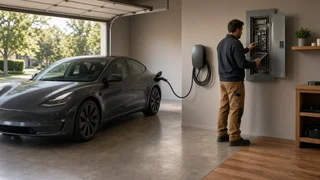
Licensed installer: Enphase products are generally installed through its certified installer network, and the work requires a licensed electrician. Electrical service capacity: your panel and service must handle the charger's load alongside existing circuits; some homes need a panel upgrade or load management. Backup configuration: using the car for outage power requires equipment that isolates the home from the grid and determines which circuits are backed up. Permits and inspection: local building and electrical permits are required, and inspectors will check the system against applicable codes and equipment safety listings for bidirectional EV equipment and grid interconnection. Utility approval: any configuration that can export to the grid typically needs an interconnection agreement before it is switched on. Location: DC units are bulkier than wall-mounted Level 2 chargers and need suitable mounting space, clearances and cable reach to the vehicle's charge port.
Who Should Consider It
The Enphase bidirectional charger makes the most sense for homeowners who already have or plan an Enphase solar and battery system, own or intend to buy a vehicle confirmed as compatible, and want meaningful outage backup or time-of-use savings from the large battery in their car. It is less compelling if your vehicle lacks bidirectional support, if you only need everyday charging, or if your utility offers no V2G program and backup power is not a priority. In those cases, a conventional Level 2 charger is simpler and less expensive, and it does not rule out adding bidirectional capability later.
Questions to Ask an Installer
Is the bidirectional charger currently available in my area, and what is the expected lead time? Is my vehicle, model year and connector type supported for both charging and discharging? Will my electrical panel need an upgrade, and what backup equipment is required? Which circuits can the car power during an outage, and for roughly how long given my typical usage? Does my utility allow grid export from this setup, and is there a V2G program I can join? How does the system coordinate between solar, a home battery and the vehicle? What warranty covers the charger, and how does bidirectional use affect my vehicle's battery warranty?
Getting clear answers to these questions will tell you whether the charger can deliver the backup or savings you expect, and whether the added cost and complexity over a standard home charger is justified for your situation.