ENERGY STAR EV Chargers for Home: What to Check Before You Buy
The Short Answer
An ENERGY STAR certified EV charger is a home charging unit that has been independently tested and meets the program's efficiency criteria. The main effect is lower energy use while the charger is idle, which is most of the time. Certification does not make your car charge faster, and it does not replace safety listing or a correct electrical installation. Choose a certified model that also fits your vehicle's connector and charging capability, your home's electrical capacity, and any rebate program you plan to use. If a utility or state rebate is part of your budget, check its rules first, because some programs require ENERGY STAR certification or a specific list of approved models.
What ENERGY STAR Certification Covers
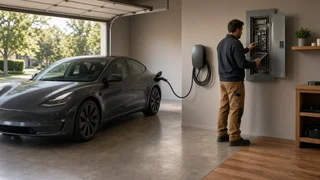
The device you mount on the wall is technically called EVSE (electric vehicle supply equipment). For most home AC charging, the actual conversion of grid power into battery power happens in the car's onboard charger. The EVSE manages the connection, communicates with the vehicle and switches power on and off safely. Because the EVSE is powered around the clock, its standby consumption adds up over years of ownership. ENERGY STAR criteria focus on keeping that idle and low-power consumption low while the unit still works properly.
Certification is not a measure of charging speed, build quality, weather resistance, app quality or customer support. Treat it as one checkbox among several.
How to Confirm a Charger Is Actually Certified
Brands often sell several versions of the same charger, and certification applies to specific model numbers. A hardwired version, a plug-in version, a different cable length, a different connector or a different amperage setting may be listed separately, and not every variant is necessarily certified.
Find the exact model number on the product listing, box or spec sheet, not just the product family name. Search that model number in the ENERGY STAR certified products finder for EV chargers. Check that the listed variant matches the connector type, installation method and power rating you intend to buy. If you are buying from a third-party seller, make sure the item is the same model and not a regional or discontinued version.
Level 1 vs Level 2 at Home
Level 1 charging uses a standard 120-volt household outlet and is slow, often adding only a modest amount of range overnight. Level 2 charging uses a 240-volt circuit, the same type used by electric dryers and ranges, and is what most owners mean by a home charger. ENERGY STAR certified home chargers are generally Level 2 units. Level 1 can be enough for short daily commutes or plug-in hybrids with small batteries. Level 2 is the usual choice for full battery-electric vehicles or longer daily driving.
Match the Charger to Your Vehicle
A more powerful charger only helps if the car can accept that power. Every EV has an onboard charger with a maximum AC charging rate, and that rate varies by manufacturer, model, model year, trim and sometimes optional equipment. Two versions of the same model can have different limits, so check the figure for your exact vehicle in the owner's manual or the manufacturer's specifications. If the car's limit is below the charger's output, the car will simply charge at its own maximum.
Connector type also matters. Many EVs sold in the US have used the J1772 connector for Level 2 charging, while Tesla vehicles and a growing number of other brands use the North American Charging Standard connector, standardized as SAE J3400. Some vehicles change connector type between model years. Buy a charger with the connector your car uses, or confirm that a certified adapter is supported by your vehicle maker. If you expect to own a different vehicle in the next few years, a charger with a swappable or dual-connector option may be worth considering.
Power Rating and Your Electrical Panel
Level 2 chargers are sold at different current ratings, measured in amps. Under standard US electrical code practice, EV charging is treated as a continuous load, so the circuit must be rated at 125 percent of the charger's continuous current. For example, a charger that delivers 40 amps continuously needs a 50-amp circuit. Many chargers let the installer set a lower maximum current to fit the available circuit.
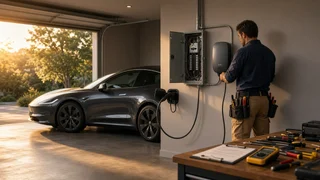
Whether your home can support a higher-amperage charger depends on your panel's capacity and existing loads such as HVAC, water heating and cooking appliances. A licensed electrician can perform a load calculation. If capacity is tight, options can include a lower current setting, a charger with load management that reduces output when other appliances run, or a panel or service upgrade. An upgrade can change the total project cost significantly.
Hardwired or Plug-In
Factor | Hardwired | Plug-in (240-volt outlet); Maximum power | Typically supports the highest current ratings a model offers | Limited by the outlet and circuit rating; Installation | Wired directly into a dedicated circuit by an electrician | Requires a properly installed outlet rated for continuous EV load; Moving the charger | Requires an electrician to disconnect | Can be unplugged and taken with you; Outdoor use | Often preferred for exposed locations | Outlet must be suitable for the location and conditions; Certification | Check that the hardwired variant is listed | Check that the plug-in variant is listed
Outlet quality matters for plug-in chargers. Sustained high current can overheat low-grade receptacles, so electricians often recommend heavy-duty, industrial-grade outlets for EV use. Follow the charger maker's installation requirements.
Safety Listing Is Separate
ENERGY STAR addresses efficiency, not electrical safety. Look for a listing from a nationally recognized testing laboratory, such as UL or ETL, on the charger itself. Local permits and inspections may be required for the installation, and some rebate programs ask for proof of a permitted, licensed installation.
Smart and Connected Features
Many certified chargers are networked, connecting over Wi-Fi or another link to an app. Useful functions include scheduling charging for off-peak hours, tracking energy use and receiving software updates. Some utilities offer time-of-use rates or demand-response programs that pay or credit owners for allowing charging to be shifted. These programs often accept only specific connected chargers, so check the list before buying if you want to participate. Some vehicles can schedule charging on their own, which may make charger-side scheduling less important.
Rebates and Incentives
Utility companies, states and some local governments offer rebates for home chargers or installation, and requirements vary widely. Common conditions include ENERGY STAR certification, a networked charger from an approved list, enrollment in a managed-charging or time-of-use program, installation by a licensed electrician, and applying within a set period after purchase. Federal tax credit rules for home charging equipment have changed in recent years. Confirm current eligibility with official sources or a tax professional instead of relying on older guides or retailer claims.
Pre-Purchase Checklist
Exact model number appears in the ENERGY STAR certified EV charger list, in the variant you are buying. Connector matches your vehicle, or a supported adapter path exists. Charger output is appropriate for your vehicle's onboard charging limit for its model year and trim. An electrician has confirmed panel capacity and the circuit size needed. Hardwired or plug-in choice fits your location, power needs and plans to move. Unit carries a recognized safety listing and suits indoor or outdoor mounting as needed. Cable length reaches the vehicle's charge port from where you park. Utility and state rebate rules have been checked before purchase, including any approved-model list. Warranty terms and the manufacturer's support reputation fit your expectations.
Next Step
Start with two facts: your vehicle's connector and maximum AC charging rate, and your utility's rebate requirements. Then have a licensed electrician assess your panel. With those in hand, narrow your options to certified models that fit all three, and compare the remaining choices on cable length, connected features, mounting needs and warranty.