Home EV Charger Installation Cost: What Drives the Price and How to Plan It
The EV charger install price for a home is not one fixed number. It is the sum of the charger itself, an electrician's labor, wiring materials, and often a permit and inspection. The factor that changes the total most is whether your home's electrical service has enough spare capacity for a new 240-volt circuit. If it does, and the charger can be mounted close to the main panel, the job is usually simple. If the panel is full or undersized, or the charger has to go far from the panel, the cost can rise substantially because of panel work, longer wire runs or trenching. This guide explains what makes up the cost of installing a car charging station at home, which conditions push the price up or down, and what to check before you request quotes or buy hardware.
The Short Answer: What You Are Actually Paying For
When people ask about the cost of a 240-volt charging station, they often mean the charger alone. The full electric car charging station installation cost usually covers several separate items. Some homes need only the first few. Others need all of them.
Cost component | What it covers | When it applies; Charger hardware | The wall unit (often called EVSE, electric vehicle supply equipment) and its cable and connector | Always, unless you use the portable cord supplied with some vehicles; Electrician labor | Running the circuit, mounting the unit or outlet, testing | Always for a new 240-volt circuit; Wire, breaker and conduit | Copper wire sized for the circuit, a two-pole breaker, conduit or protective sheathing | Always; cost grows with distance and circuit size; Permit and inspection | Local approval and a final inspection of the new circuit | Required in many jurisdictions; GFCI protection | Ground-fault protection, often a GFCI breaker for 240-volt receptacles | Common for plug-in installations under current electrical codes; Panel upgrade or subpanel | Replacing or adding a panel when there is no room or capacity | When the existing panel is full or near its limit; Service upgrade | Increasing the utility service to the home, sometimes involving the utility | When the whole home's supply capacity is insufficient; Trenching or wall repair | Underground runs to a detached garage or driveway post; patching finished walls | When the charger is far from the panel or in a finished space
Level 1 vs. Level 2: Two Very Different Price Profiles
Level 1 charging uses a standard 120-volt household outlet and the cord that comes with many EVs. Installation cost can be close to zero if a suitable outlet already exists near where you park. The trade-off is slow charging, which may be enough for drivers with short daily commutes and long overnight parking but often is not for larger batteries or higher mileage.
Level 2 charging runs on 240 volts, the same type of circuit used by an electric dryer or range. This is what most people mean by a home EV charger, and it is where nearly all installation cost comes from. Level 2 can typically replenish a day's driving overnight with time to spare, which is why most owners choose it despite the higher setup cost.
The Biggest Factor: Your Panel and Supply Capacity
Supply capacity means how much electrical current your home's service and main panel can deliver in total. An EV charger is a large, continuous load, so an electrician will check whether adding it could overload the service when other major appliances run at the same time. This is usually done through a load calculation.
Panel has open breaker slots and spare capacity: usually the simplest and least expensive scenario. Panel has spare capacity but no open slots: tandem breakers or a small subpanel may solve it, depending on what the panel allows. Panel or service lacks capacity: options include a lower-power charger, a load management device, or a panel or service upgrade, which is typically the most expensive path. Older or recalled panel models: some electricians will recommend replacement before adding any major circuit, which affects the total regardless of the charger.
Load management devices and some smart chargers can monitor household demand and reduce charging current automatically when other appliances are running. In homes with limited capacity, this can sometimes avoid a service upgrade. Whether it is acceptable depends on local code and the electrician's assessment.
Charging Power and Circuit Size
Charging power is how fast energy flows into the battery, and it depends on the circuit's amperage. Under US electrical code, an EV charger is treated as a continuous load, so it may draw only up to 80 percent of the circuit's breaker rating. For example, a charger set to deliver 32 amps needs a 40-amp circuit, and one delivering 48 amps needs a 60-amp circuit. Larger circuits require thicker, more expensive wire and use more of your panel's capacity.
Higher power is not always useful. Every EV has an onboard charger with a maximum AC charging rate, and that rate varies by model, model year and sometimes trim. If your vehicle accepts less than the charger can supply, the extra circuit capacity adds cost without faster charging. Check your specific vehicle's maximum AC charging rate before choosing circuit size, and consider whether a future vehicle might accept more.
Plug-In vs. Hardwired Installation
Many Level 2 chargers can either plug into a 240-volt receptacle, commonly a NEMA 14-50, or be hardwired directly to the circuit.
Plug-in: lets you unplug and take the charger with you when you move, and makes replacement easy. Current code often requires GFCI protection for these receptacles, which can add to material cost. Receptacle quality matters, because cheap outlets can overheat under long, continuous loads. Hardwired: required for higher-power settings above what a plug-in setup supports, avoids receptacle wear and GFCI breaker issues in many cases, and is often preferred for outdoor mounting. Moving the unit later requires an electrician.
Location and Distance From the Panel
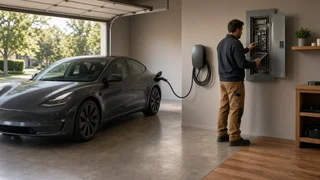
Labor and material costs grow with the length of the wire run and the difficulty of the route. A garage charger mounted on the other side of the wall from the panel is the easiest case. Costs rise when the circuit has to cross a finished basement, go through an attic, run along the exterior in conduit, or travel underground to a detached garage or a driveway pedestal. Drywall cutting and patching may or may not be included in a quote, so ask.
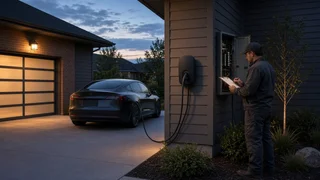
Outdoor installations need a charger rated for outdoor use and weather-appropriate fittings and conduit. Also consider cable length: the charger's cable must reach your vehicle's charging port comfortably, and port locations differ between models.
Vehicle Compatibility and Connector Standard
In North America, two connector standards are in use for home charging: J1772, used by most non-Tesla EVs historically, and the North American Charging Standard (NACS), standardized as SAE J3400 and used by Tesla. Many automakers have announced or begun a shift to NACS ports, with timing that varies by brand and model year. Adapters exist in both directions, though some owners prefer a native connector.
The connector does not change installation cost much, because the circuit is the same. It does affect which charger you buy. If your household may own EVs with different ports, check whether a charger offers interchangeable or dual connectors, or plan on using an adapter. Confirm the port type for your exact model year, since it can differ even within the same model name.
Smart Features and Charging Protocol
Basic chargers simply supply power. Smart chargers add Wi-Fi or app control, scheduling, energy tracking and, on some units, support for a charging protocol such as OCPP, which lets the charger communicate with utility or management platforms. Smart features raise the hardware price but can pay off in two ways: some utility rebates and time-of-use programs require a networked or certified charger, and scheduling makes it easy to charge during cheaper off-peak hours. Many vehicles can also schedule charging themselves, so a smart charger is not strictly necessary for that alone.
Installation Cost vs. Running Cost
The house car charger cost is a one-time expense. Ongoing cost depends on your vehicle's energy consumption, usually expressed in kilowatt-hours per 100 miles or miles per kilowatt-hour, multiplied by your electricity rate and the miles you drive. A faster charger does not change how much energy the car uses for a given distance; it only shortens charging time. Time-of-use rates, where available, can lower running cost noticeably if you charge overnight.
Ways to Reduce the Total Cost
Match circuit size to what your vehicle can actually accept rather than buying maximum power by default. Mount the charger as close to the panel as practical, as long as the cable still reaches your parking spot. Ask whether a load management device or a power-sharing charger can avoid a panel or service upgrade. Check your electric utility for rebates, discounted equipment or EV-specific rates; programs vary widely by provider. Check current federal, state and local incentives, since eligibility rules and availability change over time. Some automakers and dealers have offered installation credits or partner programs with new vehicle purchases; ask before you buy the car. Get at least two or three quotes that describe the same scope of work.
What to Ask When Comparing Quotes
Electric vehicle charging point installation cost quotes can differ widely because they often include different work. Use these questions to compare them on equal terms.
Did the electrician perform a load calculation, and does the quote assume the current panel is sufficient? What breaker size and wire gauge are included, and what charging current will the charger be set to? Is the installation plug-in or hardwired, and is GFCI protection included where required? Are the permit and inspection fees included? What is the exact route of the wire, and is wall patching or painting included? Is the charger hardware included, or are you supplying it? What happens to the price if the electrician finds the panel needs work once the job starts? What warranty covers the labor?
Should You Install It Yourself?
A 240-volt circuit carrying a heavy continuous load is a fire and shock risk if done incorrectly. Many jurisdictions require a permit, and some limit electrical work to licensed electricians. Charger manufacturers may require professional installation for the warranty to remain valid, and an unpermitted installation can complicate insurance claims or a future home sale. For most owners, hiring a licensed electrician is the sensible choice, and the savings from doing it yourself are smaller than they first appear once permits and materials are counted.
Your Next Step
Before shopping for a charger, look up your vehicle's maximum AC charging rate and port type for its model year, note where you park relative to your electrical panel, and check how much capacity the panel has, which an electrician can confirm. With those three facts, you can choose an appropriate charger and circuit size and request quotes that reflect your home's real EV charger setup cost rather than a generic estimate.