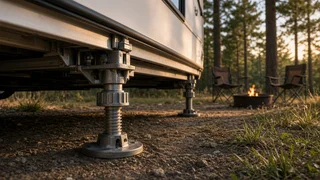
Drop-Down Jacks for Caravan Stabilization
The Short Answer
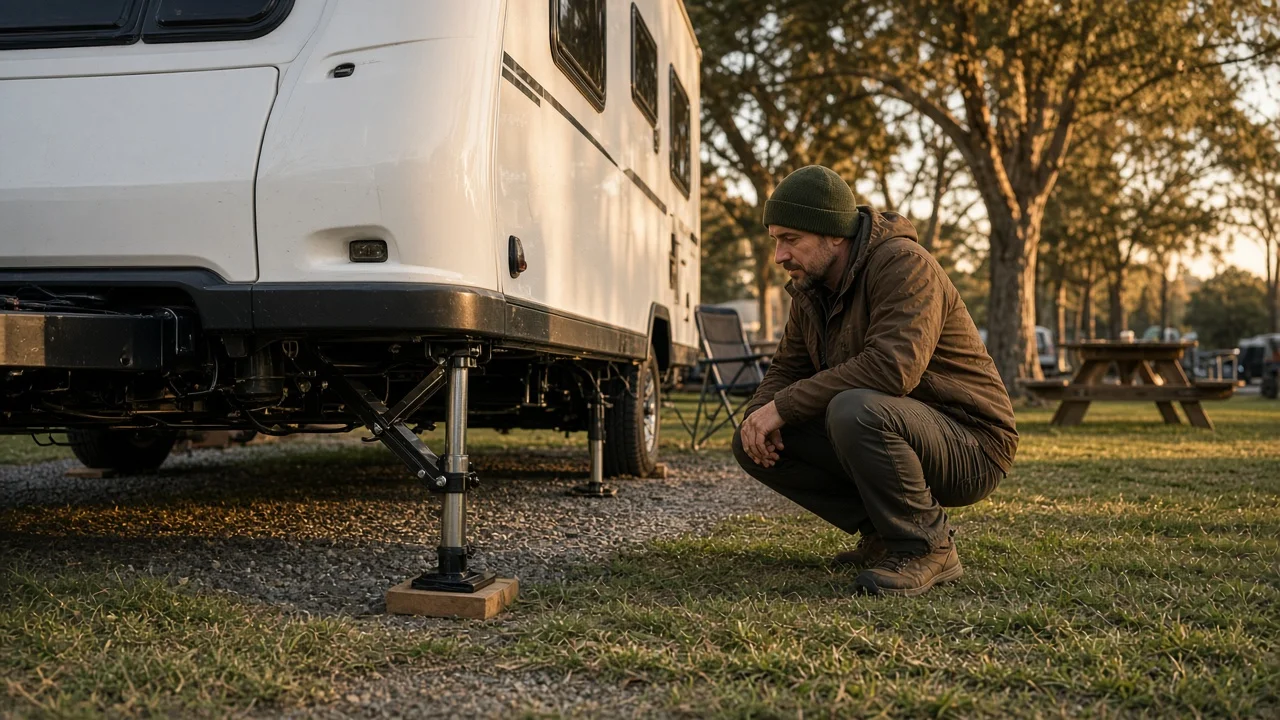
A drop-down jack is a frame-mounted support leg that swings or slides down from a stowed position to brace a parked caravan (called a travel trailer in most of the US) against the ground. Its main job is stabilization: it reduces the rocking and bouncing you feel when people move around inside. On most designs it is not meant to lift the caravan, take its weight off the tires, or do the main work of leveling it. Leveling is usually done first, with ramps or blocks under the wheels for side-to-side and the tongue jack for front-to-back, and the drop-down jacks are lowered afterward until they make firm contact.
The condition that changes this answer is the manufacturer's rating. Some heavier-duty drop-down units are sold for limited leveling or load-bearing use. Whether a particular jack can safely carry weight depends entirely on what its maker states, so treat any product without a clear rating and intended-use statement as stabilization-only.
How Drop-Down Jacks Fit Into Campsite Setup
A typical sequence looks like this, and the jacks come near the end of it:
Position the caravan and check side-to-side level with a bubble level or app. Correct side-to-side tilt with leveling ramps or blocks under the wheels. Chock the wheels before unhitching. Adjust front-to-back level with the tongue jack. Lower each drop-down jack, on a pad if the ground is soft, until it is snug against the ground without lifting the frame. Before leaving, raise and secure every jack in its stowed position.
Using stabilizer jacks to raise one corner of a caravan can put loads on the jack and the frame that they were not designed for, and it can shift the caravan off its chocks or level. If a corner is noticeably low, the fix is usually more blocking under the wheel, not more jack extension.
What to Check Before Buying
No verified product specifications, prices or test results were available for this guide, so the points below are general selection criteria rather than recommendations for specific models. Confirm each one against the manufacturer's documentation and your caravan's own specifications.
Rated Capacity and Intended Use
Look for a stated load rating and a clear statement of whether the jack is for stabilizing only or also for supporting weight. Compare the rating with your caravan's weight figures, which are normally listed on the manufacturer's label or in the owner's documentation. A higher rating generally indicates a sturdier build, but it does not turn a stabilizer into a lifting jack unless the maker says so.
Mounting and Frame Compatibility
Drop-down jacks are usually sold as bolt-on or weld-on units. Check that the mounting plate or bracket suits the shape and size of your caravan's frame members, and that there is clear space at each intended mounting point, away from tanks, plumbing, wiring and suspension parts. Welding to a chassis may affect the frame's coating or a manufacturer warranty, so check your caravan maker's guidance before choosing a weld-on design. Frame layouts vary by model, model year and floor plan, so fitment that works on one caravan should not be assumed for another.
Height Range and Ground Clearance
Two measurements matter here, and you will need to take them on your own caravan. First, the distance from the frame to the ground when parked, which tells you how much extension the jack needs. Second, how far the stowed jack hangs below the frame, which affects ground clearance on rough campsite tracks, driveways and ramps. A jack that cannot reach the ground on uneven sites, or that sits too low when stowed, is a poor fit regardless of its other features.
Foot Design and Ground Contact
A larger foot spreads the load and is less likely to sink into grass, sand or gravel. If the built-in foot is small, plan to use separate jack pads. Swivel feet can help on uneven ground by sitting flatter against the surface.
Operating Method
Manual drop-down jacks are typically operated with a hand crank, and many can also be driven with a cordless drill and a suitable socket adapter, which speeds up setup. Powered versions add convenience but also add wiring, electrical load and more parts that can fail. Check whether a drill can be used on the model you are considering and whether the maker sets any limits on doing so.
Locking and Stowage
The jack should lock securely in both the deployed and stowed positions, usually with a pin, latch or spring mechanism. A leg that can drop while driving is a hazard, so check how positive the stowed lock is and how easy it is to confirm by sight before setting off.
Corrosion Resistance
Drop-down jacks sit under the caravan, exposed to road spray, mud and, in some regions, road salt. Look for a durable protective finish such as galvanizing or powder coating, and check whether the screw mechanism is accessible for cleaning and lubrication.
How Many You Need
Stabilizer jacks are most often fitted at or near the four corners of the frame, so they are commonly sold in pairs or sets of four. Check whether your caravan already has corner stabilizers fitted, since many travel trailers do, and whether you are adding, replacing or upgrading them.
Quick Comparison: Stabilizing vs Leveling Equipment
Equipment | Main job | Typically bears caravan weight? Leveling ramps or blocks | Side-to-side leveling at the wheels | Yes, through the tires; Tongue jack | Front-to-back leveling and supporting the hitch | Yes, at the front; Drop-down stabilizer jacks | Reducing movement once parked | Not usually; check the rating; Rated leveling jacks | Leveling and supporting weight where the maker allows | Yes, within the stated rating
Gaps to Fill Before You Decide
This guide could not draw on verified prices, load ratings, dimensions or independent test results for specific drop-down jacks. Before buying, get the rated capacity, extended and retracted heights, mounting dimensions and stated intended use from the manufacturer, and compare them with measurements taken from your own caravan frame. If you are unsure about mounting, especially for a weld-on unit, a trailer or RV service shop can confirm fitment for your model.