Bolt-On Drop-Leg Trailer Jacks: What to Check Before You Buy
The Short Answer
A bolt-on drop-leg jack is a sensible upgrade for most caravans and travel trailers that already have a standard jack mounting point, because the drop leg lets you reach the ground quickly instead of cranking through the jack's full travel at every campsite. Pick one by confirming four things in this order: the rated capacity comfortably exceeds your loaded tongue weight, the mount style matches your trailer's frame, the lift and drop-leg travel cover the height range you need, and the retracted jack and its handle clear the tow vehicle, propane tanks and ground while towing. If your trailer has no compatible mounting point, a bolt-on jack may still work with a separate bracket, but that changes the job from a simple swap to a fitment and frame-strength question.
What a Bolt-On Drop-Leg Jack Is
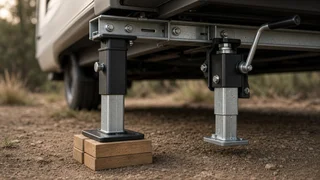
A trailer tongue jack supports the front of the trailer when it is unhitched and lets you raise or lower the coupler onto the hitch ball. A drop-leg jack adds a separate inner leg that slides out of the main tube and locks in position with a pin. You pull the pin, let the leg drop near the ground, pin it, and then use the crank only for the final adjustment. That saves time and effort, especially on trailers with high tongues or on sloping pitches.
Bolt-on means the jack attaches with bolts, either directly to a mounting plate on the A-frame or through a bracket clamped or bolted to the tongue. The alternative is a weld-on jack, where the mount is permanently welded to the frame.
The term drop leg is also used for corner stabilizer jacks that bolt to the trailer's side frame rails. Those steady the trailer against rocking once it is parked and leveled; they are not designed to lift the trailer or carry tongue weight. Most of this guide covers tongue jacks, with a short section on corner units at the end.
Bolt-On vs Weld-On
Factor | Bolt-on | Weld-on; Installation | Hand tools, often a direct swap | Requires welding skill and equipment; Replacement | Unbolt and swap | Cut off or grind out the old mount; Frame finish | Paint and galvanizing left intact | Heat damages coatings; needs refinishing; Fit flexibility | Limited by bolt pattern or bracket design | Can be placed almost anywhere on the frame; Ongoing care | Bolts should be checked for tightness | No fasteners to loosen
For most owners replacing a worn or undersized jack, bolt-on is the practical choice. Weld-on makes more sense on custom or heavy-duty frames where no bolt-on mount fits properly.
Match the Mount Type to Your Trailer
Mount style is the most common reason a jack does not fit. Look at what is on your trailer now, or at the frame where a jack will go, before comparing anything else.
A-frame mount: The jack drops through a hole in a plate at the point where the two frame rails meet behind the coupler and bolts down from above. This is typical on travel trailers and caravans with V-shaped tongues. Check that the jack's bolt pattern and tube diameter match the existing hole and plate. Swivel bracket mount: The jack attaches to a bracket bolted to the side of a straight tongue and pivots up horizontally for towing. Common on utility, boat and smaller trailers. Confirm the bracket suits your tongue's width and profile, and that it is rated for the jack's load. Square or rectangular tube mount: Some jacks clamp or bolt around a straight box-section tongue. The bracket must match the tube dimensions; a loose fit lets the jack shift under load. Round pipe mount: A sleeve or clamp mount used on some older or lighter trailers. Less common for full-size caravans.
If you are replacing an existing jack, measure its tube diameter, bolt hole spacing and mounting plate before ordering, and compare those to the new jack's listed mounting dimensions. Do not assume two jacks with the same capacity share the same mount.
Capacity: Size It to Tongue Weight, Not Trailer Weight
A tongue jack carries tongue weight, which is the downward force the trailer's front puts on the hitch, not the full weight of the trailer. A commonly used rule of thumb for conventional bumper-pull trailers is that tongue weight runs roughly 10 to 15 percent of loaded trailer weight, but your actual figure depends on how the trailer is built and loaded. Front storage boxes, batteries, propane tanks and a full fresh-water tank near the front all push it higher.
Use the trailer's published tongue weight as a starting point, then account for your typical load, or measure it with a tongue weight scale or at a public scale. Choose a jack rated above that figure with a margin, because the jack also takes side loads when the trailer is bumped, when the ground is soft, or when you raise the coupler off the hitch. Buying the highest-rated jack available is not automatically better: heavier jacks can be larger, harder to crank and may not suit a light trailer's mount.
Some listings state separate lift and static (support) capacities. Lift capacity is what the jack can raise; static capacity is what it can hold once set. Size to the lift figure, since that is the more demanding job.
Travel, Drop-Leg Range and Ground Clearance
Three height figures matter, and listings do not always present them the same way.
Screw travel (lift): How far the crank mechanism raises or lowers the foot. This sets how much fine adjustment you get once the drop leg is pinned. Drop-leg range and pin spacing: How far the inner leg extends and how far apart the pin holes are. Closer spacing means less cranking to cover the gap; wider spacing reach the ground faster on high tongues but leaves more to crank. Retracted height: The jack's length when fully raised with the drop leg stowed. This must clear the ground while towing, including on ramps, dips and driveway transitions.
Measure your coupler height when hitched, and the height you need to raise it to clear the hitch ball and allow front-to-back leveling at camp. The combined drop-leg range plus screw travel should cover that span from the ground with some room to spare, including when you set the foot on a block or pad. On a steeply sloped pitch, a jack with too little total range may not level the trailer front to back.
Wind Style and Handle Clearance
Manual jacks come as top-wind, where the crank turns on top of the jack, or side-wind, where a geared crank sticks out to the side. Side-wind jacks usually need less effort per turn on heavier tongues. Top-wind jacks have a more compact footprint but can clash with items mounted on the tongue.
On caravans, the A-frame is often crowded with propane cylinders, a battery box, a storage pod or a cover. Check that the crank handle can turn through a full rotation without hitting any of them, and that you can reach it comfortably from the side you normally stand on. Also confirm the jack's top does not contact the tow vehicle's tailgate or bumper during tight turns.
Manual or Powered
Electric drop-leg tongue jacks are available and reduce effort considerably, which helps on heavier trailers or for owners with limited grip or shoulder strength. They need a 12-volt supply, usually from the trailer battery, plus suitable wiring and fusing. Confirm the jack has a manual override in case the battery is flat or the motor fails, and check whether it adds features you will actually use, such as a work light. A manual drop-leg jack is simpler, has fewer failure points and is usually the better value for lighter trailers.
Build Details Worth Comparing
Finish: Zinc plating, powder coat or paint all protect against rust to different degrees. Trailers that see salted winter roads, coastal campsites or boat ramps benefit from a more corrosion-resistant finish. Foot: A wider footplate or swivel foot spreads load on soft ground and gravel. Some jacks accept add-on foot pads or wheels; a caster wheel helps move a light trailer by hand but is unsuitable on soft or uneven ground under load. Pin and retention: Look for a pin with a secure clip or spring retainer so it cannot work loose while traveling. A lost pin lets the drop leg fall. Internal gearing and grease points: Enclosed gears and an accessible grease fitting make long-term maintenance easier. Included hardware: Check whether bolts, nuts and any bracket are supplied, and whether the bolts are of an appropriate grade for the load.
Installation Checks
With the trailer hitched to the tow vehicle, or with the tongue securely supported on a stand rated for the load, remove the old jack and clean the mounting surface. Fit the new jack with the hardware specified by the jack's maker and tighten fasteners evenly to the torque the maker recommends. Avoid drilling new holes in the frame unless you are certain the location does not weaken the structure; if in doubt, consult the trailer maker or a trailer shop.
After installation, cycle the jack through its full screw travel and test each drop-leg pin position. Recheck bolt tightness after the first few trips, since mounts can settle. If you install an electric jack, route and fuse the wiring so it cannot chafe against the frame.
Using the Jack at Camp
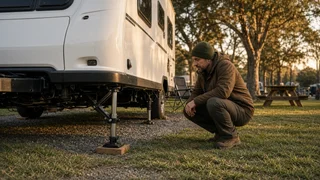
The tongue jack handles front-to-back leveling and supports the trailer once unhitched. Side-to-side leveling is done with blocks or ramps under the wheels before unhitching. Chock the wheels before you lift the coupler off the ball. On soft ground, put a solid pad or block under the jack foot so it does not sink. Never work under a trailer supported only by its tongue jack or stabilizers.
Bolt-On Drop-Leg Stabilizer Jacks
If your search was for corner jacks rather than a tongue jack, the same drop-leg idea applies: a pinned leg drops close to the ground and a short screw or crank takes up the remaining gap. These bolt to the trailer's main frame rails near each corner. When choosing them, confirm they fit your frame rail size and shape, that the retracted height clears the ground and any under-floor tanks or plumbing, and that the leg range suits your typical pitch. Treat them only as steadying devices; lowering them should take up slack, not lift the trailer. Level first, then deploy stabilizers.
Quick Buying Checklist
Know your loaded tongue weight and choose a jack rated above it with margin. Identify your mount type and match tube diameter, bolt pattern or bracket fit. Confirm drop-leg range plus screw travel covers your coupler height and leveling needs. Check retracted height for towing ground clearance. Make sure the crank handle or motor housing clears propane tanks, battery box and tow vehicle. Decide between manual and electric based on tongue weight and your physical needs. Prefer a corrosion-resistant finish if you tow in salted or coastal conditions. Verify the pin has a secure retainer and that mounting hardware is included.