Drop-Leg Stabilizer Jacks with Mounting Channel: What to Check Before You Buy
The short answer
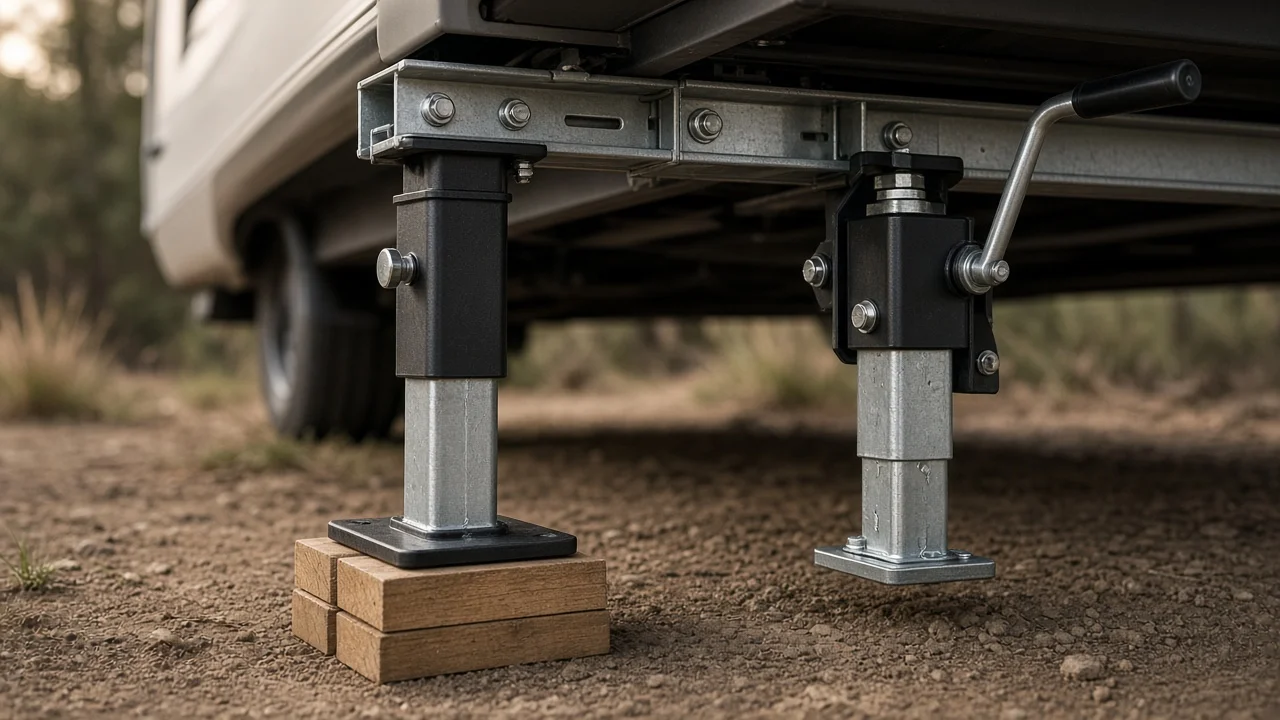
A drop-leg stabilizer jack with a mounting channel is a frame-mounted support for a travel trailer or caravan. The channel attaches to the trailer frame, and the jack's telescoping leg drops toward the ground and is then fine-tuned with a screw or crank. It can be a good choice if you want a permanently installed stabilizer with a long reach. It suits trailers that sit well above the ground and owners who don't want to place loose stands at every stop. Whether a given kit suits your trailer depends mainly on three things: whether the channel fits your frame, whether you can install it the way the kit requires (welding or bolting), and whether the leg's adjustment range matches your trailer's height at the frame.
One condition changes how you should use any stabilizer jack. Stabilizers reduce bounce and sway once the trailer is already level and resting on its tires and tongue jack. They are not designed to lift or level the trailer. If you need to raise a side or corner, use leveling blocks or a jack rated for lifting, then lower the stabilizers into firm contact.
What the parts do
The mounting channel is a bracket, usually a formed steel channel, that is welded or bolted to the trailer frame rail. The jack body attaches to that channel. On some designs the jack can be unbolted from the channel for service or replacement without disturbing the frame mount, but this varies by design, so check the product details.
The drop leg is an inner tube that slides out of the jack body. It is usually held at a set length by a pin through one of several holes, which gets the foot close to the ground quickly. A threaded screw, turned by a hand crank or sometimes a drill driver, then brings the foot into firm contact. This two-stage adjustment is the main reason to choose a drop-leg design over a simple fixed-length stabilizer: it covers a wider range of frame heights and uneven ground.
What to check when choosing
Frame fit: Measure your frame rail's profile and width, and confirm the channel is made for that frame type. A channel that doesn't seat squarely can twist under load. Mounting method: Confirm whether the kit is weld-on, bolt-on or both, and what hardware is included. Load rating: Look for the manufacturer's stated rating per jack and whether it applies to stabilizing only. Do not treat a stabilizer rating as a lifting rating. Adjustment range: Compare the leg's shortest and longest reach with the height from your frame to the ground at the mounting point, allowing for sloped sites. Stowed clearance: Check how far the jack hangs below the frame when retracted, so it won't strike the ground on steep driveways, ramps or ferry ramps. Foot design: A wider foot spreads load on soft ground. Some owners add separate pads under the foot on grass, gravel or asphalt that softens in heat. Operation: Check whether the screw accepts a hand crank only or also a socket or drill adapter, and where you will stand to reach it. Finish and materials: Plating or powder coating affects corrosion resistance, which matters if you tow on salted winter roads or camp near the coast. Quantity: Confirm whether the listing is for a single jack, a pair or a set of four, and whether channels are included for each jack.
Weld-on versus bolt-on mounting
Factor | Weld-on channel | Bolt-on channel; Installation | Needs competent welding on the frame | Uses bolts or clamps, sometimes with drilling; Removability | Effectively permanent | Can be removed or relocated; Frame and warranty | Check the trailer maker's guidance before welding | Check the maker's guidance before drilling the frame; Ongoing checks | Inspect welds for cracks | Recheck bolt tightness periodically
Both approaches modify the trailer frame, and frame designs differ between manufacturers, models and model years. Before installing, check your trailer's owner documentation or ask the manufacturer or dealer whether welding or drilling is permitted and where. If you are not confident welding structural steel, a trailer or RV service shop is the safer route.
Where the jacks usually go
Stabilizers are normally mounted near the corners of the trailer, ahead of and behind the axles, where the body tends to rock most. Before committing to a position, check for obstructions along the frame: wiring, brake lines, plumbing, propane lines, tanks and existing factory stabilizers. You also need room for the leg to drop straight down and space to reach the crank point.
Using them correctly at the campsite
Level the trailer first, chock the wheels, and set the tongue jack. Then lower each drop leg to the nearest pin position above the ground, insert the pin, and crank the screw down until the foot is firmly in contact. Tighten each jack only enough to take out movement; cranking hard can lift a corner and work against your leveling. Retract all stabilizers fully and confirm the pins are secured before moving the trailer.
Gaps in the available information
No specific product evidence was supplied for this guide. That means no load ratings, adjustment ranges, dimensions, prices, brands or test results. Treat the checks above as a framework, and confirm every figure against the specific product listing and your own trailer measurements before buying.