Electric RV Stabilizer Jacks: What to Check Before You Buy
The Short Answer
Electric stabilizer jacks are a worthwhile upgrade if you set up camp often and want to stop cranking manual jacks. They do not level your RV. They steady a trailer that has already been leveled, reducing the bounce and sway you feel when people move around inside. Before buying, confirm four things: the jacks will mount to your frame, they reach the ground at your typical site heights, your 12-volt system can power them safely, and they include a manual override for when the motor or battery fails. If you want push-button leveling that actually raises corners of the coach, you need an automatic leveling system, which is a different and usually more involved product.
What Stabilizer Jacks Do and Don't Do
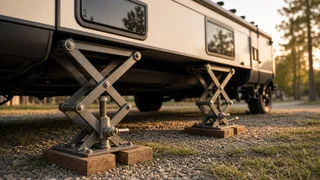
A parked travel trailer or fifth wheel rests on its tires, suspension and hitch jack or landing gear. Those points let the body flex and rock. A stabilizer jack adds a firm contact point at a corner of the frame, which takes some of that movement out. Most stabilizer jacks use a scissor-type mechanism that folds up under the frame for travel and extends down to the ground at camp.
Most manufacturers state that stabilizer jacks are not intended to lift the RV or bear its weight. Using them to raise a low side, or to take load off the tires, can bend the jack, damage the frame mount or strip the drive mechanism. Leveling is done first with blocks, ramps or the hitch jack; stabilizers go down last, snug against the ground, and come up first.
Electric, Manual or Hydraulic Leveling
Type | How it works | Main advantage | Main trade-off; Manual scissor stabilizers | Crank handle or drill adapter turns a screw | Simple, light, nothing to wire | Kneeling and cranking at each corner; Electric stabilizers | 12-volt motor drives the screw at each jack | Fast, consistent setup with a switch | Wiring, battery draw and more parts that can fail; Hydraulic or electric leveling systems | Powered jacks designed to lift and level the coach | Can level and stabilize together, often automatically | Higher cost and more complex installation; not always offered for lighter trailers
Electric stabilizers sit in the middle. They save effort and time compared with manual jacks, but they keep the same basic job: steadying, not lifting.
What to Check Before Buying
Frame fit and mounting
Look under your RV and identify where each jack would mount. Check the frame rail width and shape, the space around tanks, plumbing, wiring and the spare tire, and whether the location is close enough to the corners to be effective. Some kits bolt on, others require welding; confirm which your trailer allows and whether modifying the frame affects your warranty. If you are replacing existing manual jacks, compare the new mounting footprint with the old one rather than assuming it will line up.
Retracted and extended height
Two measurements matter. Retracted height determines ground clearance on the road; a jack that hangs too low can catch on driveway lips, speed bumps or uneven campsite entrances. Extended reach determines whether the jack touches the ground at sites where you have leveled with blocks or parked on a slope. Measure the distance from your frame to the ground at the jack locations and compare it with the product's stated range. If you often camp on uneven ground, you may need pads or blocks under the feet to close the gap.
Load rating and intended use
Stabilizer jacks carry a rating, but that number describes stabilizing capacity, not a license to lift the trailer. Choose jacks that the manufacturer lists as suitable for your RV type and size class, and treat the rating as a sign of build strength rather than a target to work up to.
Power supply and wiring
Electric jacks run from the RV's 12-volt house battery. Check that the kit includes, or specifies, appropriate wire gauge, fuses or circuit breakers, and a sensible place to tie into your system. Motors draw significant current while running, so a weak or nearly flat battery can make jacks slow or stop partway. Consider how you will retract the jacks if you are boondocking with a low battery or if the tow vehicle is not connected.
Controls
Options range from a single switch that runs all jacks to individual switches per corner, wall-mounted panels and handheld or wireless remotes. Individual control helps on uneven ground, where one corner needs more travel than another. Think about where you want to stand when operating them; being able to see each jack as it touches down reduces the risk of overextending.
Automatic stop and overload protection
Look for limit switches or current-sensing shutoffs that stop the motor when the jack is fully retracted, fully extended or meets firm resistance. Without them, holding a switch too long can strain the motor or the mount. A travel-position warning or indicator is also useful if you are prone to forgetting a jack before pulling out.
Manual override
Every electric jack should have a way to crank it by hand or with a drill if the motor, switch or battery fails. Confirm the override method, check that the access point is reachable once the jack is installed, and keep the required tool in the RV.
Weather and corrosion resistance
Jacks under the frame face road spray, salt, mud and gravel. Check the finish on the metal parts, how well the motor housing is sealed, and whether connectors are weather-resistant. If you travel in winter or near the coast, corrosion protection deserves more weight in your decision.
Footpads
Small feet can sink into soft ground or dig into asphalt. Check the foot size and whether add-on pads fit. Wider pads spread the contact area and help on grass, gravel and sand.
Installation: DIY or Professional
A confident DIYer with the right tools can install a bolt-on kit, but the job combines frame work and 12-volt wiring under the trailer. If the kit requires welding, if you are unsure where to tap power, or if your RV is under warranty, a professional RV service shop is the safer choice. Ask the installer to confirm clearance with the jacks retracted and to show you where the fuse and manual override are.
Using Electric Stabilizers Correctly
Level the RV first using blocks, ramps or the hitch jack. Chock the wheels before lowering any stabilizer. Lower each jack until it makes firm contact, then stop; do not try to raise the RV with it. Use pads on soft or hot surfaces. Retract all jacks fully and confirm visually before moving the RV.
Ongoing Maintenance
Keep the screw and pivot points clean and lubricated according to the manufacturer's guidance, check mounting bolts for tightness periodically, and inspect wiring for chafing where it runs along the frame. Operate the jacks occasionally during long storage so the mechanism does not seize, and test the manual override before a trip so you know it works when you need it.
Are Electric Stabilizer Jacks Right for You?
They make the most sense if you move campsites frequently, find manual cranking difficult, or simply want quicker setup. If you mostly park in one place for long stays, manual jacks may be enough. If what you really want is automatic leveling, compare full leveling systems instead. Whichever you choose, base the decision on measured frame clearance, verified compatibility with your specific RV, adequate battery capacity and a reliable manual backup.