Extinguishers for combustible metal fires
The short answer
Fires involving burning metals such as magnesium, titanium, sodium, potassium, zirconium or metallic lithium require a Class D extinguisher. In the US classification system, Class D is the category reserved for combustible metals, and it is the only extinguisher type intended for them. Common household and vehicle extinguishers rated A, B or C are not designed for metal fires and can be ineffective or make the fire more dangerous.
One qualification changes the answer for many drivers: a lithium-ion battery fire in an electric or hybrid vehicle is generally not treated as a combustible metal fire. Lithium-ion cells contain very little metallic lithium, and fire services and vehicle manufacturers typically direct responders to use large volumes of water on EV battery fires rather than Class D agents. A Class D extinguisher is therefore not an EV battery fire solution.
What makes a metal fire different
Burning metals reach extremely high temperatures and can react with substances that put out ordinary fires. Water can react violently with some burning metals, producing hydrogen gas or causing molten metal to spatter. Carbon dioxide may fail to smother the fire and can react with certain metals. Standard multipurpose dry chemical agents are not formulated to form a heat-resistant crust over molten metal. These reactions are the reason metal fires sit in their own class.
How Class D extinguishers work
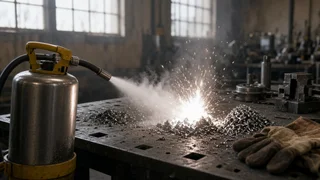
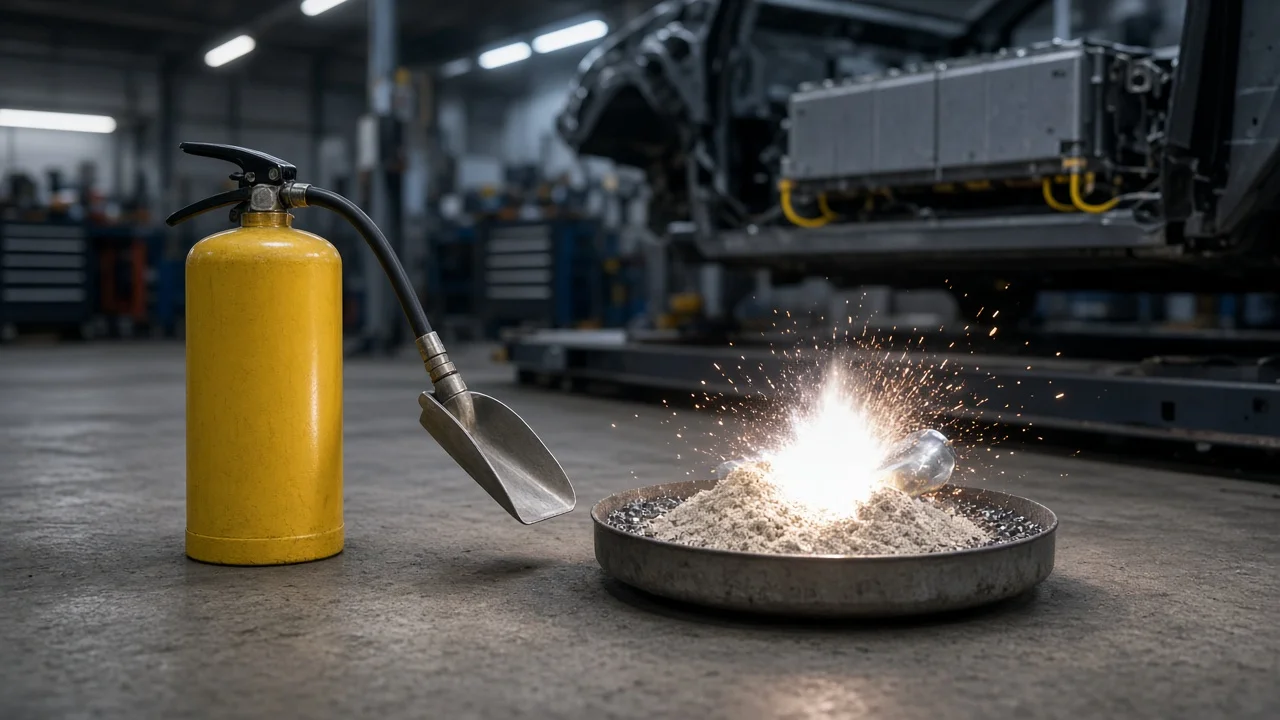
Class D extinguishers use dry powder agents, not the dry chemical found in ABC units. The powder is applied gently, usually through a low-velocity nozzle or applicator wand, so it covers the burning metal without scattering it. The agent smothers the fire by excluding air and absorbing heat, often forming a crust over the metal.
Class D agents are not universal. Each extinguisher is listed for specific metals, and an agent suited to one metal may not suit another. Commonly referenced agent types include:
Sodium chloride-based powder, used on a range of metals including magnesium and sodium; Copper-based powder, developed mainly for metallic lithium fires; Graphite-based powder, used on several metals, including some at very high temperatures
The label on a specific extinguisher states which metals it is listed for, and that label is the deciding reference. In the US, Class D extinguishers are commonly marked with a yellow star symbol containing the letter D.
How Class D differs from other extinguisher classes
Class | Fire type | Typical agent; A | Ordinary combustibles such as wood, paper, cloth and many plastics | Water, foam or multipurpose dry chemical; B | Flammable liquids and gases such as gasoline and oil | Foam, CO2 or dry chemical; C | Energized electrical equipment | Non-conductive agents such as CO2 or dry chemical; D | Combustible metals | Metal-specific dry powder; K | Cooking oils and fats | Wet chemical
Where combustible metals show up in vehicles
Some vehicles use magnesium alloys in parts such as wheels, transmission or engine housings, steering components and seat frames. Use varies by manufacturer, model, generation and trim, so confirm for a specific vehicle through the manufacturer’s documentation or emergency response guide. In a severe vehicle fire, these parts can ignite once other fuels have heated them, and spraying water on burning magnesium can produce flare-ups. This hazard concerns professional responders far more than drivers carrying a portable extinguisher.
What this means for a driver
For ordinary roadside fire response, a small extinguisher rated for Class B and C fires, or a multipurpose ABC unit, is the type most often recommended for passenger vehicles. A Class D extinguisher is a specialized tool, usually found in workshops, machining facilities, laboratories and industrial sites that handle metal fines or shavings. It is not a typical item for a road car.
If a vehicle fire appears to involve burning metal, shows intense white light or sparking, or involves an EV battery pack, the sensible response is to get everyone away from the vehicle, stay well back and upwind, and call 911. Tell the dispatcher about the vehicle type and powertrain so responders can bring the right equipment and tactics.
Gaps in the available information
This overview is based on general fire classification principles. No product-specific evidence was available, so it gives no extinguisher brands, capacities, ratings, prices or test results. Anyone choosing a Class D extinguisher for a workshop or other site should match the unit’s listing to the exact metals present and follow applicable fire codes and the manufacturer’s instructions.