Extinguishers for Flammable Liquid Fires: Fire Class and Choosing the Right Type
The short answer
In the United States, fires involving flammable and combustible liquids are Class B fires. That covers gasoline, diesel, motor oil, transmission fluid, many solvents and similar liquids a driver might carry or that a vehicle uses. To fight them, use an extinguisher whose label includes a B rating. Common choices are multipurpose ABC dry chemical, BC dry chemical, carbon dioxide (CO2), foam rated for Class B, and clean agent units. Plain water extinguishers are not suitable.
One qualification changes the answer in some cases. Cooking oils and fats in commercial kitchens fall under a separate category, Class K, and need a wet chemical extinguisher. Electric vehicle traction battery fires are also a different problem, covered below. For fuel and fluid fires around a conventional car, truck or garage, Class B is the class that matters.
How US fire classes differ from other systems
US extinguisher labels follow the classification used in NFPA standards and UL testing. International readers, or anyone buying an imported extinguisher, may see different letters, so it helps to know how they line up.
Fuel type | US class | European/Australian equivalent; Ordinary combustibles (wood, paper, cloth, some plastics) | A | A; Flammable liquids (gasoline, diesel, oil, solvents) | B | B; Flammable gases (propane, natural gas) | B | C; Energized electrical equipment | C | Not a separate fuel class; marked as safe for electrical use; Combustible metals | D | D; Cooking oils and fats | K | F
The key difference is that the US groups flammable gases with liquids under Class B, while European and Australian systems give gases their own class. The US Class C letter does not describe a fuel at all; it means the extinguishing agent does not conduct electricity, which matters when wiring or a battery is still live.
Why flammable liquid fires need a specific extinguisher
A liquid fuel does not burn as a liquid. Its vapor burns above the surface, and the liquid keeps feeding vapor as long as it is hot enough. An effective agent must either interrupt the chemical reaction in the flame, smother the vapor by cutting off oxygen, or form a barrier over the liquid surface.
Water does none of these well. A stream of water can splash burning fuel and spread the fire, and because most fuels are lighter than water and do not mix with it, the fuel can float and keep burning on top. That is why water-only extinguishers carry an A rating but no B rating.
Extinguisher types that work on Class B fires
ABC dry chemical (monoammonium phosphate): The most common multipurpose type. Works on liquid fuels, electrical fires and ordinary combustibles such as upholstery. The powder is mildly corrosive and messy, and it can damage electronics and engine bay components if not cleaned up promptly. BC dry chemical (sodium or potassium bicarbonate): Effective on liquid fuel and electrical fires and generally less corrosive than ABC powder, but it does not carry an A rating, so it is weaker on burning seats, carpet or other solid materials. Carbon dioxide (CO2): Leaves no residue and is safe on electrical equipment. It works by displacing oxygen, so its effectiveness drops outdoors and in wind, and the fire can reignite once the gas disperses. CO2 units tend to be heavy for their capacity, and the discharge horn gets extremely cold. Foam (AFFF, film-forming foam and similar): Forms a layer over the liquid surface that suppresses vapor and helps prevent reignition, which makes it well suited to fuel spills. Many foam units also carry an A rating. Some fluorinated foams face increasing regulatory restrictions, and fluorine-free alternatives are becoming more common. Clean agent (halocarbon types such as Halotron): Leaves little or no residue and is safe on electrical equipment, which appeals to owners of collector cars and vehicles with sensitive electronics. These units usually cost more for a given rating than dry chemical.
Reading the B rating on the label
A US label such as 1-A:10-B:C or 5-B:C tells you both which fire classes the unit is listed for and how capable it is. For Class B, the number in front of the letter roughly corresponds to the area, in square feet, of a flammable liquid fire that a non-expert operator should be able to extinguish under test conditions. A higher number means more capacity.
Treat that figure as a comparison tool, not a promise. Real fires involve wind, pressurized fuel lines, pooled fuel under a vehicle and burning plastics, all of which make them harder than a test pan. A small unit can knock down an early fire, but it empties in seconds.
Choosing an extinguisher for a vehicle
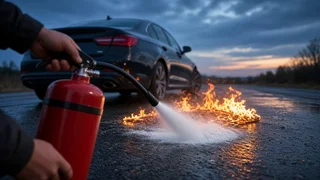
For a passenger car or light truck, most owners are best served by a compact ABC dry chemical extinguisher, because a vehicle fire often involves both fuel or oil (Class B), live wiring (Class C) and interior materials (Class A). Owners who want to avoid powder cleanup on a valued vehicle often choose a clean agent unit instead, accepting a higher price and lower rating per pound.
Look for a B:C rating at minimum; an A:B:C rating adds coverage for interior fires. Choose a size you can mount securely and reach quickly; a loose cylinder becomes a projectile in a crash. Use a sturdy metal bracket rather than leaving the unit in a trunk where it can be buried under cargo. Check the pressure gauge regularly and follow the label's inspection and service guidance. Dry chemical powder can compact with constant vibration; follow the manufacturer's maintenance instructions for that unit.
Commercial motor vehicles in the US are subject to federal carriage rules. Under FMCSA regulations, power units generally must carry an extinguisher rated at least 5 B:C, and vehicles transporting placarded hazardous materials need at least 10 B:C. Requirements can vary by vehicle type and operation, so fleet operators should confirm the rule that applies to their equipment.
When an extinguisher is not the answer
A portable extinguisher is meant for small, early-stage fires. If a fire is spreading, involves the fuel tank, produces heavy smoke inside the cabin, or you cannot stay between the fire and a clear escape route, get everyone away from the vehicle and call 911. Personal safety comes before the vehicle.
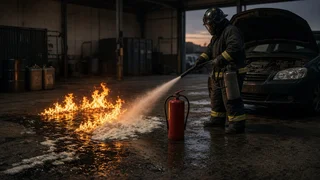
For engine compartment fires, avoid fully opening the hood, since the sudden rush of air can intensify the flames. If you attempt to fight it, aim the agent through the grille, wheel wells or a slightly opened hood gap from a safe distance.
Electric and hybrid vehicles add another limit. A fire in the 12-volt system, wiring or interior can often be handled like any other vehicle fire, but a lithium-ion traction battery in thermal runaway can keep generating heat and reignite, and handheld extinguishers are generally not effective against it. In that situation, move well away, warn others and leave it to firefighters.
Using a Class B extinguisher
The common PASS method applies: Pull the pin, Aim at the base of the fire, Squeeze the handle, and Sweep side to side. On a liquid fire, keep the stream at the base and avoid blasting directly into a pool of fuel at close range, which can splash it. With foam, aim to let the foam flow gently across the surface or bank it off a nearby surface. Back away once the fire appears out, and keep watching it, because liquid fuel fires can reignite.
Key takeaways
Flammable liquid fires are Class B in the US; gases share that class, unlike in European systems. Use an extinguisher with a B rating: ABC or BC dry chemical, CO2, Class B foam or clean agent. Never use a water-only extinguisher on a fuel or oil fire. For most vehicles, an ABC-rated unit offers the broadest coverage; clean agent avoids powder residue at a higher cost. The number before B indicates relative capacity, but real vehicle fires are harder than test fires. EV traction battery fires and large or spreading fires call for evacuation and emergency services, not a handheld extinguisher.