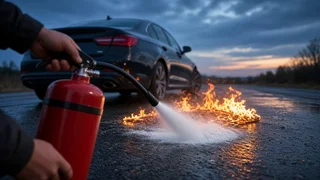
What Is a Class B Fire? Flammable Liquids, Gases and Vehicle Ignition Sources
The Short Answer
A Class B fire is a fire fueled by flammable or combustible liquids, or by flammable gases. In the United States, this classification follows the system used by the National Fire Protection Association (NFPA), and it covers fuels such as gasoline, diesel, kerosene, oils, greases, solvents, alcohols, oil-based paints, lacquers, tars, propane and natural gas. Class B is the fire class that involves flammable liquids, and it is the one most directly tied to the fuels and fluids carried in a typical vehicle.
One regional qualification matters: the US system places flammable gases in Class B, while the European and Australian systems generally limit Class B to liquids and assign flammable gases to a separate class (Class C in those systems). If you are reading an extinguisher label or safety guide from outside the US, check which scheme it uses.
How Class B Differs From Other Fire Classes
Fire classes exist so that people can match an extinguishing method to the fuel that is burning. Using the wrong method can make a fire worse. The US classes are summarized below.
Class | Fuel type | Common examples; A | Ordinary combustibles | Wood, paper, cloth, many plastics, upholstery; B | Flammable and combustible liquids and gases | Gasoline, diesel, motor oil, grease, solvents, propane; C | Energized electrical equipment | Live wiring, powered components; D | Combustible metals | Magnesium, titanium, sodium, lithium metal; K | Cooking oils and fats | Commercial kitchen fryers
Real vehicle fires rarely stay in one class. A fuel leak that ignites is a Class B fire, but if it spreads to seat fabric it involves Class A material, and if wiring is still energized it involves Class C hazards as well. This overlap is why multipurpose extinguishers are common in vehicles.
Materials Associated With a Class B Fire in Vehicles
Most conventionally powered cars, trucks and motorcycles carry several Class B materials at once. The exact fluids depend on the powertrain, so a diesel pickup, a gasoline sedan and a propane-converted fleet vehicle will differ.
Gasoline and diesel fuel, in the tank, fuel lines, injectors and fuel rail; Engine oil, which can leak onto hot exhaust parts from failed gaskets or seals; Automatic transmission fluid and power steering fluid; Brake fluid, which is combustible and can ignite on very hot surfaces; Grease and lubricants on chassis and driveline components; Gaseous fuels in vehicles designed or converted to run on propane (LPG), compressed natural gas (CNG) or hydrogen; Cleaning solvents, spare fuel cans or other liquids carried as cargo
Engine coolant based on ethylene glycol is not usually thought of as a fuel, but it can burn under certain conditions, particularly when it sprays onto very hot components. Battery fires in electric and hybrid vehicles are a different matter: lithium-ion battery fires involve chemical reactions inside the cells and are not treated as ordinary Class B fires, even though they may ignite surrounding liquids and plastics.
How a Class B Fire Works
With flammable liquids, it is the vapor above the liquid that burns, not the liquid itself. Every flammable liquid has a flash point, the lowest temperature at which it gives off enough vapor to ignite when a source of ignition is present. Gasoline has a flash point far below normal outdoor temperatures, which is why it ignites so readily. Diesel and motor oil have much higher flash points and generally need to be heated, atomized into a mist or sprayed onto a hot surface before they ignite easily.
This vapor behavior gives Class B fires their practical characteristics. They can start quickly, spread across the surface of a spill, flow with leaking fuel to new areas, and reignite if vapors keep forming after the flames are knocked down. Pressurized fuel systems can spray fuel as a fine mist, which ignites much more easily than a pool of the same liquid.
Ignition Sources Associated With a Class B Fire
A Class B fire needs fuel vapor, oxygen and enough heat or energy to start combustion. In and around vehicles, the common ignition sources include:
Hot exhaust components, including exhaust manifolds, catalytic converters and turbocharger housings; Electrical arcs or sparks from damaged wiring, short circuits or loose battery connections; Sparks from metal scraping on pavement during a collision or when a component drags; Overheated brakes or wheel bearings; Open flames, smoking materials or nearby welding and grinding work; Static electricity discharge during refueling, especially when filling portable containers
A common pattern in vehicle fires is a leak combined with a heat source: a failed fuel line, oil seal or fluid hose drips or sprays onto a hot exhaust part or near a wiring fault. Catalytic converters can also ignite dry grass or debris under a vehicle parked over vegetation, which may then spread to leaking fluids.
How Class B Fires Are Extinguished
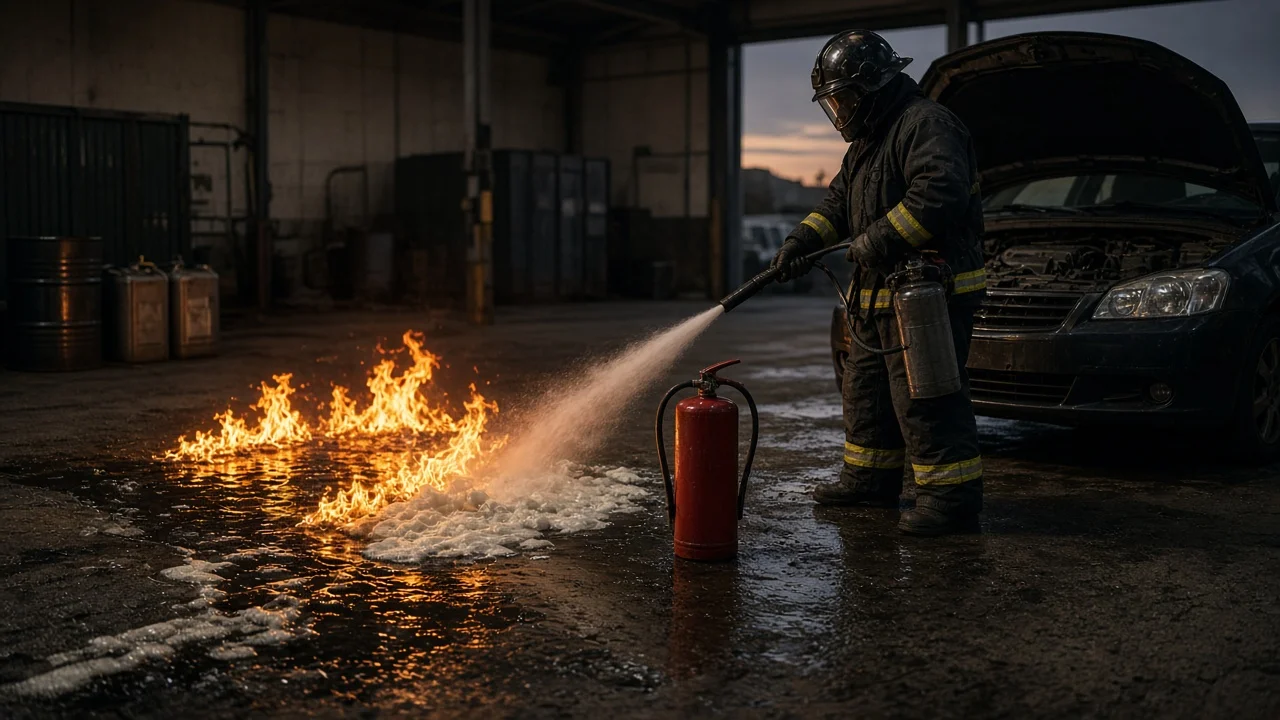
Extinguishing agents for Class B fires work by smothering the fire, separating fuel vapor from oxygen, or chemically interrupting combustion. Extinguishers rated for Class B carry a B on the label, often combined with other ratings such as B:C or A:B:C.
Dry chemical agents, used in B:C and A:B:C extinguishers, interrupt the chemical reaction of combustion and are the type most commonly carried in vehicles; Foam blankets the liquid surface and suppresses vapor release, which helps prevent reignition; Carbon dioxide displaces oxygen around the fire but is less effective outdoors, where wind disperses it
Water is generally not suitable for a Class B fire. Most fuels and oils float on water, so a stream of water can spread the burning liquid instead of putting it out. Professional firefighters may use water in specialized ways, but that is not a technique for bystanders.
What This Means if a Vehicle Catches Fire
Knowing the fire class helps you understand why vehicle fires are treated as serious emergencies. General US fire-safety guidance for a vehicle fire is to prioritize getting people away rather than fighting the fire:
Signal, pull over to a safe spot and turn off the engine; Get everyone out of the vehicle and move well away from it, staying clear of traffic; Call 911; Do not open the hood or trunk, because the added air can make the fire flare up; Do not return to the vehicle to retrieve belongings
If you carry an extinguisher, a unit rated for Class B and Class C (or A, B and C) suits most vehicle fire scenarios. Only consider using it on a small fire with a clear escape route, aim at the base of the flames, and back away if the fire grows or does not go out quickly. Fires involving fuel tanks, pressurized gas systems or electric vehicle battery packs should be left to the fire department. For gaseous-fuel or electric vehicles, consult the owner's manual or manufacturer guidance for model-specific emergency information.
Limits of This Overview
This article explains the general classification and behavior of Class B fires. It does not provide vehicle-specific fire statistics, flash point values for individual products, or extinguisher sizing recommendations, since those depend on the vehicle, the fluids used and local regulations. Commercial vehicles may also be subject to separate federal or state extinguisher requirements that are not covered here.